Online schooling - a challenge for students and teachers
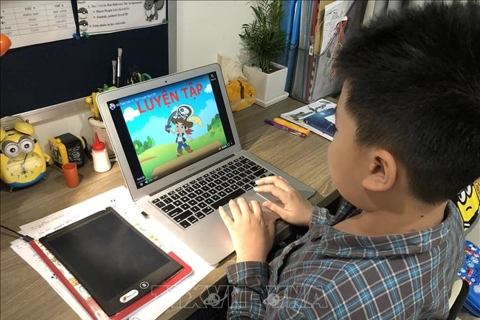
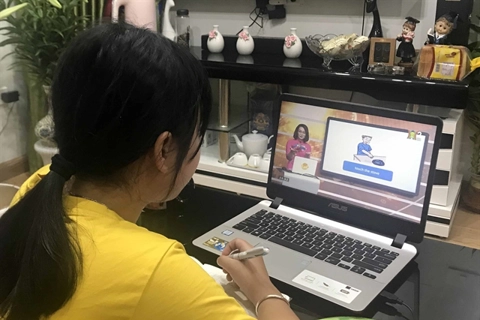
Testing and evaluating students of online classes is one of the difficulties facing Vietnamese teachers amid the Covid-19 pandemic.
Vietnam’s Ministry of Education and Training (MoET) has acknowledged online schooling with validity equaling to face-to-face instruction, following months of remote teaching due to the Covid-19 pandemic.
According to MoET, online teaching is not only an alternative for face-to-face instruction during the pandemic but also an important method to improve the quality of education from preschool to university level.
Being the first option given its advantages in the context of a complicated and long-lasting Covid-19 pandemic, but teachers say distance learning has many issues which must be solved in order for it to be reliable and validated.
Talking to Hanoitimes, Dao Van Diep, a teacher of Hanoi-based Lomonosov My Dinh Primary School said internet bandwidth and getting pupil’s motivation are the biggest challenge for distance learning.
Dao Van Diep, a teacher of Lomonosov My Dinh Primary School in Hanoi, is teaching onlinewhile students are off from school due to the Covid-19 pandemic. Photo: Nguyen Ngan |
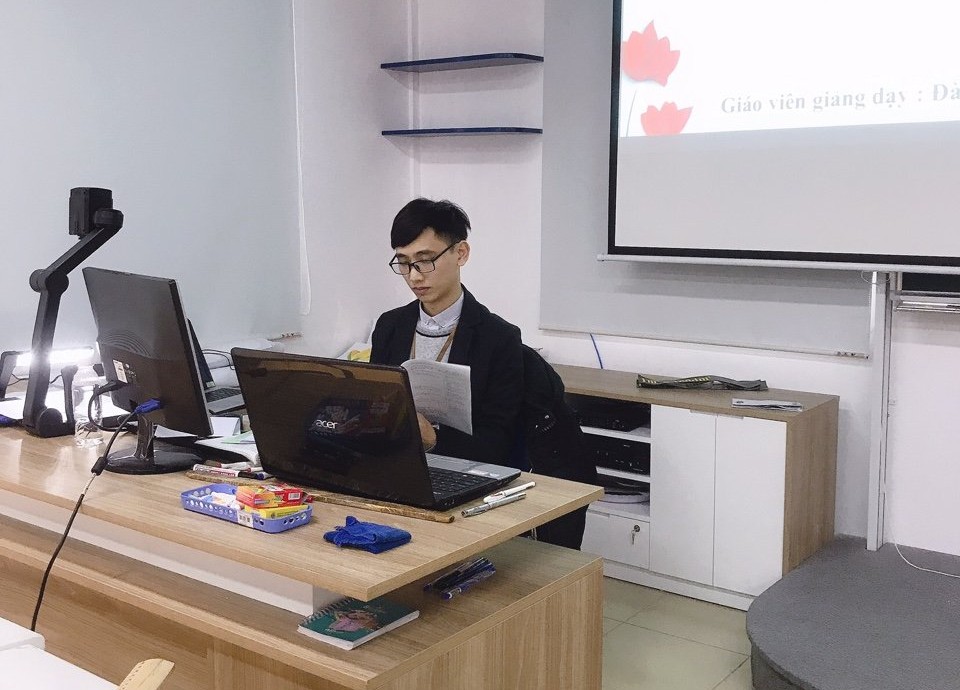
In the online environment, pupils might lose motivation for learning, Diep said, despite the biggest advantage of online classes which is online storage of all materials, discussion questions and tests which is easily accessible for students anytime and anywhere.
“Other challenge of online classes is testing and evaluating students. I am struggling to find out what kind of test should be taken to best assess my students. When we let students take the test from a distance, it is very difficult to ensure they do the test honestly. We need the instructions from the Ministry of Education and Training on this matter,” Diep said.
With the slogan "Closing school without stopping learning", in 2021, the MoET has encouraged educational institutions to move their activities online during the months-long school closure period triggered by the novel coronavirus crisis.
After reviewing and evaluating online schooling, the ministry is drafting a regulation on online education which will serve as legal basis for validating remote teaching and learning.
A legal framework for online schooling is needed
A legal framework is necessary for online schooling. It’s also a condition to acknowledge online results.
Currently, the MoET is compiling a draft circular to allow universities to apply online education and the results will be validated.
In a phone interview with Hanoitimes, Nguyen Son Hai, director of the Department of Information and Technology under the MoET said that online schooling has been proven as the right choice for Vietnam in the current context the Covid-19 pandemic.
Both teachers and students have quickly adapted to the online teaching and learning methodology, Hai said, adding that it is also a good opportunity for the Vietnamese educational sector to speed up the application of the digital technology in both teaching and learning.
The pandemic has provided an opportunity for virtual learning, Hai said, adding that the ministry has issued related regulations and guidelines to create legal framework for localities and schools to carry out online learning practically and effectively, Hai stressed.