Opportunity at hand: Leveraging global minimum tax for FDI attraction
2024 is a pivotal year, opening up new opportunities for Vietnam to attract high-quality foreign investment.
With a shift in the trend of foreign direct investment (FDI), the implementation of the global minimum tax, and the upgrading of Vietnam's diplomatic relations with the US, the year 2024 faces favorable conditions and is a pivotal year that will offer Vietnam new opportunities to attract high-quality foreign investment.
Nguyen Van Toan, vice chairman of the Vietnam Association of Foreign Invested Enterprises (VAFIE), shared his views with Thoi bao Tai chinh newspaper on the prospects of attracting foreign investment to Vietnam.
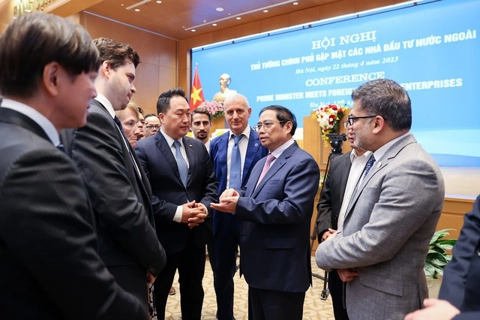
| Vietnamese and French businesses at the Vietnam-France Business Forum in 2023. Photo: Pham Hung |

What is the outlook for FDI inflows into Vietnam in 2024?
We have to look back at some highlights of 2023 to assess the prospects for 2024.
First, in 2023, we upgraded diplomatic relations with the US, which had a strong impact on economic relations between the two countries in general and investment flows from the US in particular.
Second, China is shifting its investment focus abroad, particularly to Vietnam. In 2023, a significant amount of Chinese investment flowed into Vietnam.
Third, the geopolitical situation, such as the Russia-Ukraine conflict and, more recently, the Israel-Hamas conflict, has affected global trade and investment flows, indirectly affecting Vietnam.
Finally, a key highlight is Vietnam's joining of the global minimum tax, which is both an opportunity and a challenge for FDI attraction.
With these events, Vietnam faces a new opportunity in 2024 to attract not only a large number, but also high-quality foreign investment.
Over the past year, Vietnam has seen a significant influx of foreign investors and large corporations from the US, European Union and South Korea.
Politburo Resolution 50-NQ/TW on attracting FDI by 2030, issued in 2019, has been translated into action. However, the results have not lived up to expectations. What are the difficulties and challenges in implementing this resolution?
Vietnam faced two major challenges in implementing the Resolution 50. First, it lacked suitable opportunities, and second, it was ill-prepared. Attracting and retaining large investors requires adequate preparation and reception.
Shortly after the issuance of Resolution 50, the Covid-19 pandemic broke out, bringing about difficulties in all areas. Vietnam had to deal with the outbreak and focus on social welfare while concentrating on reviving ailing businesses, resulting in inadequate preparedness.
In order to attract a significant amount of high-quality capital, the capacity of domestic enterprises needs to be enhanced, the investment environment has to be improved, infrastructure requires investment, and there should be an abundant supply of high-quality human resources to participate in hi-tech projects.
In particular, Vietnamese companies need to improve their capabilities to be part of the value chain. We need to be fully prepared, rather than waiting for foreign companies to bring everything in, offering them only the location and tax mechanisms.
Unfortunately, we have recently been struggling with Covid-19 and it has taken a long time to recover. At the moment, local businesses are facing immediate challenges, making it difficult to think long term.
You mentioned that the introduction of a minimum tax is also an opportunity to attract FDI. How should this opportunity be used?
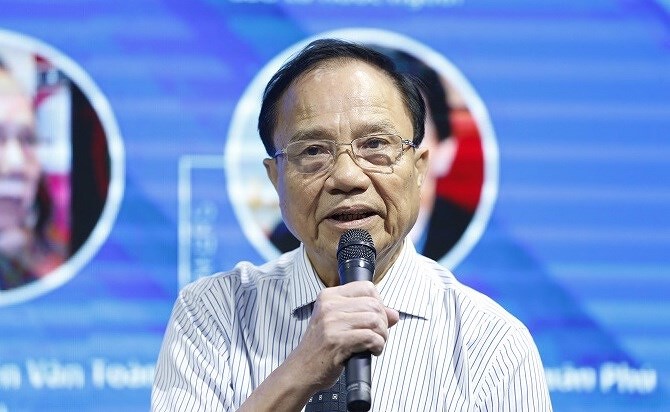
| Nguyen Van Toan, Vice Chairman of the Vietnam Association of Foreign Invested Enterprises. |
Vietnam's active participation in 16 free trade agreements and its highly integrated economy provides a strong basis for reaping the benefits of global minimum tax policies.
First, the application of global minimum tax policies will increase budget revenues. As a country that receives a large amount of foreign direct investment, tackling transfer pricing and tax evasion is a challenge. The global minimum tax will fundamentally address transfer pricing issues.
Secondly, this source of revenue gives us the opportunity to implement policies to support foreign investors in the direction we want.
While the introduction of a minimum tax may pose initial challenges in terms of retaining investors, it can bring long-term benefits by effectively implementing sustainable policies that do not rely solely on tax incentives.
Take, for example, policies that promote improvements in the business environment for investment, allocating a proportionate amount of public investment to improving the quality of the workforce while upgrading infrastructure.
This is an extremely important push that we need to make without further delay, even in 2024.
The government is drafting a decree for the Investment Support Fund, which will use revenues from the global minimum tax and other legitimate sources. Do you have any suggestions for this policy?There are two ways to support investors after the introduction of the global minimum tax.
The first is direct support, for example, when they set up research and development centers or innovative projects. We can support them directly through policies that encourage innovation. We can also provide infrastructure support, such as land clearing, production expansion and workforce training. This approach is legitimate.
Another form of support, which we have discussed extensively, is to encourage Vietnamese companies to participate in the global value chain, especially in supporting industries. For example, if Samsung needs a new technology, the government can financially support Vietnamese enterprises to acquire that technology for Samsung, so that they can participate in the chain.
There is a perception that only small and medium-sized enterprises supply products to foreign-invested enterprises. But I think large companies can do it too.
Therefore, the government can allocate funds from the Investment Support Fund from global minimum tax revenues and other legitimate sources to both support foreign-invested enterprises and implement policies that support domestic businesses.
This will enable them to become better positioned, connected and involved in the global value chain.
Thank you!