Log in
Vietnam

Progress towards market-based economy in Vietnam remains slow: Experts

The government should refrain from excessive intervention into the market and only hold core business fields with potential impacts on national security.

Contribution of private enterprises to Vietnam’s GDP is less than 10%, which indicates the slow progress towards a full market-based economy in the country, according to economist Pham Chi Lan.

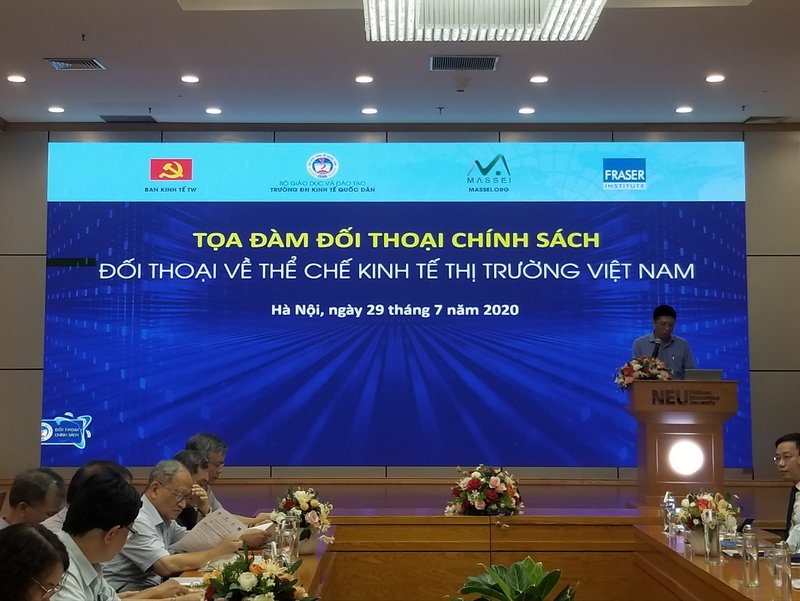
 Overview of the conference. Photo: Nguyen Tung. 

Lan’s assessment is similar to a previous statement by Chairman of Vietnam Chamber of Commerce and Industry (VCCI) Vu Tien Loc that of the 40% of GDP contribution by the private sector, five million business households make up 30% and the remaining by 700,000 private firms.

“There have been resolutions and legal documents from the government to form a market-based economy in Vietnam, but the focus has only been to address difficulties in the business environment for the business community,” Lan said at a conference on July 29.

Meanwhile, many countries in the world have now shifted to the process of creating favorable business conditions, Lan added.

According to Lan, there remain major issues hindering the country from moving towards a full market-based economy. Lan went on to say that, of the three major economic components, namely state-owned enterprise, foreign-invested enterprise and private enterprise, the third one is the least favored in government incentive policies.

“It is challenging for private firms to access state resources for development,” Lan asserted.

Economist Le Dang Doanh added while over 90 countries and territories have recognized Vietnam’s market-based economy, the US and EU, Vietnam’s two major economic partners, have not done so.

“Institutional barriers must be removed, while the state should refrain from excessive intervention into the market,” Doanh suggested, adding it should only hold core business fields with potential impacts on national security to ensure true market-based economy in Vietnam.

“Benefits would be huge if Vietnam is recognized as a market-based economy by major global economies,” Doanh stressed. For example, Vietnam’s export products would be less susceptible to trade protection measures, or the country is set to attract more investment capital, Doanh said.

Sharing the same view, former Director of the Central Institute for Economic Management (CIEM) Nguyen Dinh Cung said the law of supply and demand, not the state, should decide the production of goods and services.

As part of the reform process, Cung urged more attention is needed to work out laws and regulations specialized in protecting the ownership rights for assets of businesses and the people.

“Once the ownership rights are ensured, the influence of the state in the economy would gradually diminish and the market is set to operate fully on its own,” Cung added.
Reactions:
Share:
Trending
Most Viewed
Related news
Cultural contest connects Vietnamese youth in Japan with President Ho Chi Minh

Cultural contest connects Vietnamese youth in Japan with President Ho Chi Minh

A children’s cultural contest held in Tokyo has helped nurture pride, creativity and a deep connection to President Ho Chi Minh among Vietnamese families living across Japan.

Vietnam strengthens role in ASEAN after 30 years of membership

Vietnam strengthens role in ASEAN after 30 years of membership

Apart from economics, Vietnam has strengthened ASEAN unity and centrality by contributing across all three pillars, from political-security to economic and socio-cultural cooperation, including maritime security, climate action, digital transformation and people-centered development.

First technical flight safely lands at Vietnam’s US$16-billion international airport

First technical flight safely lands at Vietnam’s US$16-billion international airport

Long Thanh International Airport in Vietnam's southern province of Dong Nai, with an investment of more than US$16 billion, is expected to welcome 25 million passengers each year once operational.

Vietnamese professor conferred Honorary Doctorate by Moscow Power Engineering Institute

Vietnamese professor conferred Honorary Doctorate by Moscow Power Engineering Institute

The conferral of the Honorary Doctorate reflects the enduring friendship between Vietnam and Russia over decades, acknowledges the traditional ties between the two nations’ scientific communities.

Party chief urges Hanoi to break bottlenecks, improve livelihoods

Party chief urges Hanoi to break bottlenecks, improve livelihoods

At a meeting with voters in central Hanoi, Party General Secretary To Lam highlighted urgent priorities for the capital, from easing traffic congestion and pollution to strengthening grassroots governance under the two-tier local government model.

EU praises Vietnam’s creative community for advancing sustainable design

EU praises Vietnam’s creative community for advancing sustainable design

EVSDA 2025 reinforces creativity’s role in driving sustainable development in Vietnam while connecting European and Vietnamese values and highlighting ideas for a greener and more inclusive future.

TECHFEST Vietnam 2025 reinforces innovation’s role in powering next growth phase

TECHFEST Vietnam 2025 reinforces innovation’s role in powering next growth phase

It is Vietnam's largest annual festival for innovative startups, highlighting inclusive innovation, encouraging technology commercialization and the development of new products to ensure that no one is left behind in the country’s transition to a knowledge-driven economy.

Innovation becomes core driver of national development: Vietnam PM

Innovation becomes core driver of national development: Vietnam PM

Innovation is the inevitable path for Vietnam's rapid and sustainable development, building an independent and self-reliant economy that is deeply integrated into the international community.