Renowned history of artists’ mansion in Hanoi
The French-style mansion at No 65 Nguyen Thai Hoc Street once used to be proud of many artist generations in Hanoi.
The mansion at 65 Nguyen Thai Hoc Street has a history full of ups and downs like a novel. The old generation of artists in Hanoi call it “the House of Fame”, which has carried with it the lives and fates of famous names, who made significant contributions to the Vietnamese culture. For over half a century, many masterpieces have been born at this address.
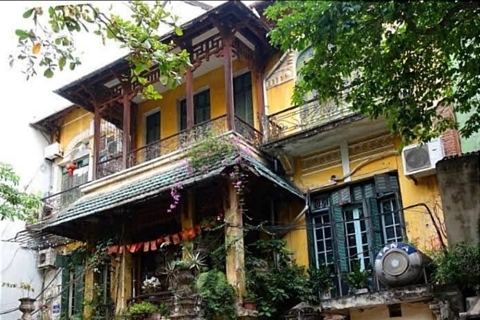
| The legendary mansion of local artists at No.65 Nguyen Thai Hoc, Ba Dinh District, Hanoi. Photo: Architecture Magazine |
According to local cultural researchers, this famous mansion was built in the 1930s by Cu Linh, a large contractor of Hanoi during the French colonial period. The French-style mansion consists of three floors, with four separate rooms on each. It is located on Hanoi’s main street, with wide, airy, and shady sidewalks, with only a passing tram’s tinkle from time to time.
After the capital’s Liberation Day in October 1954, the place became the office of the Vietnam Fine Arts Association, and then the residence of artists, who all came from the Viet Bac anti-French resistance base and were lodged here, living an honest and decent life.
There used to be the studio, as well as gallery and home of painter Song Van, who built the statues of Uncle Ho at the two ends of Vietnam and was an ethnology expert.
In the back was the room of painter Mai Van Hien, a famous caricaturist who won many national fine arts awards. Every Mid-Autumn Festival, he decorated a stage for the children in the house, with musician Do Nhuan playing music and sculptor Nguyen Van Ly contributing a tray of ripe grapes.
Besides Do Nhuan, General Secretary of the Vietnamese Musicians’ Association for decades, painter Nguyen Phan Chanh also lived on the 2nd floor. He was a calm man, living a leisurely life like a Confucian, and hardly joined the noisy debates of the junior painters in the house.
There was also the tiny apartment of the well-mannered and gentle couple Vu Tu Nam-Thanh Huong (formerly used by writer Nguyen Dinh Thi). He was the Editor-in-Chief of Van Nghe Newspaper and General Secretary of the Vietnamese Writers' Association, while she was the Editor-in-Chief of Vietnamese Women Newspaper.
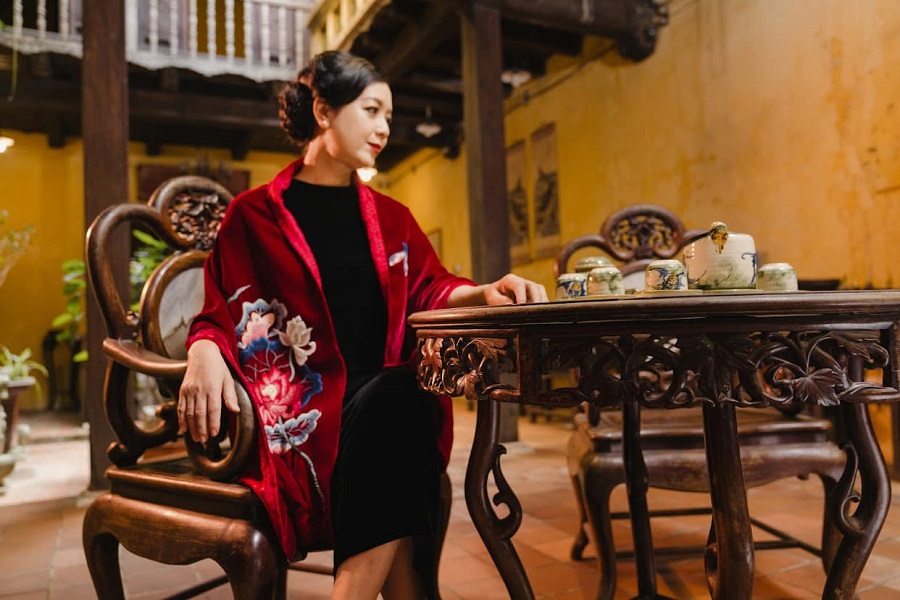
| Renowned artist Nguyen Thi Chieu Xuan- a resident of the artist mansion at No 65 Nguyen Thai Hoc Street. Photo courtesy of the artist |
The 3rd floor was used to accommodate the special personalities of Vietnamese painting. The first is painter Nguyen Tu Nghiem, one of the Four Pillars of modern Vietnamese painting. He hardly opened his door or socialized, towards the end of his life, he befriended animator Thu Giang - writer Nguyen Tuan’s daughter. It is said that some of his old paintings are still kept in the room he once used.
Next is painter Van Giao, who painted the most about Uncle Ho, while authoring bright landscape paintings as well. Also living there was the family of painter Tran Dong Luong, who spent most of his life depicting the delicate and elegant beauty of Hanoi girls - over 500 of his silk and pastel paintings have traveled around the world with collectors.
Another veteran of Vietnamese painting is painter Nguyen Sang, the number one drinker of mansion No. 65. He could drink alone from early morning until late at night in a poor stall on Sinh Tu Street, or with friends in his 10-square-meter room. He got married at the age of 60 to a young bride, who was fragile due to heart disease. She fainted on their wedding day and passed away sometime later. Sang was only able to convey his love for his unfortunate wife in portraits drawn from memory.
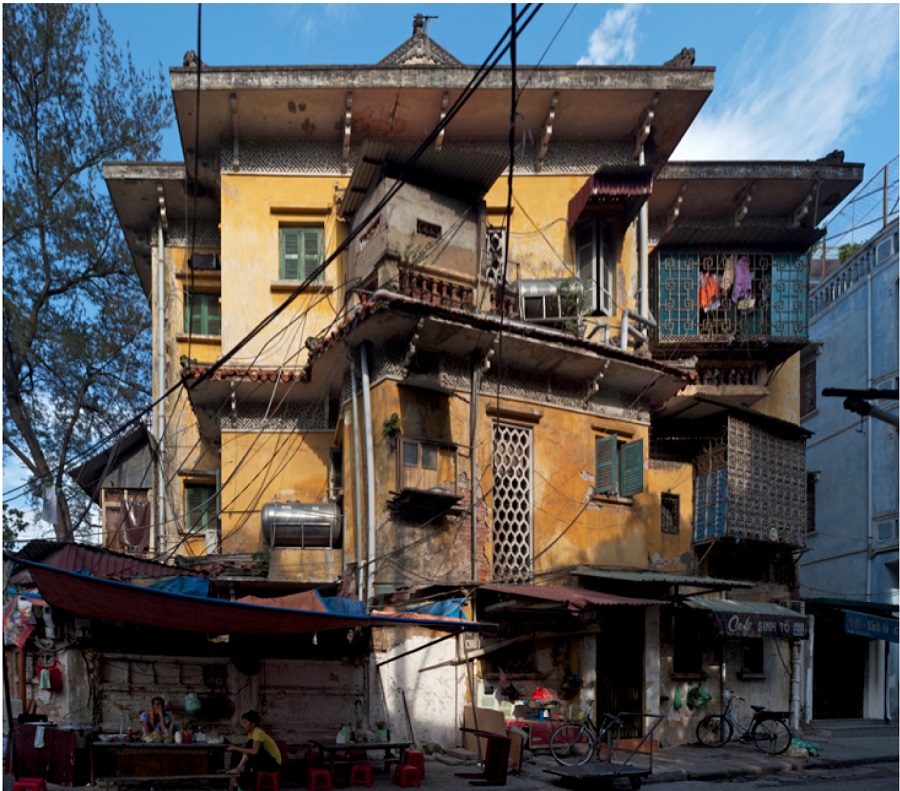
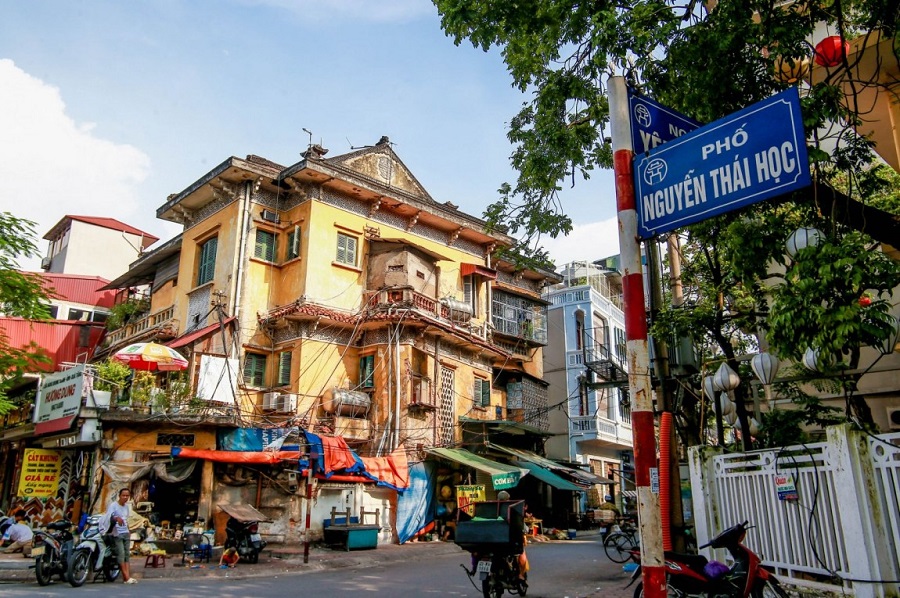
| The current situation of the mansion No 65 Nguyen Thai Hoc Street. Photo: Reatimes |
Mansion No. 65 was also frequented by other artists at that time, like writers Tran Dan and Nguyen Tuan, poet Nguyen Binh, musician Van Cao, painters Duong Bich Lien, Bui Xuan Phai and Tran Van Can. They often came here to confide their thoughts and feelings. By now, more than 10 artists who lived here, as well as their visiting soul mates, have gathered in the other world, while their children also gradually drifted away.
At present, the graceful body of this French-style mansion is spoiled by adjoining kiosks of hair wash, sewing machine sale, motorbike repair, painting framing in the front, together with “tiger cages” (illegal extensions) on the 2nd and 3rd floors.
The entrance was originally built according to Japanese architecture with tubular tiles, flower walls, and two large iron-wood gates, which were subsequently replaced with iron ones - then stolen on a stormy night. Now the old gate frame is full of things like souvenir paintings, children’s toys and comic books.
Before October 1954, the mansions were owned by colonial government officials. When the Viet Minh troops took over the capital, most of the owners fled back to France or migrated to the South. Beautiful abandoned mansions were then selected as the main offices of state administrative agencies, as well as residences for senior officials, artists, and people with meritorious services to the resistance war.
People with higher privileges were assigned a whole mansion each, several families with lower privileges shared one, while officials from the South were assigned one room each as an apartment. Any former owner, if stayed in Hanoi, had to live in only one room, sharing the mansion’s amenities.
The current situation of the formerly glorious mansions is sad to witness. The porch and outer fences of many on the streets of Quang Trung, Han Thuyen, Le Van Huu, Hai Ba Trung, Ba Trieu among others, have turned into rows of kiosks shops.
The interiors are even worse with dilapidated and overcrowded apartments, while the several square meter grounds have a dull and dirty look. When asked, most people in these places don’t even know that they are living in what used to be the fine architectural heritage of Hanoi!