Econ
Samsung to encourage Vietnamese enterprises participating in its supply chain
It is expected that in 3 years, Vietnam will have 50 enterprises being the tier 1 vendor in Samsung’s supply chain.
Starting this year, Samsung will expand its support to hi-tech industries, helping local firms to produce sophisticated electronic parts and be part of Samsung’s global supply chain for hi-tech products. It is aimed to help enterprises improve their production process and meet the criteria for supplying products and components to Samsung factories with products’ error ratio decreasing by an average of 25 per cent and production capacity increasing by 30 per cent.
In the meeting between the Prime Minister Nguyen Xuan Phuc and the Chief Executive Officer of Samsung Electronics – Mr. Shin Jong Kyun at the government office in October 06, the Prime Minister highly regarded the bilateral cooperation between Vietnam and Korea across fields. This year, the two countries are celebrating 25 years of establishing the diplomatic relationship. The Prime Minister stated the importance of Korean investors, especially the Samsung Corporation being the leading investors in Vietnam for many years.
The Prime Minister said the government will be supportive and creating favorable conditions for foreign investors, including Samsung to invest in Vietnam. The Prime Minister hoped Samsung will continue expanding its investment in Vietnam, not only in electronics, but also other fields which Samsung has advantages of; suggested the Corporation to support in training and technology transfer, so that Vietnamese enterprises, especially small and medium enterprises (SME) can take part in Samsung’s supply chain. The Prime Minister requested Samsung to implement the project Samsung Development and Research center according to plan.
Mr. Shin Jong Kyun expressed his thanks for the warm welcome from the Prime Minister, and remembered the Memorandum of Understandings signed between Vietnam and Samsung on the Corporation investment in Vietnam 10 years ago. 10 years later, total investment of Samsung into Vietnam has increased to 17 billion USD. Samsung is expected to export products with value up to 50 billion USD in 2017, contributing to 20% of Vietnam export. Currently, two factories of Samsung in Vietnam have the biggest scale and the most modern in global. “We hope to continue receiving the support and attention from the Vietnamese government, as well as the Prime Minister, so that Samsung can contribute more to the development of Vietnam” – Mr. Shin Jong Kyun said and is convinced that “Without the support from the government, related ministries and agencies, Samsung can have the successes like today”.
Upon the request of the Prime Minister, Samsung will focus on researching and training Vietnamese human resources working in the Corporation, in which to send Vietnamese engineers to Korea for training. Samsung will also increase the number of Vietnamese enterprises to take part in its supply chain to 29 tier 1 vendors by the end of this year. After 3 years, the number is expected to rise to 50 enterprises.
A total of 215 enterprises, including 25 tier-1 vendors and 190 tier-2 vendors, are currently participating in the supply chain for Samsung’s factories in Vietnam. Mr. Shin Jong Kyun said, Samsung is very interested in the telecommunication market in Vietnam. The Prime Minister said information & technology is one of the priority of Vietnam, as such, Vietnam will always be supportive to the Corporation to solve any arising problems. Samsung Vietnam has achieved a significant breakthrough in increasing the localization rate of its products from 35 per cent in 2014 to 57 per cent at present.
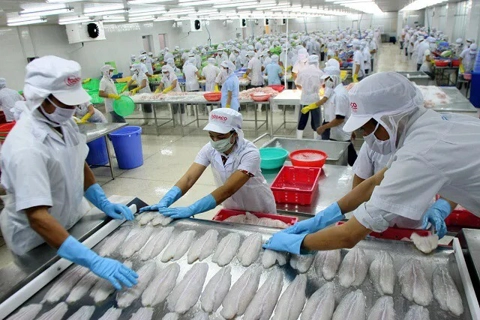
Samsung's production line in Vietnam.
|
The Prime Minister said the government will be supportive and creating favorable conditions for foreign investors, including Samsung to invest in Vietnam. The Prime Minister hoped Samsung will continue expanding its investment in Vietnam, not only in electronics, but also other fields which Samsung has advantages of; suggested the Corporation to support in training and technology transfer, so that Vietnamese enterprises, especially small and medium enterprises (SME) can take part in Samsung’s supply chain. The Prime Minister requested Samsung to implement the project Samsung Development and Research center according to plan.
Mr. Shin Jong Kyun expressed his thanks for the warm welcome from the Prime Minister, and remembered the Memorandum of Understandings signed between Vietnam and Samsung on the Corporation investment in Vietnam 10 years ago. 10 years later, total investment of Samsung into Vietnam has increased to 17 billion USD. Samsung is expected to export products with value up to 50 billion USD in 2017, contributing to 20% of Vietnam export. Currently, two factories of Samsung in Vietnam have the biggest scale and the most modern in global. “We hope to continue receiving the support and attention from the Vietnamese government, as well as the Prime Minister, so that Samsung can contribute more to the development of Vietnam” – Mr. Shin Jong Kyun said and is convinced that “Without the support from the government, related ministries and agencies, Samsung can have the successes like today”.
Upon the request of the Prime Minister, Samsung will focus on researching and training Vietnamese human resources working in the Corporation, in which to send Vietnamese engineers to Korea for training. Samsung will also increase the number of Vietnamese enterprises to take part in its supply chain to 29 tier 1 vendors by the end of this year. After 3 years, the number is expected to rise to 50 enterprises.
A total of 215 enterprises, including 25 tier-1 vendors and 190 tier-2 vendors, are currently participating in the supply chain for Samsung’s factories in Vietnam. Mr. Shin Jong Kyun said, Samsung is very interested in the telecommunication market in Vietnam. The Prime Minister said information & technology is one of the priority of Vietnam, as such, Vietnam will always be supportive to the Corporation to solve any arising problems. Samsung Vietnam has achieved a significant breakthrough in increasing the localization rate of its products from 35 per cent in 2014 to 57 per cent at present.