Solutions to develop Vietnam’s stable labor supply chain
Experts have given real situations and recommendations on building a stable labor supply chain at a seminar held in HCM City this week.
Building a stable labor supply chain, putting workers at the center of all policies, and focusing on income guarantees and social security are the solutions for Vietnam's economic recovery in the post-Covid-19 pandemic.
| An overview of the seminar. Photo: laodong.vn |
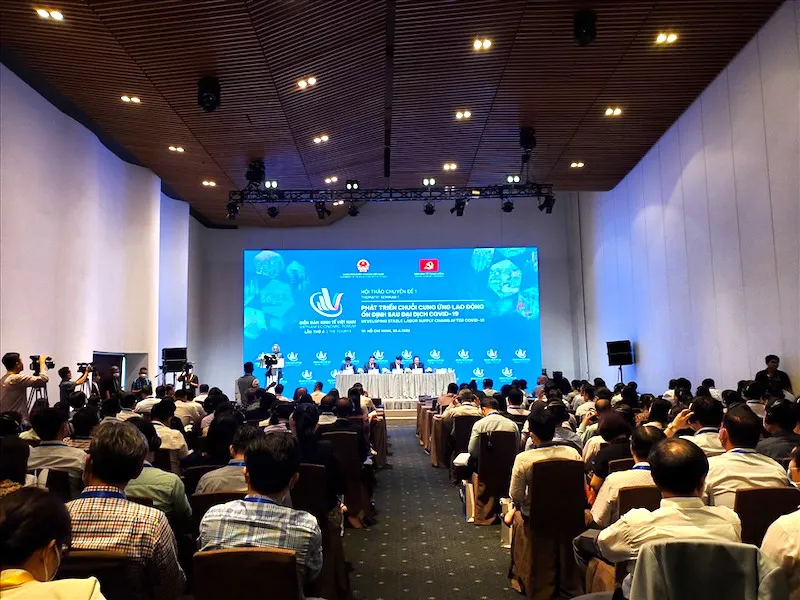
Ngo Duy Hieu, Vice President of the Vietnam General Confederation of Labor, put forth the idea at a discussion session within the framework of the 4th Vietnam Economic Forum organized by the Party Central Committee’s Economic Commission on June 5.
To build human resources for economic recovery, Hieu said Vietnam needs to focus on developing a synchronous, modern, flexible and unified labor market and continue to amend policies and regulations governing labor supply-demand relations.
“The labor sector needs to soon finalize policies on wages and social security, comprehensively revise policies on social housing, worker accommodation, and upgrade existing standards of dormitories,” he said.
Hieu emphasized that labor market information and job exchanges need to be refined and improved.
The labor industry needs to innovate policies and regulations on attracting domestic and foreign investment, avoiding the concentration of many investment projects in one locality, which would lead to labor shortage, mounting pressure on infrastructure, and an increasing influx of migrant workers.
Many fluctuations in labor supply
Delegates attending the seminar said the Covid-19 pandemic has slowed down economic growth, disrupted production and business activities, and negatively affected the labor and employment situation as well as workers’ lives.
| Deputy Minister of Labor, War Invalids and Social Affairs Le Van Thanh gives his speech at the seminar. Photo:hcmcpv.org.vn |
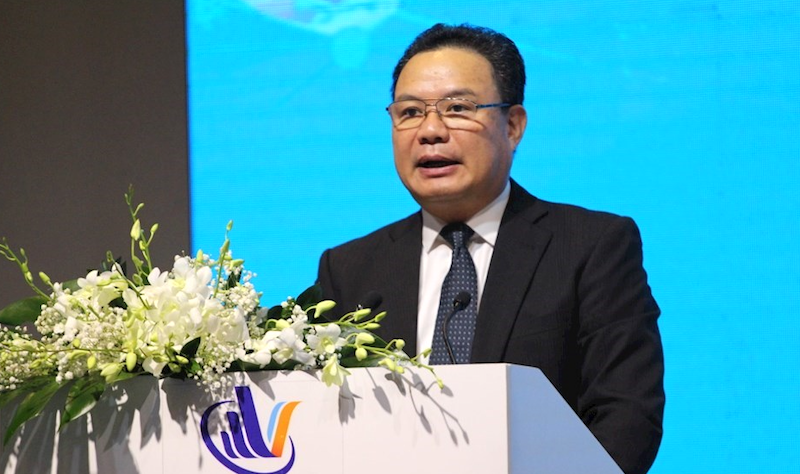
Deputy Minister of Labor, War Invalids and Social Affairs Le Van Thanh said that labor supply has been severely reduced and the number of employed workers has fallen to the lowest level in the past years, in which, the labor force aged 15 and over decreased the most in the third quarter of 2021, to 49.1 million people. The labor force employed in the fourth quarter of 2021 was 49.07 million people, a drop of 1.79 million people over the same period last year.
The rate of underemployed and unemployed workers increased considerably, reaching the highest level in the third quarter of 2021 at 3.98% (more than 1.7 million employees). The unemployment rate in urban areas was the highest at 5.54%.
Thanh added wages of employees dropped and life of workers was difficult as their average monthly income decreased from VND6.7 million (US$286.9) per month in 2019 to VND5.2 million ($222.6) per month in the third quarter of 2021.
In addition, there has been a shift in labor structure by sector (agriculture - industry - service) and by region with about 1.3 million workers moving from urban to rural areas, and from major economic centers to provinces.
Labor supply is unable to meet the needs of enterprises during the economic recovery period, especially for highly qualified workers, he said.
According to the Ministry of Labour, War Invalids and Social Affairs, some localities, regions, and industries face an imbalance between supply and demand and a local supply shortage. In the first quarter of 2022, the labor shortage was about 120,000 people, between 2% and 3% more than in previous years, mainly unskilled workers in the textile and garment industry, assembly, and manufacturing of electronic components.
The qualifications of workers have not met the requirements of technological restructuring, especially during the recovery period, and the digital transformation that many enterprises are embarking on, as well as the application of the achievements of the 4th Industrial Revolution.
To reduce the informal employment rate, Bui Sy Loi, former vice-chairman of the Social Affairs Committee of the National Assembly, stressed that the relevant legal system in accordance with the Labor Code needs to be perfected.
"Support is needed for the vocational training of workers, the development of financial institutions, and the provision of microfinance for the informal economy," he said.
The Government also needs to set aside funding for the “Statistics of the Informal Economic Sector” project, support policies for the informal economic sector to develop properly, encourage local business in the informal sector to formalized.
Duong Anh Duc, vice chairman of the Ho Chi Minh City People's Committee, stressed that workers should be an integral part in developing business strategies of local companies. In the context of the pandemic period, this helps businesses avoid disruption to their operations.
Makiko Matsumoto, Employment Specialist at the International Labor Organization (ILO) Regional Office in Bangkok, Thailand, also recommended strengthening labor institutions and promoting inclusive economic growth, as well as creating full and sustainable employment for all in Vietnam.