Econ
Vietnam boosts regulatory reforms to fit new trade deal
A recent review of the country’s legal documents showed that 265 legal documents must be reviewed, while seven laws will have to be amended to stay tuned with the CPTPP.
Local authorities are expediting the reviewing and amending of the country’s laws to ensure compliance with the Comprehensive and Progressive Agreement for Trans-Pacific Partnership (CPTPP).
After the CPTPP’s ratification, the National Assembly (NA) has assigned the government, the People’s Supreme Court, the Supreme People’s Procuracy of Vietnam, and other relevant organizations and agencies to review laws and legal documents so that the authorized agencies can revise them.
“This is aimed to ensure the consistence of Vietnam’s legal system and also ensure the right roadmap in implementing commitments under the CPTPP,” the NA states in a resolution.
According to the NA’s resolution, the prime minister will be responsible for approving and directing relevant organizations and agencies at the central and local levels to deploy plans to implement the CPTPP.
A recent review of the country’s legal documents showed that 265 legal documents must be reviewed, while seven laws will have to be amended, including the Labor Code, the Criminal Code, the Criminal Procedure Code, and the laws on Anti-Corruption, Intellectual Property, Insurance Business and Food Safety.
Professor Nguyen Mai, chairman of the Vietnam Association of Foreign Invested Enterprises, said that the CPTPP provides a fairly comprehensive chapter on cross-border investment, including principles relating to most-favored nation treatment, transparency and disclosure of information, the rights of investors and investment recipients, and settlement of disputes.
Vietnamese laws have already set forth quite appropriate regulations on investment, Mai said, but attention should be paid to three demanding requirements prescribed in the CPTPP: the publicity, transparency, and predictability of the legal system and changes of law; strict regulations on intellectual property rights, despite the suspension of some related provisions such as those regarding pharmaceuticals; and labor and worker rights, including the right to form independent unions.
In order to attract foreign investment, Mai suggested that it is necessary to approach the provisions of the CPTPP’s investment chapter to make necessary adjustments and supplements to the Vietnamese legal system.
Opportunities to meet international rules
Nguyen Quan, former minister of Science and Technology, indicated that Vietnam faces three major challenges when it comes to intellectual property in the CPTPP: there is no regulation that criminalizes violations of intellectual property as is required by the CPTPP; protection of medicines, especially the protection of test databases; and issues related to agriculture.
As such, intellectual property remains a big test for Vietnam, Quan said, adding that to earn benefits from the CPTPP, Vietnam needs to amend and supplement the Intellectual Property Law in accordance with the provisions of the agreement.
However, Quan said, the challenge should be considered an incentive to better implement legal documents on intellectual property protection, counterfeit, and trademark violations.
Sharing the same view, Marko Walde, chief representative of German Industry and Commerce Vietnam, said that the CPTPP, as a quite comprehensive agreement, will offer Vietnam not only trade and investment opportunities, but also a chance to modernize and bring its labor law, penal law, anti-corruption law, and the intellectual property rights policy in line with international standards.
This will certainly have a positive effect on the ratification of the EU-Vietnam Free Trade Agreement (EVFTA) next time, Walde said.
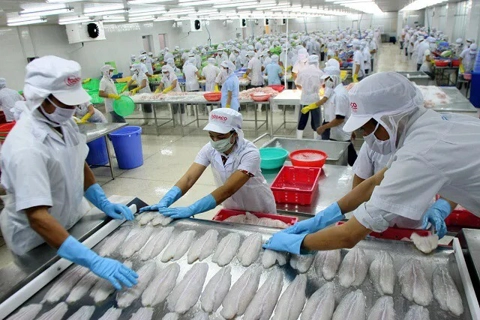
Regarding labor, experts also said that Vietnam should use this as an opportunity to modernize its labor legislation and labor relation system as the CPTPP and EVFTA are called new-generation FTAs, with a strong emphasis on labor rights, and the protection of environmental stability, in order to ensure that free trade contributes to sustainable development, while helping employees and businesses equally enjoy the economic benefits.

The CPTPP has a strong emphasis on labor rights
|
“This is aimed to ensure the consistence of Vietnam’s legal system and also ensure the right roadmap in implementing commitments under the CPTPP,” the NA states in a resolution.
According to the NA’s resolution, the prime minister will be responsible for approving and directing relevant organizations and agencies at the central and local levels to deploy plans to implement the CPTPP.
A recent review of the country’s legal documents showed that 265 legal documents must be reviewed, while seven laws will have to be amended, including the Labor Code, the Criminal Code, the Criminal Procedure Code, and the laws on Anti-Corruption, Intellectual Property, Insurance Business and Food Safety.
Professor Nguyen Mai, chairman of the Vietnam Association of Foreign Invested Enterprises, said that the CPTPP provides a fairly comprehensive chapter on cross-border investment, including principles relating to most-favored nation treatment, transparency and disclosure of information, the rights of investors and investment recipients, and settlement of disputes.
Vietnamese laws have already set forth quite appropriate regulations on investment, Mai said, but attention should be paid to three demanding requirements prescribed in the CPTPP: the publicity, transparency, and predictability of the legal system and changes of law; strict regulations on intellectual property rights, despite the suspension of some related provisions such as those regarding pharmaceuticals; and labor and worker rights, including the right to form independent unions.
In order to attract foreign investment, Mai suggested that it is necessary to approach the provisions of the CPTPP’s investment chapter to make necessary adjustments and supplements to the Vietnamese legal system.
Opportunities to meet international rules
Nguyen Quan, former minister of Science and Technology, indicated that Vietnam faces three major challenges when it comes to intellectual property in the CPTPP: there is no regulation that criminalizes violations of intellectual property as is required by the CPTPP; protection of medicines, especially the protection of test databases; and issues related to agriculture.
As such, intellectual property remains a big test for Vietnam, Quan said, adding that to earn benefits from the CPTPP, Vietnam needs to amend and supplement the Intellectual Property Law in accordance with the provisions of the agreement.
However, Quan said, the challenge should be considered an incentive to better implement legal documents on intellectual property protection, counterfeit, and trademark violations.
Sharing the same view, Marko Walde, chief representative of German Industry and Commerce Vietnam, said that the CPTPP, as a quite comprehensive agreement, will offer Vietnam not only trade and investment opportunities, but also a chance to modernize and bring its labor law, penal law, anti-corruption law, and the intellectual property rights policy in line with international standards.
This will certainly have a positive effect on the ratification of the EU-Vietnam Free Trade Agreement (EVFTA) next time, Walde said.
Regarding labor, experts also said that Vietnam should use this as an opportunity to modernize its labor legislation and labor relation system as the CPTPP and EVFTA are called new-generation FTAs, with a strong emphasis on labor rights, and the protection of environmental stability, in order to ensure that free trade contributes to sustainable development, while helping employees and businesses equally enjoy the economic benefits.