Vietnam can overlook China fishing ban in South China Sea: Prof. Thayer
The Professor said China has violated Vietnam’s sovereignty over the Paracel Islands and Exclusive Economic Zone, including the Gulf of Tonkin.
Vietnam is fully within its international rights to not only protest China’s annual fishing ban but to disregard the ban entirely, said Prof. Carl Thayer, a prominent expert on the South China Sea disputes.
Prof. Thayer raised the issue following the fishing ban in the South China Sea that Beijing imposed for three months starting on May 1.
| Prof. Carl Thayer, Emeritus Professor of the University of New South Wales (UNSW), Canberra, at an international conference in Hanoi in 2016. Photo: Dan Tri |

The expert, who is an Emeritus Professor the University of New South Wales (UNSW), Canberra, shared that “China violates Vietnam’s claim to sovereignty over the Paracel Islands and Vietnam’s claim to sovereign jurisdiction over the marine resources in its Exclusive Economic Zone including the Gulf of Tonkin.”
On May 1, the China Coast Guard announced a three-and-a-half-month fishing ban in the South China Sea (called East Sea by Vietnam) in waters 12 degrees north latitude. This covers waters around the Paracel Islands and part of the Gulf of Tonkin. The ban is expected to end on August 1.
Prof. Thayer said China first unilaterally imposed an annual ban on fishing in 1999. The ban has been renewed every year since. The purpose of the ban was to let fish stocks regenerate during the spawning season because fish stocks in the South China Sea had become seriously depleted due to overfishing.
In an interview with The Hanoi Times, Prof. Thayer said China imposes rigorous controls on its fishermen during this period. For example, China Coast Guard vessels conducted patrols in major fishing grounds during the first three days of the ban to ensure compliance. The China Coast Guard plans to conduct law enforcement actions in the middle of the ban in the Pearl River Estuary, its waters bordering Fujian and Guangdong provinces, and in the Gulf of Tonkin to stop illegal fishing.
China also had another reason to impose an annual fishing ban. In May 1999 China first tabled its nine-dash line to the United Nations Commission on the Limits of the Continental Shelf and laid claim to most of the South China Sea. Beijing has since used the fishing ban as the legal pretext for the China Coast Guard and China Maritime Militia to harass fishermen from Vietnam, the Philippines and other states.
According to Prof. Thayer, Chinese vessels have rammed and on occasion capsized or sunk foreign fishing vessels. Chinese officials routinely seize the fish catch, radios, navigation devices, tools and other possessions of foreign fishing vessels. Sometimes, Chinese officials arrest Vietnamese fishermen and impose a fine (bribe) for their release. Chinese officials also have damaged fishing boats and polluted their fuel rending them unsafe.
"In sum, Chinese maritime law enforcement authorities have violated numerous international laws such as COLREGS (Convention on the International Regulations for Preventing Collisions at Sea and SOLAS (Convention on Safety of Life at Sea) in their enforcement efforts," he said.
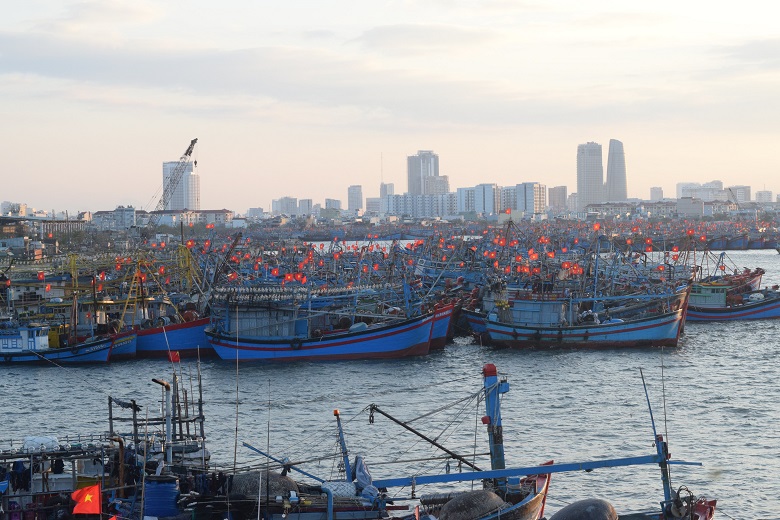
| Fishing boats gather in Danang, Vietnam. Photo: Hoang Hiep/Baodanang |
Protecting fishing stock requires multilateral work
Prof. Thayer said China’s actions in imposing an annual unilateral fishing ban run counter to the spirit of its 2018 proposal for the draft Code of Conduct.
“China should build trust and confidence with South China Sea claimant states by immediately working multilaterally to protect the fish stock ‘without prejudice to sovereignty claims’,” he noted.
He argued that the United Nations Convention on the Law of the Sea enjoins parties to enter into an arrangement of a “practical nature” if they cannot resolve disputes over maritime delimitation. In other words, China, Vietnam and the Philippines and other affected states should have entered an agreement – without prejudice to their sovereignty claims – to cooperate to protect the marine environment including depleted fish stocks.
The clause “without prejudice to their sovereignty claims” is a legal term that means countries that agree to cooperate cannot later argue that the other party acquiesced to its sovereignty claims.