Vietnam, China continue negotiating on delimitation of Gulf of Tonkin
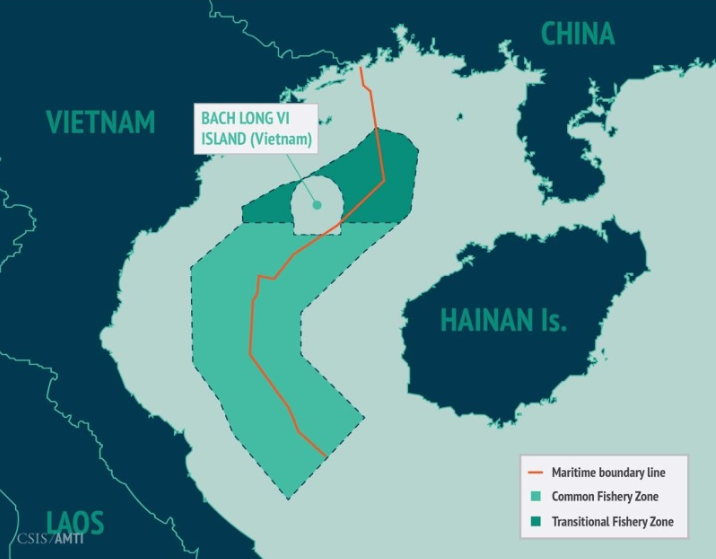
Signed in 2000, the maritime delimitation agreement in the Gulf of Tonkin establishes the first maritime boundary between China and Vietnam.
Vietnam and China last week held the 12th round of negotiations on the seas beyond the mouth of the Gulf of Tonkin and the 9th round of talks for consultation on cooperation for mutual development at sea in Beijing.
| Gulf of Tonkin maritime boundary map. Photo: Center for Strategic & International Studies' Asia Maritime Transparency Initiative |
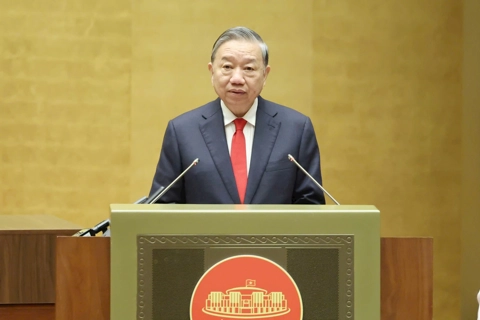
The delegations led by Phung The Long, vice chairman of the National Boundary Commission under the Vietnamese Ministry of Foreign Affairs, and Hong Liang, director of the Chinese Ministry of Foreign Affairs’ Department of Boundary and Ocean Affairs.
The two sides exchanged opinions in a friendly, straightforward, and constructive atmosphere, according to the Vietnam News Agency.
They affirmed their serious adherence to common perceptions reached by the countries’ leaders, including the 2011 agreement on basic principles guiding the settlement of sea-related issues and directions given by the heads of governmental delegations for border and territorial affairs.
They shared the view that on the basis of the agreed road map and international law, especially the 1982 United Nations Convention on the Law of the Sea (UNCLOS), to which both Vietnam and China were parties, the two countries would exert efforts to promote negotiations on the delimitation.
Both China and Vietnam recognize the significance of developments relating to the Gulf of Tonkin and consider the agreement on delimitation of the maritime border in the Gulf as a major achievement in managing disputes between the two countries.
The Gulf of Tonkin agreements
The Gulf of Tonkin issues were handled through a series of talks and discussions developed by China and Vietnam in the early 1990s.
The maritime delimitation agreement in the Gulf of Tonkin was signed on December 25, 2000. On the same day, the two countries also signed an agreement on fishery co-operation in the Gulf of Tonkin.
Both the boundary and fishery agreements entered into force on June 30, 2004 following the completion of the ratification process.
The maritime delimitation agreement relating to the Gulf of Tonkin established the first maritime boundary between China and Vietnam. It was also China’s first maritime boundary agreement.
This is of significant importance due to the fact that it is the only case of maritime delimitation involving China and thus the only case to study China’s practice in maritime delimitation, Ramses Amer and Li Jianwei said in an article titled “Maritime Delimitation in the Gulf of Tonkin is Too Important to be Ignored.”
The agreement reaffirms the Vietnamese position of using a single line for both the continental shelf and an exclusive economic zone in an area of less than 400 nautical miles between opposite and adjacent coasts.
According to the experts, it is important to have international scholars studying the agreements to get a better understanding of China’s state practice in dealing with maritime disputes because so far mainly Chinese and Vietnamese scholars have studied the agreements.
Furthermore, to study the China-Vietnam approach to managing disputes would also generate a deeper understanding of China’s practice in dispute resolution, they noted.