Vietnam forcast to achieve GDP growth of 6% this year: IMF
The country's inflation is expected to remain below the Government's 4% target.
A strategic shift towards living-with-Covid prompted by policy support and an impressive vaccination rollout will help Vietnam achieve GDP growth of 6% in 2022 and then accelerate to 7.2% in 2023.
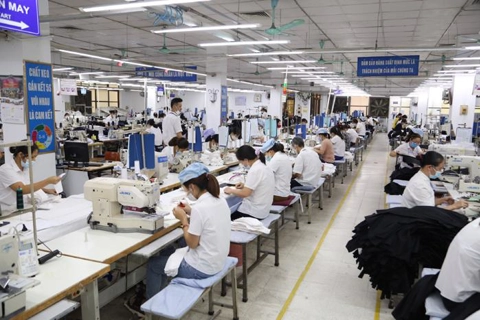
| Production at Rhythm Precision Vietnam in Noi Bai Industrial Park, Hanoi. Photo: Pham Hung |

The International Monetary Fund (IMF) gave the forecast following discussions for the 2022 Article IV consultation with Vietnam during April 4-20.
During the consultation, the IMF’s team, led by its Division Chief in the Asia and Pacific Department Era Dabla-Norris has exchanged views with senior officials of the State Bank of Vietnam (SBV), the Ministry of Finance (MOF), the Ministry of Planning and Investment (MPI), the Central Economic Commission (CEC), the National Assembly, and other government agencies. It also met with representatives from the private sector, think tanks, academics, and other stakeholders.
According to Dabla-Norris, the conflict in Ukraine is expected to have a moderate impact on the pace of recovery and inflation. Despite rising commodity prices, inflation has been contained and is expected to remain below the government’s 4% target, partly reflecting the remaining economic slack.
This year, IMF predicted Vietnam’s inflation to edge up to 3.9%. Meanwhile, IMF’s report noted the recovery has been so far uneven, with the service sector still lagging, while financial risks and inequality have likely risen.
“The outlook is subject to significant risks. Growth risks are tilted to the downside while inflation risks are tilted to the upside. The most immediate risks include the intensification of geopolitical tensions and a slowdown in China. Other risks include a tightening of global financial conditions and developments in the domestic real estate and corporate bond markets,” noted Dabla-Norris.
Standard Chartered in its outlook report on Vietnam’s economy also pointed out rising concern over the disruption of global supply chains and geopolitical risks that may further result in higher inflationary pressure in Vietnam.
The bank opted for a more cautious view with estimated GDP growth of 4% for Vietnam in 2022, and 5.5% in 2023.
Action going forward
To further address rising risks, Dabla-Norris called for policymaking to be agile, and the size and composition of policy support proactively be adjusted to the pace of recovery.
“Fiscal policy should take the lead in policy support, especially if downside risks materialize as the scope for further monetary easing is limited in light of rising inflation risks,” she noted.
“Efficient and steadfast implementation of the program for recovery and development will be key to supporting growth. It appropriately prioritizes health, economic recovery, and medium-term growth prospects,” she continued.
Going forward, fiscal policy will need to strike a balance between providing temporary, targeted support and facilitating economic transformation. The headline fiscal deficit is projected to widen moderately in 2022, Dabla-Norris added.
Meanwhile, she suggested monetary policy remain vigilant to rising inflation pressures. If sustained inflation pressures emerge, the SBV should tighten its monetary policy stance and communicate the underlying drivers to help contain inflation.
In time to come, credit growth policy must strike a reasonable balance between promoting the recovery and safeguarding financial stability. “The team welcomes recent steps towards greater exchange rate flexibility and modernization of the monetary policy framework,” she said.
The IMF’s representative suggested strengthening the resilience of the banking sector is essential for sustainably supporting medium-term growth. Relaxation of loan classification and provisioning rules should be unwound as the recovery is firming up. Regulatory forbearance on loan classification should not be extended beyond June 2022, as it would delay the recognition of problem assets and could exacerbate credit misallocation and excessive risk-taking.
“Financial regulation and supervision should be strengthened to address emerging risks and build a more resilient banking sector. The macroprudential framework can play an important role in helping safeguard financial stability. The insolvency and institutional framework should be strengthened to facilitate bad debt resolution,” she noted.
“Decisive structural reforms are needed to meet the authorities’ aspirations of sustained, inclusive growth. The business climate should be improved by creating a level playing field for finance and land access and reducing the regulatory burden, especially on SMEs and young firms. Further efforts are needed to improve the quality of the labor force and reduce skill mismatches,” Dabla-Norris concluded.