Vietnam gears up efforts to establish domestic carbon market
The move would help achieve Vietnam’s net-zero emissions target by 2050.
The Vietnamese Government is aiming to establish a domestic carbon market soon, ahead of the planned launch of a pilot carbon credit exchange platform in 2025.
| Overview of the event. Photo: Ngoc Mai/The Hanoi Times |
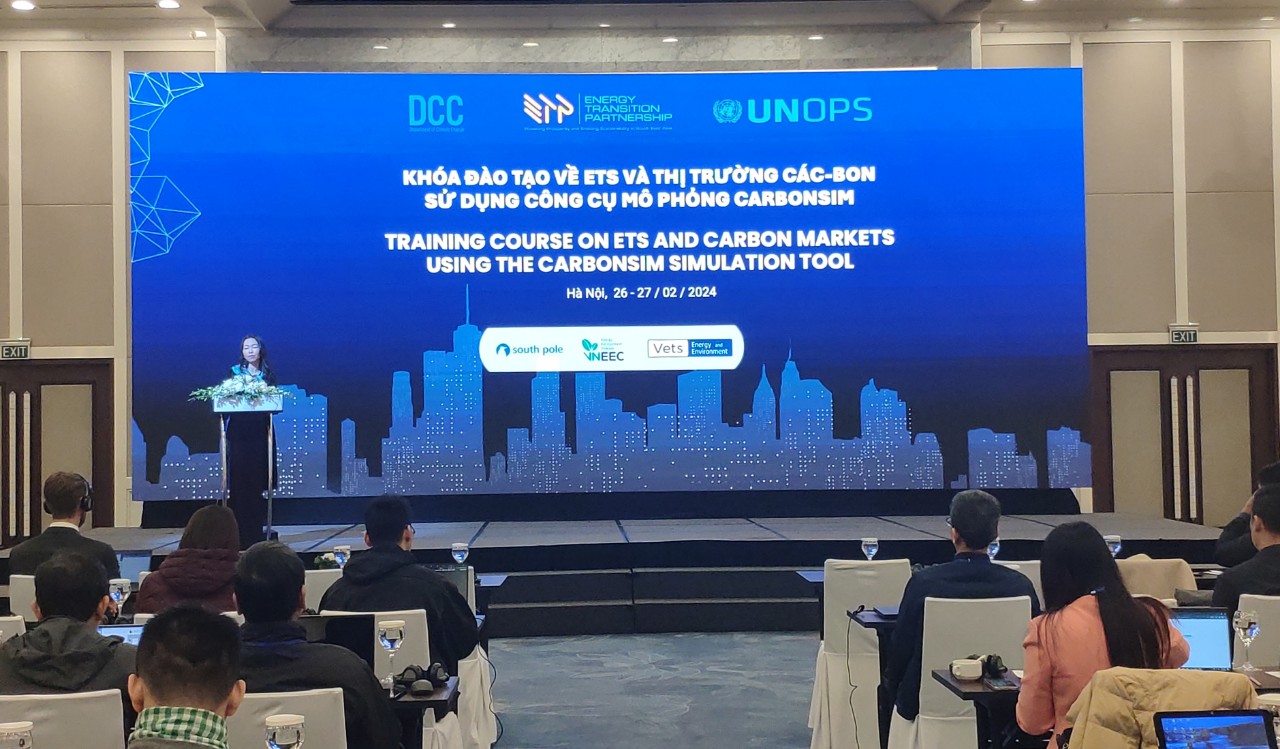
Deputy Director of the Department of Climate Change (DCC) under the Ministry of Natural Resources and Environment Mai Kim Lien revealed the target at the opening of a training course on the Emissions Trading System (ETS) and the carbon market held today [February 26], as part of the Southeast Asia Energy Transition Partnership's (ETP) support to the development of the carbon market in Vietnam.
“Today’s training course is part of the effort to realize that goal and ultimately raise awareness among all stakeholders about Vietnam’s net-zero emissions target by 2050,” Lien added.
Lien added that in Vietnam, since the mid-2000s, companies have been voluntarily trading carbon credits with the world through projects and programs under the Clean Development Mechanism (CDM) - a United Nations carbon offset program that allows countries to sponsor greenhouse gas emission reduction projects in other countries and count the reduced emissions as part of their efforts to meet international emission reduction targets.
Data from the DCC shows that, to date, there have been over 300 programs and projects registered to implement the carbon credit mechanism. Among them, approximately 150 programs and projects have been issued over 40.2 million carbon credits and traded on the global carbon market.
Maria Fritzie Reyes, ETP’s Regional Coordinator, echoed Lien's sentiments, noting that the event was the first capacity training in Vietnam to engage both public and private stakeholders in a comprehensive and systematic training curriculum on ETS and carbon markets using a market simulation tool.
| Pricing carbon makes activities emitting greenhouse gases more costly. Photo: Thanh Hai/The Hanoi Times |

“The initiative comes at a crucial time in Vietnam’s commitment to reducing Greenhouse Gas (GHG) emissions in line with its obligation under the Paris Agreement,” said Maria.
With goals set to reduce GHG emissions by 15.8% unconditionally and 43.5% conditionally by 2030, the establishment of a robust ETS plays a key role, she noted.
Maria added that by placing a cap on total emissions and allowing companies to buy and sell allowances, the ETS introduces economic incentives for businesses to reduce their emissions efficiently. Additionally, the revenue generated by auctioning of allowances can be reinvested in climate-related initiatives, further supporting the national efforts to combat climate change.
The first training is scheduled from February 26-27 and is aimed at representatives from ministries, development donors, financial institutions, and participants involved in the establishment and operation of Vietnam’s carbon trading exchange and carbon market.
Each course is expected to host more than 80 participants, providing them with an opportunity to engage in hands-on carbon market simulations and improve their understanding of the complexities and dynamics of the ETS.
The training courses in Hanoi will be followed by two training events in Ho Chi Minh City and Binh Duong for stakeholders in southern Vietnam.
Under the Government Decree 06/2022/ND-CP on the roadmap for developing the domestic carbon market, by 2027, Vietnam will implement several activities such as establishing regulations for managing carbon credits, conducting greenhouse gas emission quota trading and carbon credit exchange activities, establishing operational regulations for carbon credit trading platforms, and piloting carbon credit exchange and offset mechanisms in potential sectors. The decree also provides guidance for implementing domestic and international carbon credit exchange and offsetting mechanisms in compliance with Vietnamese laws and international treaties to which Vietnam is a party. Furthermore, Vietnam will pilot a carbon credit trading platform in 2025, along with capacity building and community awareness activities for carbon market development. |