

Vietnamese Gov’t to divest state capital at 141 businesses until 2025
The Government is determined to accelerate the divestment and privatization process at state firms that have stagnated due to the impacts of the Covid-19 pandemic.
The Vietnamese Government has set the target of divesting state capital at 141 companies and completing the privatization process at 19 state-owned enterprises (SOEs) by 2025.
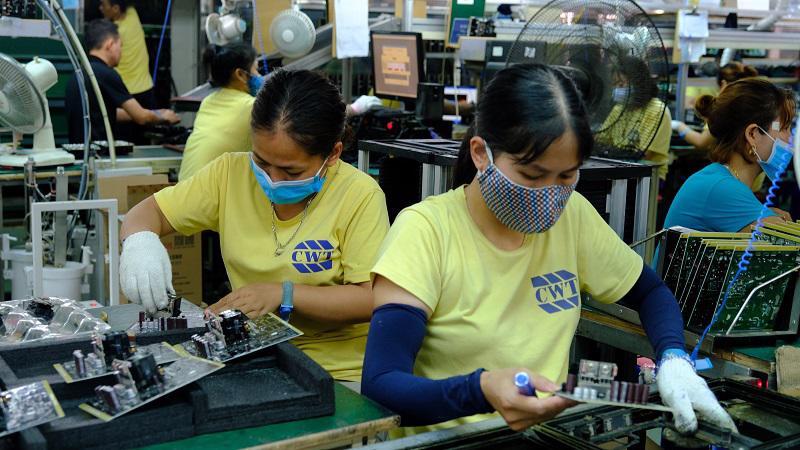
| Electronics production at Channel Well Technology Vietnam at Quang Minh Industrial Park, Me Linh District. Photo: Pham Hung |
The move was revealed under a Government decision signed by Deputy Prime Minister Le Minh Khai on the restructuring of SOEs during the 2022-2025 period, aiming at accelerating the divestment and privatization process at state firms that have stagnated due to impacts from the Covid-19 pandemic.
Under the decision, the Government plans to keep state-holding unchanged at 126 companies, maintain its presence in 195 others, divest state capital in 141, privatize 19, and restructure five.
Statistics from the Steering Committee for Enterprises Innovation and Development revealed 180 SOEs had completed the privatization process during the 2016-2020 period, raising VND177.4 trillion (US$7.23 billion) in proceeds, representing a 6.5-fold increase against the book value.
Such processes, however, have lagged behind schedule during the past three years, partly due to the pandemic impacts, noted the committee.
Last year, only three completed the privatization process, while 18 SOEs divested state capital worth VND4.4 trillion (US$192.4 million) for a combined book value of VND1.66 trillion ($72.6 million) during the period.
Among the remaining SOEs required for privatization, those in Hanoi and Ho Chi Minh City make up 54% of the total, including 13 in the capital city and 38 in the country’s southern hub. The others include six supervised by the Committee for State Capital Management (CSCM), four under the Ministry of Industry and Trade (MoIT), and two under the Ministry of Construction (MoC).
The Ministry of Finance suggested during the first ten months of 2022, SOEs divested a total of VND527 billion ($21.5 million) in book value for VND3.36 trillion ($137 million).
The overall objective of SOEs' restructuring process is to enhance their efficiency and competitiveness, which should operate based on modern and innovative technological platforms, along with a corporate governance model of international standards.
SOEs, especially major ones, should be industry-leading companies to steer those of smaller size operating in the sector for greater efficiency in allocating social resources while avoiding loss of public capital.
The SOEs subject to the restructuring process is mainly in key economic fields or located in cities/provinces which are strategic in terms of security and defense; or in sectors that draw no interest from the private sector.
The Government also targets restructuring weak and ineffective SOEs or public projects sustaining losses for a long period.
By 2025, Vietnam expects to complete the restructuring process of SOEs, for which a minimum of VND248 trillion ($10.84 billion) in proceeds should be raised from the 2021-2025 period.







