Vietnam human capital index higher than countries of same income level: WB
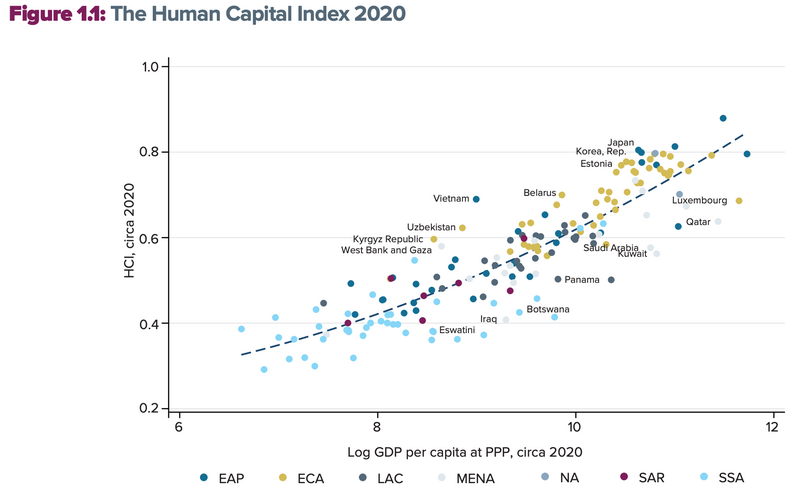
A child born in Vietnam today will be 69% as productive when growing up for enjoying complete education and full health, higher than the global average of 56%.
Vietnam’s Human Capital Index (HCI) continues to be higher than the average for East Asian and Pacific region and countries of the same income level despite the level of public spending on health, education and social assistance being lower than that of its peers, according to the World Bank.
Between 2010 and 2020, the HCI for Vietnam increases from 0.66 to 0.69 out of the maxium of 1. This indicated a child born in Vietnam today will be 69% as productive when growing up for enjoying complete education and full health.
| Source: World BAnk. |
A breakdown of the index shows that 98 out of 100 children born in Vietnam survive to age 5 and 25 out of 100 children are stunted. In Vietnam, a child who starts school at age 4 can expect to complete 12.9 years of school by age 18 and once what children actually learn is factored, expected years of school reduces to only 10.7 years.
The World Bank’s latest report indicated investments in human capital—the knowledge, skills, and health that people accumulate over their lives—are key to unlocking a child’s potential and to improving economic growth in every country.
The World Bank Group’s 2020 HCI includes health and education data for 174 countries – covering 98% of the world’s population – up to March 2020, providing a pre-pandemic baseline on the health and education of children.
The analysis shows that prior to the disease outbreak, most countries had made steady progress in building human capital of children, with the biggest strides made in low-income countries. Despite this progress, and even before the effects of the pandemic, a child born in a typical country could expect to achieve just 56% of their potential human capital, relative to a benchmark of complete education and full health.
"The pandemic puts at risk the decade's progress in building human capital, including the improvements in health, survival rates, school enrollment, and reduced stunting. The economic impact of the pandemic has been particularly deep for women and for the most disadvantaged families, leaving many vulnerable to food insecurity and poverty," said World Bank Group President David Malpass. “Protecting and investing in people is vital as countries work to lay the foundation for sustainable, inclusive recoveries and future growth."
Due to the pandemic’s impact, most children – more than 1 billion – have been out of school and could lose out, on average, half a year of schooling, adjusted for learning, translating into considerable monetary losses. Data also shows significant disruptions to essential health services for women and children, with many children missing out on crucial vaccinations.
Today, hard-won human capital gains in many countries are at risk, but countries can do more than just work to recover the lost progress, stated the World Bank.
To protect and extend earlier human capital gains, the Word Bank said countries need to expand health service coverage and quality among marginalized communities, boost learning outcomes together with school enrollments, and support vulnerable families with social protection measures adapted to the scale of the Covid-19 crisis.