Vietnam seeks ways to boost competitiveness of tourism
Vietnam strives to restore tourism back to the state of 2019 before the Covid-19 pandemic broke out.
Vietnam’s latest tourism planning places emphasis on the sustainable development of the industry to make it the spearhead in the country’s economy in the years to come.
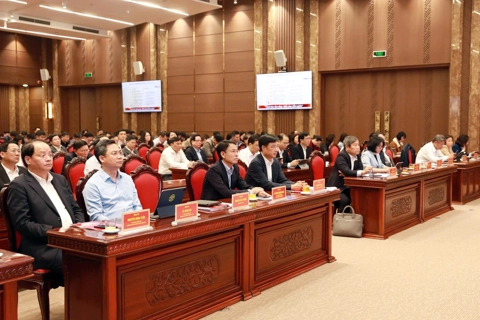
| Overview of the conference held on August 9. Photo: MCST |
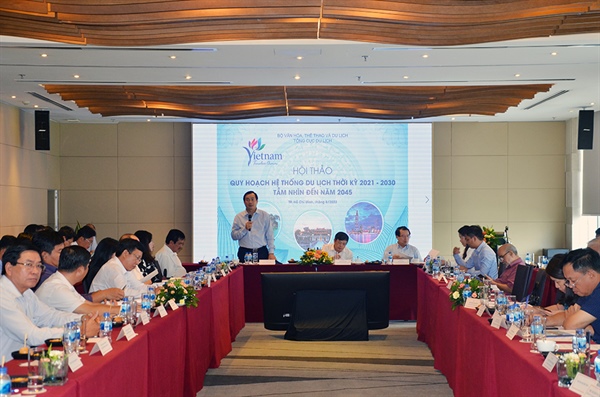
The issue was discussed at a conference held on August 9 which gathered domestic and foreign officials and experts to provide ideas for Tourism Planning for the period 2021-2030 and a vision for 2045.
The planning has many important points, including quality, efficiency, and competitiveness of an industry that generated US$32 billion in 2019 (before the Covid-19 pandemic).
It aims to restructure the tourism industry with spatial orientations and development solutions coupled with the planning of tourist sub-regions, maritime tourism, among others.
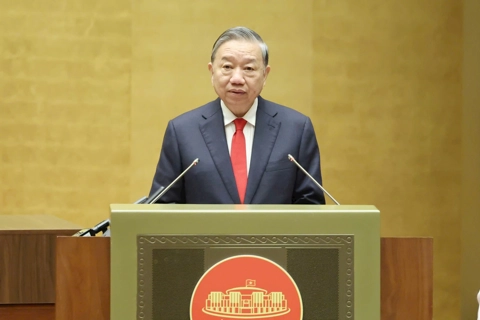
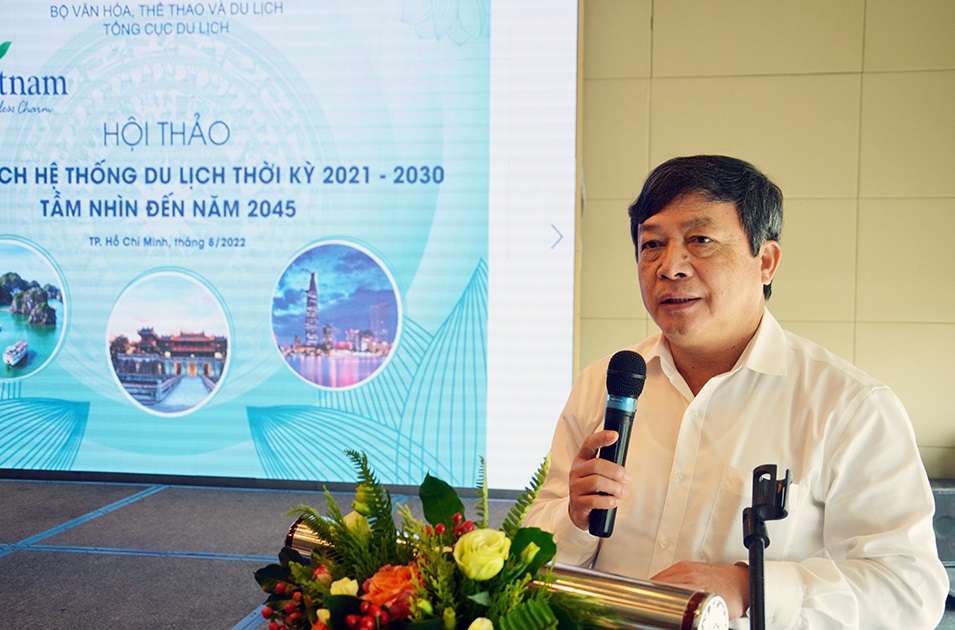
Vietnam’s tourism industry needs to be oriented by a long-term vision, based on which tourism development policies and programs would be built in line with the country’s development strategy in the new phase, Doan Van Viet, Deputy Minister of Culture, Sports and Tourism (MCST) said at the conference.
| Doan Van Viet, Deputy Minister of Culture, Sports and Tourism, speaks at the event. Photo: VNA |
Toward the recovery of tourism by 2025
The tourism planning is aimed to restore tourism back to the state before the Covid-19 pandemic by 2025. In its growth scenarios, the country is expected to welcome 18 million international visitors (the same as in 2019) and 120 million domestic tourists.
Nguyen Tien Sy, representing the consultants shared with The Hanoi Times that the planning covers six main parts: developing tourism into a spearhead in the economy; combining domestic and international tourism; making full use of national strengths; developing tourism associated with heritage and cultural values; emphasizing digital transformation, and associating the sector with climate response and environmental protection towards sustainable development.
Experts also highlighted the role of local heritage and cultural values, saying the factor would help navigate Vietnamese tourism on the world’s map, at the same time, sticking the industry to green growth in the years ahead.
For that reason, solutions for the planning cover 15 areas specifically: policies, resource use, inter-connection among sectors and localities, investment, labeling, marketing, high-quality manpower, cooperation, environmental protection, community-based tourism models, ensuring national defense and security, communication, database development, science and technology development, green finance and international cooperation.
Critical implementation arrangements issues are also addressed for various ministries, local governments, associations, businesses, citizens, and civil society. A list of specific prioritized activities and tasks is also provided.
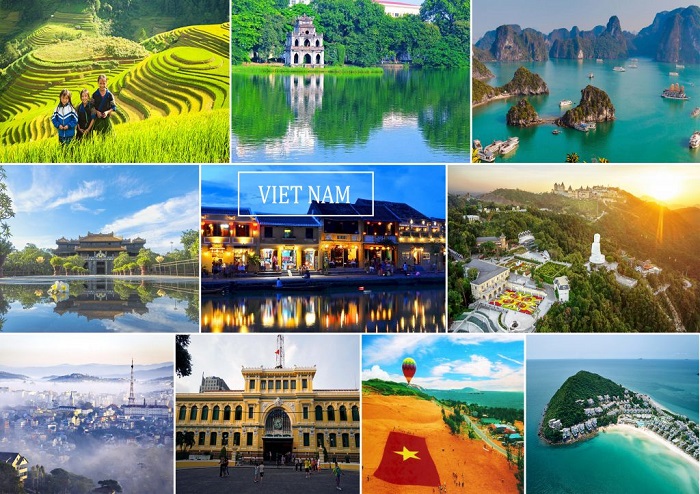
| Vietnam's tourism rich in culture and heritage. |
Vietnam’s tourism landscape
Tourism has been an important part of economic growth in recent years as Vietnam has shifted away from its reliance on agriculture and toward a service-based economy.
In 2019, the country had one of the highest numbers of international tourist arrivals in the Asia-Pacific region. East Asian visitors constituted the largest group of foreign arrivals to Vietnam. Meanwhile, the number of domestic tourist travelers is rapidly increasing.
Given the high Covid-19 vaccination rate, Vietnam reopened its border to international tourists in March 2022, hoping to make the first step in reviving inbound tourism. Accordingly, tourism has been showing signs of recovery since with some significant results from inbound tourism and it will take some time to recover to pre-pandemic levels.
A report by the Asian Development Bank (ADB) asserted that Vietnam's economy will rebound by 6.5% this 2022, a significant improvement when compared to the 2.6% rate registered in 2021. This prediction is closely tied to the anticipated increase in tourism earnings.
The boost that the tourism industry will provide will most likely play a significant role in Vietnam's attempt to meet the set economic projections.
Businesses in the hospitality industry, particularly those specializing in services such as food and beverage, lodging, and adventure and recreation, are expected to thrive, particularly as Covid-19 restrictions are eased across the region and events such as the SEA Games (which took place in May 2022) drive up tourist numbers.
As a result, local businesses should capitalize on their position by innovating their products and services, as well as optimizing their advertising and communication efforts to attract potential customers, according to consulting company YCP Solidiance.
For instance, a number of companies recently worked with pottery businesses in Bat Trang, one of Hanoi's most well-known trade villages, to design and launch tourism initiatives to serve arriving tourists. This not only raises understanding of Vietnamese culture but, more crucially, is likely to boost the village's economic output.
Furthermore, local firms should take into account how the internet economy is developing in Vietnam.
![[Video] Vietnam tourism introduces clip of natural wonders](https://cdn-media.hanoitimes.vn/2022/07/11/Di_de_yeu.jpg?w=480&h=320&q=100)