Vietnam set for 6.1% GDP growth in 2024: WB
The World Bank expected Vietnam's growth prospects to improve thanks to a recovery in exports, tourism, consumption, and investment.
The World Bank (WB) has released an updated economic report for Vietnam, highlighting the resilience of the country's economy amid global challenges, with the GDP’s growth set for an expansion of 6.1% this year, a significant increase from the 5.5% projection made in April.
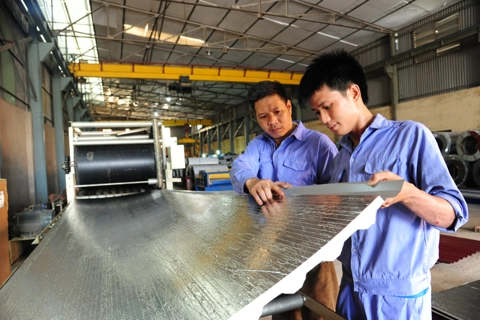
| Production at Yen Phong Industrial Park. Photo: Pham Hung/The Hanoi Times |

The WB expects GDP growth to continue, potentially reaching 6.5% over the next two years.
In the first half of this year, Vietnam recorded a growth rate of 6.42%, according to the General Statistics Office. The WB noted that the economy's acceleration during this period was driven by a rebound in exports, consumption, and investment.
Based on data from the General Statistics Office, the WB calculated that exports and imports in the first half of the year increased by 16.9% and 17%, respectively, compared to the same period last year. Investment and consumption growth were also notable, at 6.7% and 5.8%, respectively.
The rebound in global demand has also stabilized Vietnam's manufacturing and export-oriented services sectors. Following the strong economic performance in the second quarter and the first half of the year, the government has updated its projections and is targeting GDP growth of 7% this year, higher than the 6-6.5% target set by the National Assembly.
Currently, besides the WB, other international financial institutions, including the IMF, ADB, UOB, and Standard Chartered, forecast Vietnam's growth this year to be around 6%. HSBC even predicts a 6.5% increase. However, the WB's analysts caution that Vietnam has not yet returned to its pre-pandemic growth trajectory.
Domestic demand remains weak, and non-performing loans are high amid sluggish credit growth. According to the State Bank of Vietnam, the non-performing loan ratio was 4.56% at the end of June, more than double the rate at the end of 2022.
Trade is also expected to slow down next year due to challenges faced by major partners like the US and China. Meanwhile, inflation is projected to decline from 4.5% this year to 4% and 3.5% over the next two years. The current account balance is expected to remain stable with a slight surplus. Government debt and government-guaranteed debt as a percentage of GDP are projected to gradually decline to 35.7% this year and 35% next year.
Sebastian Eckardt, the WB's Lead Economist for Macroeconomics, Trade, and Investment in the East Asia and Pacific Region, suggested that to maintain growth momentum, Vietnam needs to "continue institutional reforms, boost public investment, and manage and supervise risks in the financial market."
In addition to public investment, Dorsati Madani, a Senior Economist at the WB, recommended that Vietnam also focus on promoting the private sector. "The external environment has changed. The green transition is happening globally. Vietnamese businesses need to consider adopting green technologies in their production. Those who pioneer in this area will capture more market opportunities," she said.
Commenting on the fact that the US has not yet recognized Vietnam as a market economy, Madani stated that this would not affect the current trade flows between the two countries. Foreign direct investment (FDI) inflows are also expected to remain stable. However, she emphasized that to sustain FDI, Vietnam needs to improve labor quality and critical infrastructure services, such as transportation, telecommunications, and electricity.
The WB's report also discussed Vietnam's capital markets. Ketut Ariadi Kusuma, a Senior Financial Specialist at the WB, noted that Vietnam's market capitalization is currently higher than Indonesia's and could surpass that of the Philippines in the near future.
However, Vietnam is still classified as a frontier market, which means it is small-scale, lacks transparency, and has limited capital-raising, savings, and pricing functions. The proportion of institutional investors is still low, and the investment channels for social security funds are not diversified.
In reality, Vietnam's stock market is currently classified as a frontier market by both MSCI and FTSE Russell. However, FTSE Russell has placed Vietnam on a watchlist for upgrading to an emerging market status. Vietnam aims to upgrade its stock market from frontier to emerging by 2025.
"Billions of dollars from global investment funds will flow into capital markets when Vietnam is upgraded to an emerging market status. It is essential to gradually diversify social insurance fund investment channels to improve long-term returns," Kusuma said.
Previously, the WB estimated that Vietnam's stock market could attract an additional $25 billion in foreign capital if upgraded. The regulatory framework is being refined by authorities, such as easing margin requirements for foreign investors, to expedite the market's consideration for upgrade.