Vietnamese automobile makers ask for more support
Among the incentives, the government is urged to lower the special consumption tax for locally made parts to help them reduce prices to compete with foreign manufacturers.
Difficulties caused by the new import tax exemption policy and the small size of the domestic market have forced Vietnamese automobile manufacturers to ask for more support from the government so that they can successfully compete against international rivals.
| It takes local car manufacturers difficult to compete against foreign rivals. |
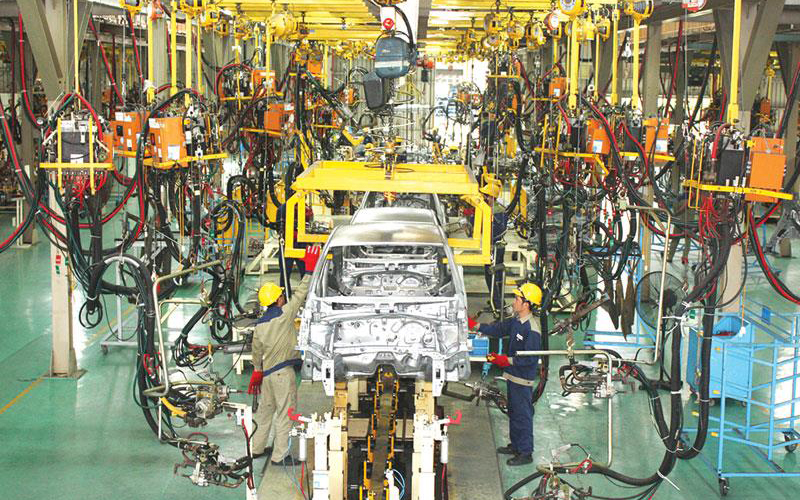
According to the manufacturers, compared to Thailand, the number of Vietnamese spare-parts suppliers in the automotive industry is small. They cited a report from the Ministry of Industry and Trade (MoIT) that Thailand has nearly 700 tier-1 suppliers which supply parts or systems directly to original equipment manufacturers, while Vietnam has less than 100. About 1,700 tier-2 and tie-3 suppliers in Thailand provide raw, or close-to-raw, materials like metals and plastics for the tier-1 category, while in Vietnam there are only 150. Locally manufactured under-nine-seat cars in Vietnam only meet 7-10% of the demand.
Thus Do Thu Hoang, deputy general director of Toyota Vietnam, said that most domestic automobile manufacturers have to import parts, which results in very high costs for packaging, shipping and import duties. The cost of manufacturing in Vietnam is currently 10-20% higher than in Thailand and Indonesia.
According to Hoang, before 2018, when there were high import duties for fully-assembled cars, locally produced cars were still able to compete. Now the duties have been cut to 0% within the bloc following ASEAN integration in 2018, it has become tougher for car manufacturers in Vietnam to compete.
Besides, Hoang said, the small size and output of the local market is a big challenge for domestic automobile manufacturers. For example, the number of Toyota’s Vios model cars produced in Vietnam was only one-eighth of Thailand's, which made production costs higher.
Compared with Thailand and Indonesia, Vietnam's automobile output is far behind. Thailand produces about 2 million cars and Indonesia 1.3 million cars each year, while Vietnam can only produce about 300,000.
Pham Tuan Anh, deputy director of the MoIT’s Industry Department, also said that small market capacity has prevented the local automobile industry from growing.
Anh also admitted that the government does not offer enough support for the automobile industry.
Incentive policies
To cope with these difficulties, Pham Van Tai, general director of automobile manufacturer Thaco Truong Hai, said that the government needs to raise certain technical barriers to help local car makers. For example, in order to enjoy the zero percent import tax rate, imported cars must have a localization rate of 40%.
Tai also said that the government should lower the special consumption tax for locally made parts to help them reduce prices to compete with foreign manufacturers.
Besides, industry insiders suggested the government to offer incentives for consumers who purchase locally-made products to increase demand. The same thing had been done successfully in Thailand and Malaysia.
According to experts, the regional automobile market is expected to see no sign of strength next year as vehicle sales volumes in Asia will stay below 2017 levels in 2020.
“We forecast mild growth of 1.5% in Asia's vehicle sales market in 2020, following an estimated 7.2% decline in 2019. Although this is positive, the volumes show that the market will still be far below previous levels at 42.4 million units compared with 45.0 million in 2017,” analysts from financial information services provider Fitch Group said.
However, it is a bit more optimistic for Vietnamese manufacturers as the analysts forecast that the best growth will continue to come from South East Asian markets, and Vietnam in particular with projected growth of 23.9% as the market continues to adjust following 2018's new import regulations.