Log in
Econ

Vietnamese Tra fish to be more qualified for US market

According to the National Agro-Forestry-Fisheries Quality Assurance Department, there are 12 more Vietnamese Tra fish exporters are now eligible to ship their products to the US, pushing the total number of eligible firms to 57 ones.

 
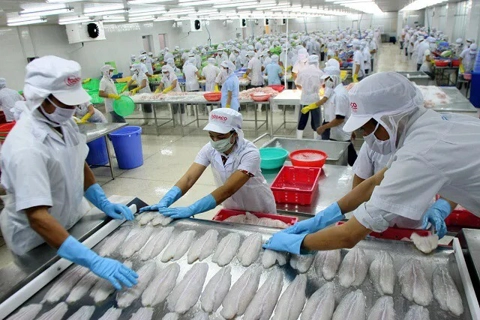
Proccessing Tra fish for export
 
There are also four more firms on the waiting list, and the agency would work with the US Department of Agriculture’s Food Safety and Inspection Service to speed up the verification process. The US is the biggest import market for Vietnamese Tra fish with a stable demand and good prices. 

Vietnam has shipped 130 million USD worth of Tra fish to the US, up 7.6% compared to the same period last year. The export volume is expected to see a year-on-year increase of between 10% and 15% in the next quarter. That action showed that the quality of Vietnamese tra fish products exported to the US was implemented as per the commitment of local firms' towards food hygiene and safety. 

Local tra fish processors and exporters should promote further management for their production, processing and export activities to reach strict standards on food quality at export markets, including the US. 

According to VASEP, in the first four months of this year, the US was the largest export market for Vietnamese tra fish products. Total export value of Vietnamese tra fish to the US had a year-on-year increase of 7.2 percent to 115.1 million USD. 

Catfish is a popular fish in the US, with the market dominated by local producers mostly from southern states such as Mississippi, Arkansas, Louisiana and Alabama. In recent years, they have been rivalled by cheaper Asian imports. 

Reactions:
Share:
Trending
Most Viewed
Real estate firms sell bonds worth $402 million in May

Real estate firms sell bonds worth $402 million in May

Real estate companies have raised $862 million from bond issuance in April and May, thanks to an improved business environment and better access to funding.

Vietnam unveils new strategies to boost domestic market, aid businesses

Vietnam unveils new strategies to boost domestic market, aid businesses

As global trade uncertainties grow, Vietnam sees the domestic market not only as a key consumption driver but also a “lifeline” for businesses hit by protectionist export barriers.

Vietnam eyes US tilapia export boost as global supply falls

Vietnam eyes US tilapia export boost as global supply falls

Vietnam aims to increase tilapia output to 400,000 tons by 2030, making it the second-largest freshwater export species after pangasius.

Vietnam’s enterprises must act fast to weather US tariff shock: Experts 

Vietnam’s enterprises must act fast to weather US tariff shock: Experts 

Many of the key Vietnamese exports, such as wood products, electronics, and textiles, that are not on the US exclusion list could face steep tariffs.

Vietnam's mobile money pilot program extended to end of 2025

Vietnam's mobile money pilot program extended to end of 2025

Mobile Money, launched by the Ministry of Science and Technology, differs from e-wallets by linking users’ payment accounts directly to mobile phone numbers.

Vietnam taps innovation, global ties to elevate national brand

Vietnam taps innovation, global ties to elevate national brand

Vietnam is intensifying efforts to enhance its national brand, leveraging innovation, global partnerships, and strategic policies to bolster its global competitiveness and market presence.

Vietnam extends US$3.9 billion loan package for agro-forestry-fisheries

Vietnam extends US$3.9 billion loan package for agro-forestry-fisheries

The government has expanded the scope and scale of the credit program for the sectors which brought about US$62.4 billion worth of exports in 2024.

Vietnamese public shows rising satisfaction in 2024 PAPI survey

Vietnamese public shows rising satisfaction in 2024 PAPI survey

The 2024 PAPI survey found increasing citizen satisfaction with governance, but highlighted persistent administrative challenges, climate vulnerability, and gaps in access to public services.