Vietnam’s agriculture most vulnerable to climate change: UNDP
Climate impacts in the agriculture sector might make many people fall back into poverty.
Vietnam’s agriculture, more than any other sector, has been suffering huge and obvious losses caused by climate change, the United Nations Development Program (UNDP) has said.
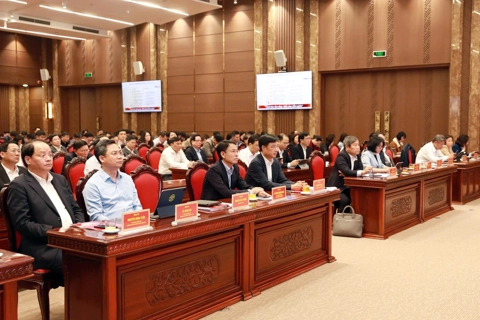
| Participants at the workshop on monitoring and evaluation system for climate change adaptation held in Hanoi on Sept 23. Photo: UNDP |

Loses and damages that natural disasters and climate change caused to the agricultural sector has been aware of people in Vietnam, UNDP Deputy Resident Representative Patrick Haverman said at a workshop held by in partnership of the Ministry of Agriculture and Rural Development (MARD) and the Green Climate Fund (GCF) in Hanoi on September 23.
“Notably, natural disasters and climate change not only affect the achievement of national development goals, but also directly make many people who rely on agriculture fall back into poverty,” Haverman stated at the event on monitoring and evaluation system for climate change adaptation in the agriculture sector.
He warned that many studies have shown that poor and vulnerable populations, such as people in remote rural areas, disadvantaged groups, ethnic minorities, women and children, are severely affected by natural disasters and climate change.
In addition, the post-disaster recovery capacity of these groups is also much lower than that of other population groups.
With this in mind, the agricultural sector has built agricultural monitoring and evaluation (M&E) database and stipulated the M&E indicators for better climate adaptation.
M&E indicators are input data are expected to ensure the applicability and comparability to the baseline over time with highlighting challenges and required actions for perfection of the M&E system both offline and online.
The set of indicators covers the fields of state management, strengthening resilience and capacity to adapt to climate change, mitigating disaster risks and minimizing damage caused by climate change, boosting investment sources for climate change adaptation, and raising awareness of climate change.
According to Haverman, these are very crucial instruments for the agriculture sector to regularly monitor, evaluate and update the progress to timely inform effective and sustainable decisions, avoiding potential overlaps or lack of connectivity.
M&E database is part of the national determination in response to climate change. These have been turned into strong actions such as promulgation of the “National climate change adaptation plan for the period of 2021 – 2030, with a vision to 2050”, recently the National Strategy on climate change for the period to 2050” and sectoral action plans.
UNDP, through the Vietnam National Adaptation Plan (NAP) Development and Operationalization Support Project, is supporting the Government of Viet Nam to promote the NAP implementation process in the country and establishment of a comprehensive M&E system associated at national, sectoral and local levels.
Objectives of the M&E system for sectoral climate change adaptation (CCA) activities include serving the M&E process of the implementation of the CCA plan/action; serving as a basis for developing sector plans; integrating the development of annual, medium-term and long-term financial plans of the MARD and localities.
The set of the indicators is the research result by MARD with the support of GIZ, involving experts in agriculture, forestry, fisheries, and other fields with the participation of non-governmental organizations namely GIZ, SRD, CARE, USAID, and Oxfam.
| Vietnam's agriculture sector is the most vulnerable sector to climate change. Photo: VNA |

According to MARD, Vietnam is an agricultural country, with agriculture accounting for approximately 20% of GDP, most of the poor live on agriculture and fishing.
The Mekong Delta, Vietnam is ranked one of the world’s three hardest-hit deltas by sea level rise. Furthermore, extreme weather events like protracted droughts and hotter spells will happen more frequently. The effects of climate change on Vietnamese farmers will be severe, with increasing crop losses predicted; decreased animal production; and generally harder living due to landslides, flash floods, and other disasters.
The World Resources Institute placed Vietnam 4th out of 164 nations in terms of the substantial economic harm that current and future floods will cause, costing the country 2.3% of its annual GDP.
Tran Quang Bao, Deputy Director of the General Department of Forestry, MARD, said a large number of people will be affected by climate change caused to the agricultural sector, requiring state agencies to address challenges and have drastic solutions for vulnerable communities, especially those in coastal areas. Specific measures must be applied in the affected areas like the Mekong Delta to ensure the livelihoods of local residents in climate response that would be costly and time-consuming, Bao told The Hanoi Times at a recent conference held by MARD and the Netherlands Embassy in Hanoi.