Vietnam’s GDP growth set to expand 7.5% in 2022: World Bank
In long term, transforming the higher education system will be key to boosting Vietnam’s productivity and helping achieve its goal of becoming a high-income country by 2045.
Vietnam’s GDP growth is forecast to surge from an estimated 2.6% in 2021 to 7.5% in 2022, with backing from resilient manufacturing and a robust rebound in services.
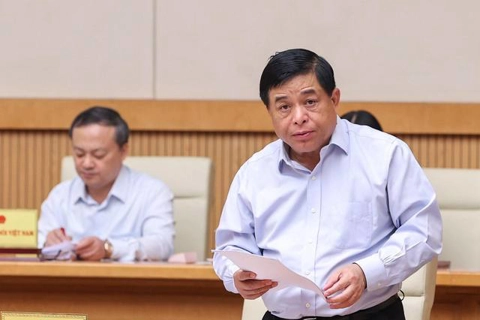
| Overview of the event. Photo: Nguyen Tung |

Country Director for the World Bank in Vietnam Carolyn Turk revealed the figures at the launch of its bi-annual economic outlook for Vietnam titled “Taking Stock: Educate to Grow” today [August 8].
According to Turk, the global economy has been experiencing a series of very large and negative shocks, including ongoing Covid-19-related disruptions and supply shocks associated with the Russia-Ukraine conflict.
In this context, Vietnam’s economy has shown “relative resilience and staged a strong rebound after last year’s Covid-19 induced slowdown,” Turk said.
Vietnam’s economic recovery accelerated over the last six months, as the GDP growth expanded by 7.7% in the second quarter this year, higher than the 5.1% recorded in the previous quarter.
However, this positive outlook is subject to heightened risks that threaten recovery prospects, she said. Risks include growth slowdown or stagflation in main export markets, further commodity price shocks, continued disruption of global supply chains, or the emergence of new Covid-19 variants. Domestic challenges include continued labor shortages, the risk of higher inflation, and heightened financial sector risks, Turk noted.
“If major economies and export markets such as the US, the eurozone, and China slow down more sharply than we currently expect, Vietnam’s exports could be further affected,” she said.
Given the nascent domestic recovery, the weakening global demand outlook, and heightened inflation risks, Turk suggests a proactive response by the authorities.
World Bank’s Senior Economist Dorsati Madani said in the short run, on the fiscal front, the focus should be on the implementation of the Recovery and Development policy package and expanding targeted social safety nets to help buffer the poor and vulnerable from the effects of the fuel price shock and rising inflation.
In the financial sector, close monitoring and strengthening non-performing loan reporting and provisioning as well as adopting an insolvency framework would be recommended, Dorsati added.
If upside risks to inflation materialize -- with core inflation accelerating and the consumer price index moving above the 4% target set by the government -- the State Bank of Vietnam should be ready to pivot to monetary tightening to quell inflationary pressures through interest rate hikes and tighter liquidity provision, he added.
Transforming the higher education system vital
“To sustain economic growth at the desired rate, Vietnam needs to increase productivity by 2-3% every year,” said World Bank’s Country Director to Vietnam Turk. “International experiences have shown that higher worker’s productivity can be achieved by investing in the education system, as an important part of a basket of investments and reforms. A competitive workforce will generate much-needed efficiency for Vietnam in the long term.”
World Bank’s Senior Education Specialist Michael Drabble suggested transforming the higher education system will be key to boosting Vietnam’s productivity and help achieve its goal of becoming an upper-middle-income country by 2035 and a high-income country by 2045.
He expected the country to have a workforce with 21st-century skills to grow, especially if the country wants to transform its economic model into a dynamic, knowledge-driven, productivity-driven, digital, and resilient economy,
In particular, to match average higher education enrollment levels in upper-middle economies, 3.8 million Vietnamese students would need to be enrolled in higher education institutions, almost twice as many as enrolled in 2019, Drabble added.
Drabble added reforms to Vietnam’s higher education system that could help support development objectives.
However, the increasing financial costs of pursuing higher education and the perception of diminishing economic returns from pursuing higher education have weakened demand. The system is further undermined by falling short of providing skills sought by employers, underinvestment by the state, and a weak and fragmented institutional structure governing higher education.
Drabble called for the Government to improve access to higher education, enhance the quality and relevance of instruction, and make more efficient use of resources. This could be materialized by expanding the use of digital technologies, enhancing the role of the private sector, and streamlining the regulatory framework, he added.
Echoing Drabble’s view, President of the National Economics University Pham Hong Chuong noted shortcomings in Vietnam’s economy partially comes from weaknesses in the labor force, or limited corporate governance among local businesses.
“Greater focus on education is a long-term solution for this issue, which requires significant investment from both the Government and universities and cooperation from international partners,” Chuong said.
“While the process may take years to see the benefits, the first step is to begin to act,” Chuong said.
According to World Bank’s report, Vietnam's average years of schooling is 10.2 years, second only to Singapore among ASEAN countries and its human capital index is 0.69 out of a maximum of 1, the highest among lower-middle-income economies. However, when it comes to tertiary education, which includes both university and vocational training, the numbers are not as good as they should be. While most jobs in Vietnam continue to be for unskilled or skilled manual workers, firms do report difficulty in securing employees with technical, managerial, or leadership skills. According to the World Bank skills and enterprise survey (2019), 73% of sampled Vietnamese firms report difficulties in recruiting employees with leadership and managerial skills, 54% with socio-emotional skills, and 68% with job-specific technical skills. The problem is related to both quality -relevance of the skills and employability of current graduates- as well as quantity – the number of graduates. In terms of quality, Vietnam currently ranks in the bottom third of the 140 countries listed in the 2018 Competitiveness Index on skills relevance of university graduates. In terms of quantity, only 10.2% of the population aged 25 or older had completed a bachelor’s degree or equivalent, as of 2019. Vietnam's tertiary gross enrollment rate was 28.6%, below regional comparators, and the average of 55.1% for upper-middle-income countries. Right now, Vietnam has about 2 million enrolled at tertiary education institutions. In the long run, to meet upper-middle income enrolment levels, enrolment would have to rise to an estimated 3.8 million students, almost double the numbers in 2019. |