Vietnam’s pandemic response – example of “Triple A” Governance: UNDP
Vietnam shows what is possible when a government and an entire nation place health and protecting people at the very center of its Covid-19 response.
Vietnam’s pandemic response provides an excellent example of what UNDP calls “Triple-A” Governance, namely Anticipatory, Agile and Adaptive.
UNDP Resident Representative in Vietnam Caitlin Wiesen gave the remarks during a virtual conference themed “ASEAN and the Covid-19 fight” held today [May 26] by the University of Social Sciences and Humanities (USHH) and Konrad Adenauer Stiftung.
| UNDP Resident Representative in Vietnam Caitlin Wiesen at the seminar. Photos: Nguyen Tung |
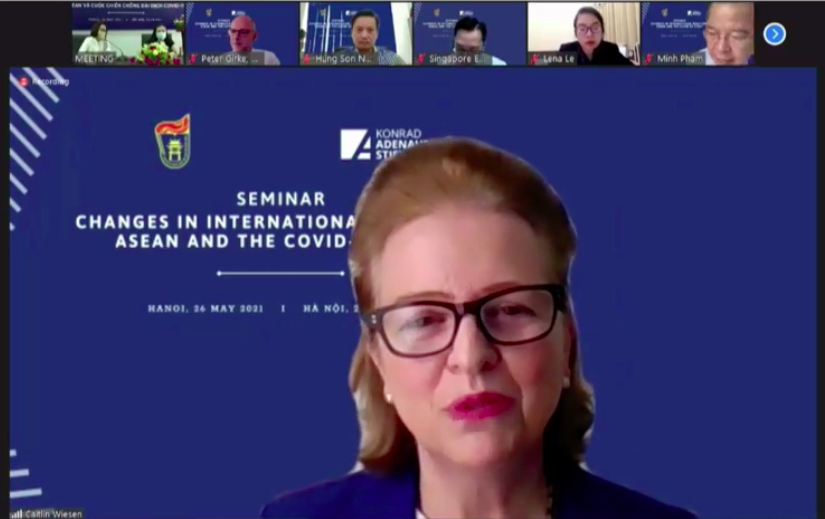
Wiesen referred to a UNDP’s study on “Citizens' Opinions of and Experiences with Government Responses to Covid-19 Pandemic in Vietnam in 2020” that confirmed widespread public support in Vietnam for the government’s Covid-19 response, saying the move is “in sharp contrast to the trust deficit in governments being registered in many parts of the world.”
According to Wiesen, such achievement came when a government and an entire nation place health and protecting people at the very center of its Covid-19 fight.
Along with tireless efforts of health workers and frontline teams carrying out tracking, tracing and testing, the government has been sending effective messages mobilizing the whole society to work together to defeat the virus.
Low-cost test kits and other innovative responses that help Vietnam keep the pandemic under control were a result of cooperation between the government and private sector, noted Wiesen.
“We have seen the positive dividends of social solidarity and transformative innovation, for example the rice ATMs and zero-dollar grocery stores that provided essential supplies during the first wave of the pandemic,” she added.
“Putting health first has had a tangible economic dividend, with Vietnam the only ASEAN country, and one of very few countries worldwide, to register economic growth in 2020.”
However, as countries around the world, including Vietnam, are experiencing a new surge in Covid-19, having access to vaccines against the virus is now a priority.
Across ASEAN member states, the rate of the population receiving at least one dose ranges from around 33% down to 1%. “Given the constraints on vaccine supplies and roll out, and the concern over new variants, most analysts predict that borders will remain largely closed until 2022 at least,” Wiesen stressed.
In this context, Vietnam’s plan to set up a US$1.1-billion vaccine fund and the decision of the National Assembly to earmark more than half a billion dollars and to accelerate efforts to urgently procure vaccines from multiple sources are important steps for the next phase of the Covid-19 response, she noted.
The UNDP’s representative also highlighted Vietnam’s initiative to apply for WHO approval to become a potential hub of mRNA-based vaccine production for the country and possibly the region, as well as active approaches to several international manufacturers to license domestic production of their vaccines.
Test for ASEAN’s cohesion
Echoing Wiesen’s view on Vietnam’s effective measures against the pandemic, Nguyen Hung Son, Vice President of the Diplomatic Academy of Vietnam, noted the key factor would be the right attitude of both the government and the public in the Covid-19 fight.
| Vice President of the Diplomatic Academy of Vietnam Nguyen Hung Son |

“The high level of cooperation from the people is what makes government’s actions truly effective,” said Son.
However, Son pointed out that Vietnam will not be safe from the pandemic until the whole region is safe, and coordinated policies are required at the regional level among countries, including a common vaccine strategy.
“A proposal on a center for public health emergencies that ASEAN is looking into may not be useful for this current pandemic, but will be a key-changing move in the next one,” Son said, adding the priority is to soon put this idea into practice.
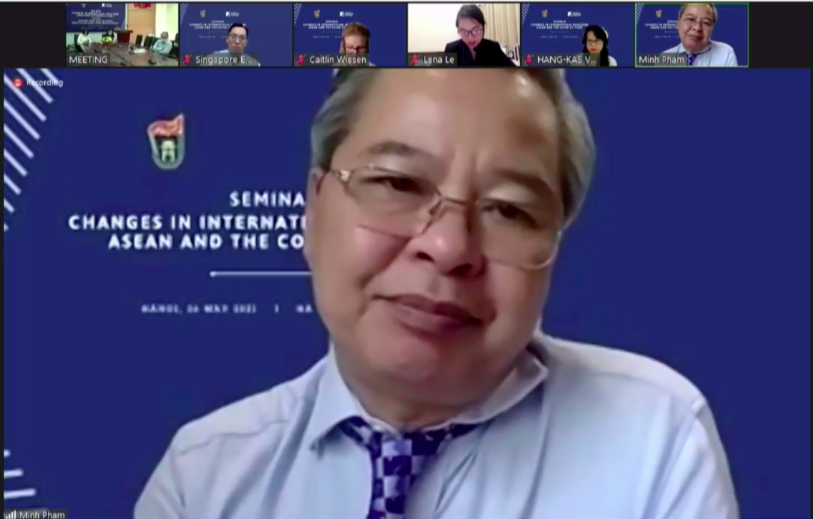
Expert Pham Quang Minh from the USSH backed up the idea by saying Southeast Asia was one of the first region affected by the pandemic.
| Expert Pham Quang Minh from the USSH. |
As of May 24, ASEAN recorded over 3.8 million infection cases and nearly 76,000 death.
“The rapid spread of the Covid-19 pandemic has led to disruption of supply chains and severe impacts on tourism, trade and investment activities,” said Minh.
“The region needs to set up a fund to support country members. As we look at the pandemic as a challenge, ASEAN as a whole would become stronger if we can successfully win over this crisis,” Minh added.
“The pandemic is a test for the cohesion of the bloc,” he said while calling for all ASEAN members to continue cooperating in sharing information, experiences and also vaccines.
“Mass vaccination is the only solution for ASEAN if the region wants to achieve herd immunity by 2022 and eventually economic recover,” he suggested.