Which pressing issues would Vietnam and ASEAN face in the rest of 2020?
Efforts to keep economic stability and security seem to be the most concerning challenges.
Vietnam, as the Chair for ASEAN this year, is facing a number of challenges relating to economic stability and security, requiring it more efforts to handle with in the remaining months of this year.
| Emeritus professor Carl Thayer, the University of New South Wales, Canberra (UNSW Canberra). Photo: Getty Images |

Emeritus professor Carl Thayer, the University of New South Wales, Canberra (UNSW Canberra), has provided a broader approach to this concerning topic.
“There are six pressing issues that need to be addressed,” the professor said in Thayer Consultancy Background Brief, June 25, 2020 in answering to a question on what Vietnam should focus on solving in the coming six months.
The issues include (1) fine tuning the Covid-19 Fund so it has the capacity to address management and mitigation of the coronavirus; (2) post-Covid-19 socio-economic recovery including open borders and economies and movement of labor; (3) revising the three ASEAN community blueprints to the year 2025 in light of current developments; (4) improving the efficiency of relations with dialogue partners; (5) completing the Regional Comprehensive Economic Partnership (RCEP); and (6) empowerment of women.
Regarding the determination of the participating countries to sign an RCEP agreement by the end of this year, Thayer wrote: “There seems to be general consensus that the RCEP agreement should be completed by the end of this year without the participation of India. Most countries stricken by the coronavirus want to resume economic growth and RCEP provides the incentive to do so.”
“There are, however, two concerns that could affect this objective. First, failure to bring the Covid-19 pandemic under control. Second, a slowing of global economic growth. Either individually or in combination it is possible that one or more countries may feel their economies are not strong enough at the moment to join RCEP.”
| Leaders of RCEP agreement at a summit held in Thailand in November 2019. Photo: Thai PBS |
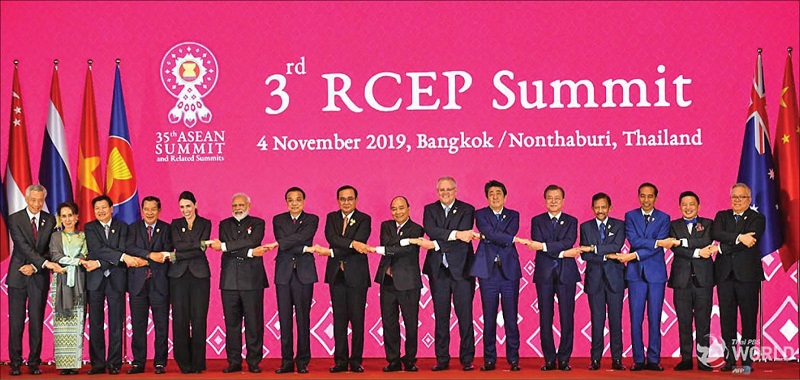
The professor also emphasized the importance of the RCEP agreement to Australia, saying that it is “very important to Australia particularly since President Trump pulled the US out of the Trans-Pacific Partnership.”
“Australia needs all the insulation it can get for its economy through multilateral efforts that promote trade by lowering tariffs and restrictions on trade. Australia sees benefit in belonging to a wide regional arrangement as this will impose some restraints on China’s behavior and make it more predictable,” he noted.
According to Vietnam’s Deputy Foreign Minister Nguyen Quoc Dung, the 15 negotiating countries expect to sign the RCEP by year-end as it is a priority for ASEAN and its partners.
The deal being signed in 2020 would show that the parties support a multilateral trading system and stronger economic integration among regional countries, thereby helping to resume economic activities and set up a “new normal” across the region.
Initiated by ASEAN in 2012, the RCEP is a free trade agreement among the ten member countries of the bloc and six partners including China, India, Japan, South Korea, Australia, and New Zealand. Once signed, it would create one of the largest free trade areas in the world.