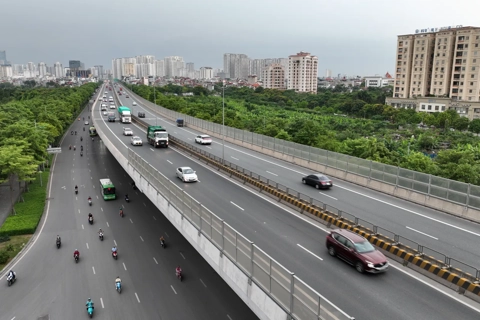
Explore historical relics on Ngoc Khanh Lake's new pedestrian path
Forty years ago, archaeologists found thousands of weapons under Ngoc Khanh Lake. They believed the weapons belonged to the armory of a feudal military academy called Giang Vo, which means "military education."
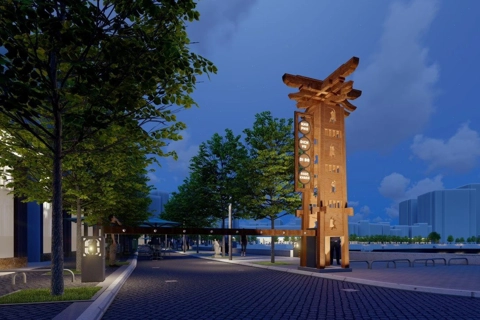
To celebrate the 70th anniversary of Hanoi's liberation (October 10, 1954 - October 10, 2024), the local authorities will open the Ngoc Khanh Lake pedestrian zone and its surroundings by October 10, the second of its kind in the central district.
New tourism rendezvous in Hanoi
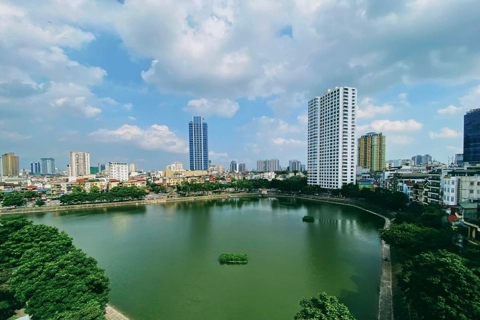
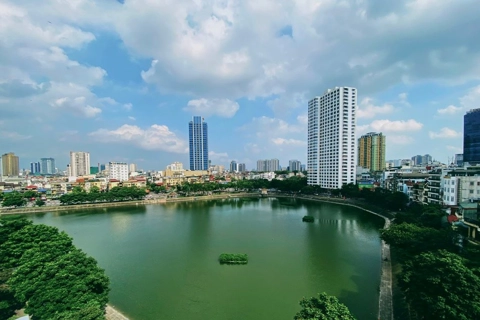
Ngoc Khanh Lake in Ngoc Khanh Ward, Ba Dinh District, with a water surface of about 3.6 ha and a circumference of about 750 m, is a special landscape in a city with a high density of high-rise buildings like Hanoi, offering skyline views and serving as a foreground for adjacent buildings.
The lakefront and promenade are ideal places for meeting, relaxing, entertaining, exercising, shopping, and for residents' businesses and services.
As planned, pedestrianize the route around Ngoc Khanh Lake in Ba Dinh District between Friday at 7 p.m. and Sunday at 0 a.m.
| The today's Ngoc Khanh Lake. Photo: Visit Ba Dinh |

Hoping to preserve the historical value of the time-honored land, Ba Dinh District pays special attention to details reminiscent of Giang Vo Military School in this urban renovation and beautification project. Let's The Hanoi Times unveil the secrets of Ngoc Khanh Lake.
The witness of the capital's history
Few people know that today's poetic and busy Ngoc Khanh Lake in Ba Dinh District was once part of the first National Military School, called Giang Vo Duong.
According to the Complete Annals of Dai Viet, the Giang Vo Hall was built in 1010 under the Ly Dynasty, followed by the Archery Hall in 1070.
In August 1253, Emperor Tran Thai Tong established Giang Vo School. This was the place for practicing martial arts, teaching military strategies and tactics, and performing military drills during these dynasties.
In 1481, the Le Dynasty dug the Hai Tri Lake west of Thang Long (today's Hanoi), which included the districts of Giang Vo, Kim Ma and Ngoc Khanh in today's Ba Dinh District. In the middle of the lake was the Thuy Ngoc Palace, while on land was the Giang Vo Hall, where soldiers and horses were trained and tested.
| Hanoi student learns history of Ngoc Khanh Lake. |
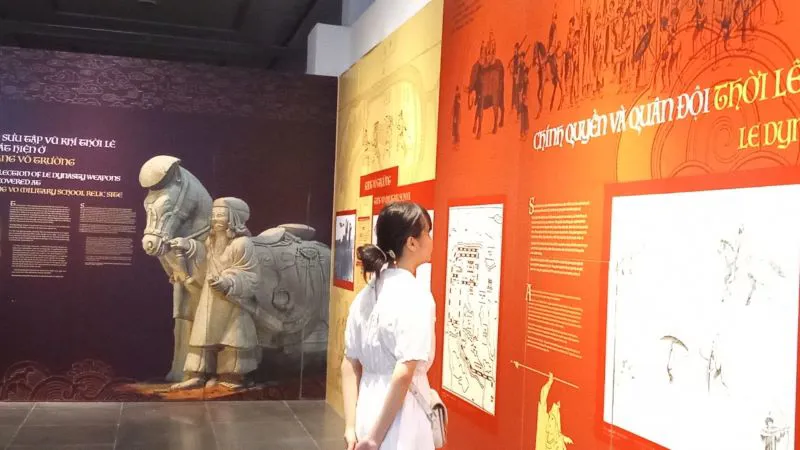
Traces of Vietnam's first military school
In the 1960s, research on the relics of Giang Vo School began after a number of ancient weapons were found at the Cau Giay Intermediate School of Transport, now the University of Transport and Communications, in Dong Da District.
A major turning point came in March 1983, when the Hanoi authorities commissioned a construction project to expand Ngoc Khanh Lake in Ba Dinh District. Digging deep underground, workers found numerous weapons, ceramics, and architectural materials made of wood and terracotta.
As a result, archaeologists conducted excavations and unearthed thousands of artifacts. In 1984, two scientific conferences held by the Ministry of Culture with extensive research reports confirmed that the Ngoc Khanh Lake area was part of the Giang Vo Military School of the Le Dynasty (1428-1527). The artifacts were then handed over to the Hanoi Museum for preservation.
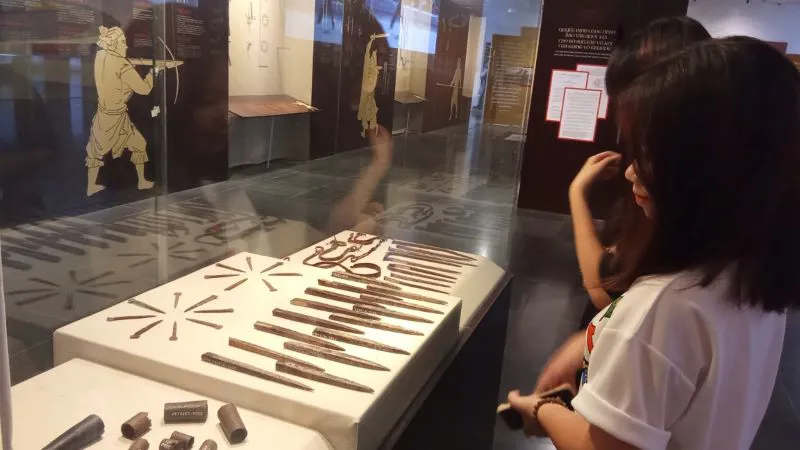
Various weapons unearthed during the expansion of Ngoc Khanh Lake are currently preserved in the Hanoi Museum. |
Treasures under the water
As explained by Nguyen Thi Ngoc Hoa, Head of the Department of Display and Communication at the Hanoi Museum, the Giang Vo School weapons collection consists of 111 artifacts divided into 13 groups according to their function. Nearly 83% of them are white weapons (spears, two-pronged spears, hook spears, pikes, tridents, swords and halberds), and the rest are firearms (signal guns and bullets). The white weapons are mainly melee and ranged weapons, while defensive weapons account for only 1.8%.
Cold weaponry was most developed during the Early Le Dynasty, the Mac Dynasty, and the Revived Le Dynasty, or from the 15th to the 18th century. Until the mid-19th century, according to the Nguyen Dynasty book "Examples of Dai Nam Imperial Ceremonies", the royal army still carried mostly white weapons into battle. The Tay Son army used cannons and various types of firearms, as well.
Most of the weapons are made of iron, with the exception of the stone bullets and signal pistols. Mostly hand-forged, they set the collection apart from any other in Vietnam to date.
| Archaeologists excavated relics under Ngoc Khanh Lake in 1983. File Photo |
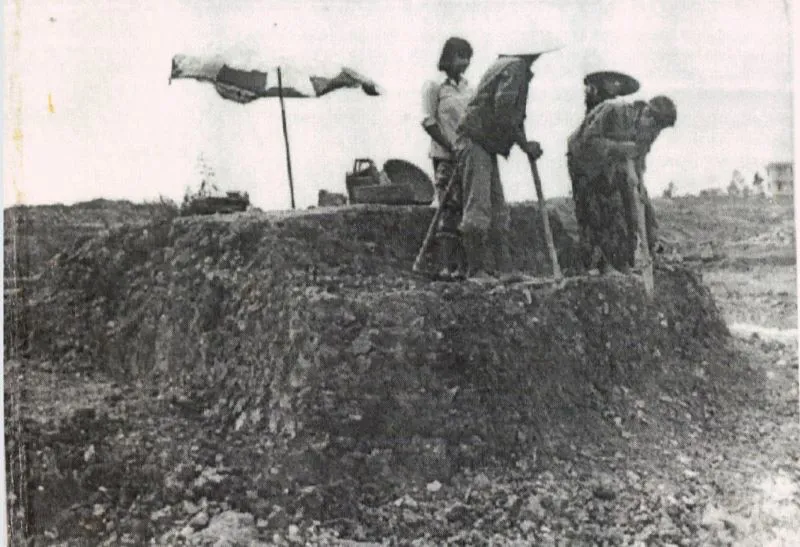
Hoa added that under Ngoc Khanh Lake, archaeologists also found remnants of furnaces, bellows, iron slag, and some unfinished items, which showed that the weapons were made locally. When they were first found, most of them came with bamboo or wooden handles, but the handles are no longer there.
The most precious underground relics
The late Prof. Dr. Do Van Ninh, who directly participated in the excavations, remarked that the Giang Vo School weapons were one of the most valuable sets of underground relics uncovered in Thang Long - Dong Kinh - Hanoi. Most of them were mentioned in the list of military weapons of the Le Dynasty as well as in the "Categorized Records of the Institutions of Successive Dynasties" by Phan Huy Chu. They were probably mainly used to repel northern invaders.
| The collection of ancient weapons from Giang Vo Military School is now on display at Hanoi Museum in Nam Tu Liem District, Hanoi. |
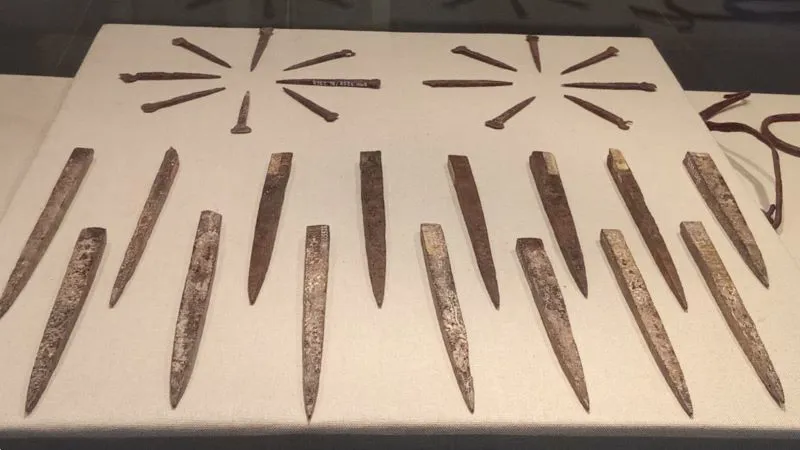
Many other archaeologists commented that the collection was more diverse and solid looking than the Tran Dynasty collection found at But Thap Pagoda (Hanoi) or the spear set found at Tran Quoc Tuan's Palace (Hai Duong Province).
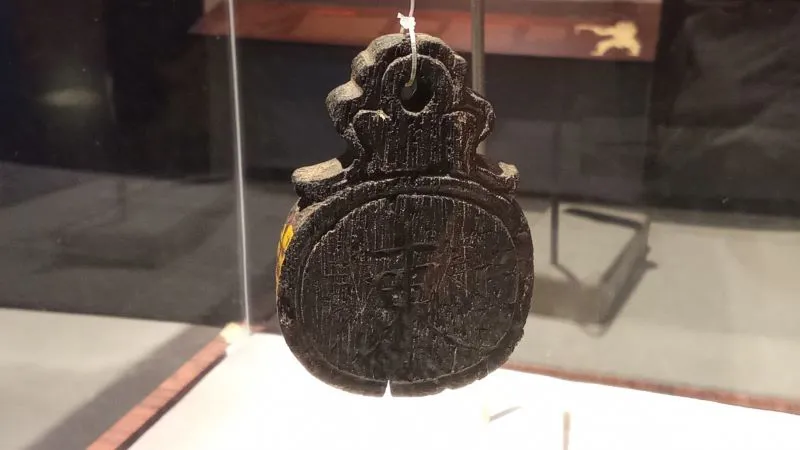
In addition to iron weapons and artifacts, the Ngoc Khanh Lake collection also includes wooden relics, typically the An Dong access control tablet. It was used as a military badge, made of ironwood with a hole to thread a string. Both the front and back are embossed with Sinographic characters that together read "An Dong" in Vietnamese.
"This is a rare relic. From the material and the content embossed on the card, it can be confirmed that it is one of the types of cards that were used as a symbol of an army unit's identity, rank, or branch at that time. This allowed researchers to determine that the Giang Vo School was originally an area for martial arts training, military tactics teaching, and high-level military exercises of the feudal court based in Thang Long - Hanoi," Hoa said.
With the above values, the Giang Vo Military School Weapons Collection has been recognized as a national treasure under Decision No.41 of the Prime Minister of Vietnam dated January 30, 2023. This brings the total number of Vietnam's national treasures to 265.
| The An Dong access control tablet found under Ngoc Khanh Lake. |