Amended Capital Law to govern the city-within-a-city model
Decentralization is key for local governments to be able to fulfill their tasks.
The draft of the amended Capital Law has raised public concerns about the development of cities within a city. The Hanoi Times has received expert feedback on the issue.
Architect Dao Ngoc Nghiem, Vice Chairman of the Vietnam Association for Urban Planning and Development: Special mechanism needed for city-within-a-city model
Hanoi aims to urbanize five rural districts to make them urban districts by 2025 and two more later. Now, the concept of the city-within-city model is being introduced by urban developers. Previously, there was no city subordinate to a first-tier city. The law stipulated that only a province has its subordinate cities.
In 2016, the first city-within-city was established, Thu Duc, a submunicipal unit of Ho Chi Minh City, one of the nation's five first-tier cities.
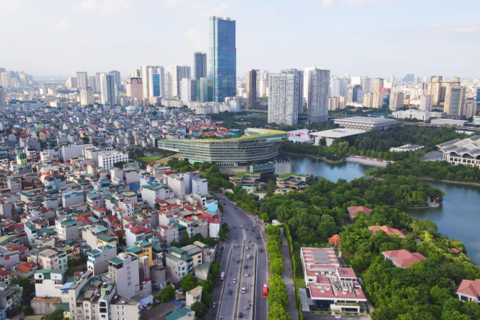
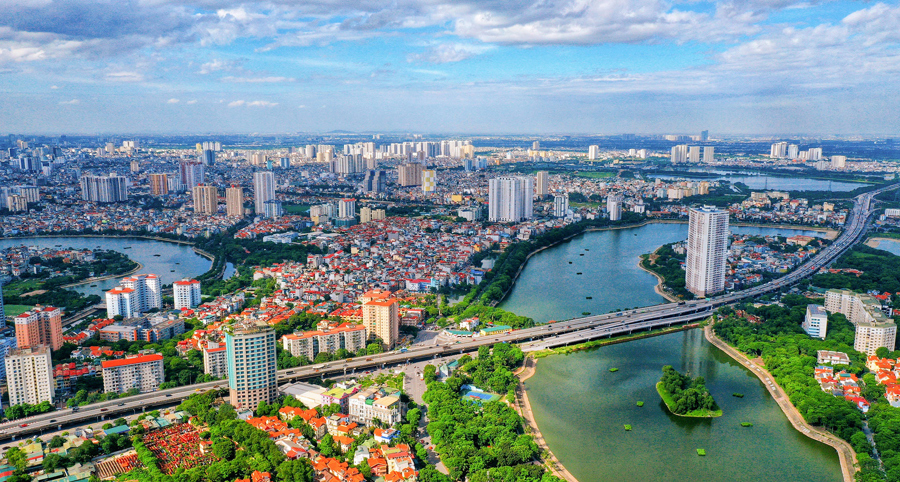
| An urban residential area in Hanoi. Photo: Hoang Ha/The Hanoi Times |
In the case of Hanoi, we need to make special provisions for the capital's satellite cities. The capital's authorities are considering developing two satellite cities, one on the northern side of the Red River with a total area of 633 km2 in Dong Anh, Me Linh, and Soc Son districts. The other, in the Hoa Lac area - Xuan Mai Town, with a total area of 251 km2, is designed to become the capital's center for education and science.
Therefore, Hanoi and its two sub-municipalities need specific regulations for future development.
On the other hand, Hoa Lac-Xuan Mai University town has a huge potential for growth. In addition to the planned areas for schools, students, and businesses, we need modern residential areas to ensure the living standards of local people. It is very noticeable that the local people are a high-quality human resource that will promote scientific study and education. Therefore, there must be preferential policies for these people.
The idea of developing the two sub-municipalities is somehow the most challenging and difficult task for Hanoi authorities to facilitate the growth of its own capital region, the northern delta region, and the northern economic zone. Hanoi must play the role of growth engine in the region and become more proactive in regional connectivity.
Dr. Chu Manh Hung, Chairman of the Board of Hanoi Law University: Decentralization is key to the city-within-a-city model
It is important to control urbanization and reduce the strain on infrastructure in large cities like Hanoi. The capital should be given more power to facilitate the establishment of its sub-cities, where socio-economic scientific and technological drivers are located.
A city-within-a-city unit should be classified in the administrative category of district according to the Constitution and the Law on the Organization of Local Administration. The city-within-city unit will become a highlight in Hanoi's development progress, and legislators must consider the development of such units due to their advantages and progressive features.
The transit-oriented development (TOD) model is another breakthrough, but we need to calculate the appropriate distance between the central area of Hanoi and its satellite cities in order to reduce the population density in urban districts, relieve the pressure on transportation infrastructure, and facilitate the growth of various socio-economic activities. In addition, we should solve the problems with the administrative apparatus to avoid turning the said satellite cities into an extension of Hanoi as Ho Chi Minh City did with Thu Duc.
Assoc. Prof. Dr. Phan Thi Lan Huong - Lecturer at Hanoi Law University: "City-within-a-city model" needs precise definition
The model needs to be studied carefully, as each geo-administrative area has its own characteristics. Developers must fully explore the potential, feasibility, and challenges of a city-within-a-city unit.
The financial resources allocated to local governments must be sufficient to ensure their decision-making authority. The basis for this, known as the income of the capital, must be secure. Therefore, the revenue of the city and the financial allocations to the district and municipal authorities must be prescribed in the amended Capital Law.
In addition, we must comply with Clause 1 of Article 12 of the Local Government Organization Law on the delegation of powers to local governments. Meanwhile, the amended Capital Law needs to clarify how powers should be delegated to local governments in each sector to ensure that the workflow is smooth and that government agencies are unable to neglect and ignore their duties.
The Hanoi authorities need to address key priorities in power decentralization to enable their sub-municipal agencies to be more creative and proactive in their duties, especially in handling administrative processes related to budget allocation, investment, administrative reform, and staffing. The provisions of power decentralization must ensure sufficient income for district-level officials so that they are able to carry out their duties.
Decentralization can only work if government agencies at all levels are able to perform their duties. Under the amended Capital Law, the Hanoi authorities must reform their administrative apparatus, reduce the number of intermediate agencies, downsize the payroll, and adopt technologies to make the capital one of the world's special metropolises.