[Efforts against pollution] Behavior change needed for solid waste management in Vietnam: Experts
Behavior change would result in collective action to help Vietnam fulfill the target of ending single-use plastic products by 2030.
Vietnamese officials and experts have stressed the importance of behavior change in dealing with solid waste in Vietnam, which wastes an estimated US$2.2-US$2.9 billion on recyclable materials per year, according to the World Bank assessment.
| Speakers at the event held at the US Embassy in Hanoi on June 8, from left: Dr. Nguyen My Hang, Dr. Duong Nguyen, and Holly Lindquist Thomas. Photos: Linh Pham |
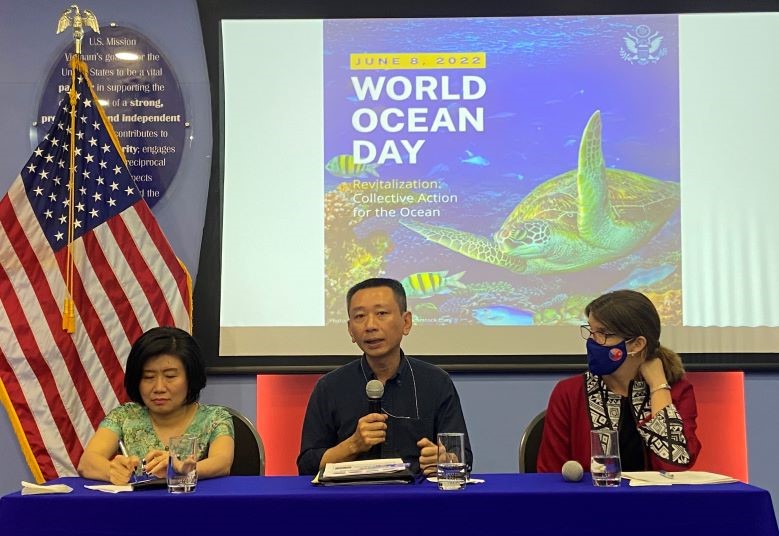
The behavioral transformation toward plastic waste in particular and solid waste in general of individuals, households, to grassroots unions would lead to significant changes in sorting, collecting, treating, and recycling waste. These are the ideas raised at a workshop titled “Let’s Join Hands to Reduce Ocean Plastic” held by the US Embassy in Hanoi on June 8.
Sorting at the site is a kind of action that should be done by each and every individual and the society as a whole to make thorough changes in the joint efforts against solid waste, Duong Nguyen, Office of Climate Change, Energy, and Environment – the United States Agency for International Development (USAID), said at the event that was held on the occasion of the World Ocean Day (June 8).
He said it has become critically necessary to have the participation of everyone, from grassroots communities to higher levels, including youth-women unions and state agencies like urban hygiene companies. The joint efforts from all players would result in combined strengths that are much more powerful than expected, he noted.
The participation of all stakeholders would create collective action, which matters a lot to public attitude towards treating waste, bringing about helpful environmental campaigns, said Dr. Duong Nguyen who has 15 years of working in USAID.
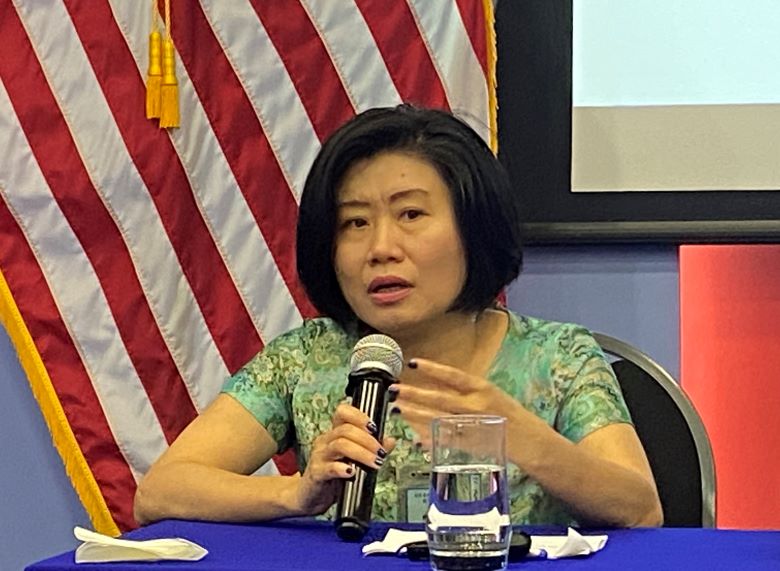
Sharing the same idea, Dr. Nguyen My Hang, Deputy Director of the International Cooperation and Science and Technology Department, Vietnam Administration of Seas and Islands (VASI), said sorting at the site is the initial but important step in which each individual should pay attention to.
Hang said the move is not merely a private activity, but it’s stipulated in law that requires solid waste to be sorted into reusable, recyclable, food, or other kinds.
Echoing Hang, Dr. Trinh Thai Ha, National Manager, Vietnam National Action Partnership, underscored the role of the media in environmental protection and waste management campaigns.
Behavior change would result in collective action to help Vietnam fulfill the target of ending single-use plastic products by 2030, but more efforts are needed in the long-term drive.
| Dr. Nguyen My Hang, Deputy Director of the International Cooperation and Science and Technology Department, Vietnam Administration of Seas and Islands (VASI). |
Keynotes for sustainability
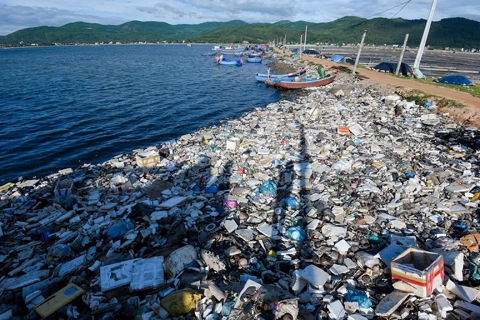
Mentioning the fact that only 6% of total domestically-generated plastic waste in Vietnam was recycled, the speakers pointed out the long-term and sustainable approaches to solving plastic waste in the fact that Vietnam is listed among the top plastic polluters of the world’s oceans.
Dr. Nguyen My Hang said dealing with waste issues requires lots of effort from all stakeholders, with a focus on fostering extended producer responsibility (EPR) in the collection, disposal, and recycling of waste products.
To make the process sustainable, the revised Law on Environment Protection that came into effect in January 2022 highlighted the integration of a circular economy in waste management and recycling. The Ministry of Natural Resources and Environment (MoNRE) is building sub-law documents to accelerate the process.
Hang focused attention on technology assistance and transfer coupled with international support, saying it really helps and is suitable for Vietnam’s context. To that end, the country is looking for different ways to promote innovative solutions, material recovery, and recycling to combine appropriate management mechanisms. In addition, she said a regional or international monitoring mechanism for transboundary plastic waste is necessary.
Meanwhile, Dr. Trinh My Ha stressed the need for multi-stakeholders in the common drive, taking the National Plastic Action Partnership (NPAP) as an example of a government-backed and cross-sectoral partnership.
Launched in December 2020, NPAP is the official initiative supporting the implementation of the national scheme for advancing plastic waste management. It helps unlock finance, boost innovation, provide strategic guidance and advance the development of key deliverables.
Duong Nguyen underlined the sustainability of managing solid waste, noting that plastic waste should be incorporated into policies and solutions for solid waste. He argued that the issue requires a long-term and multisectoral approach for sustainable growth.
He stressed that locally-led actions should be taken widely and effectively to benefit residents first and society in the long run.
| Holly Lindquist Thomas, Environment, Science, Technology and Health Officer from the US Embassy in Hanoi. |
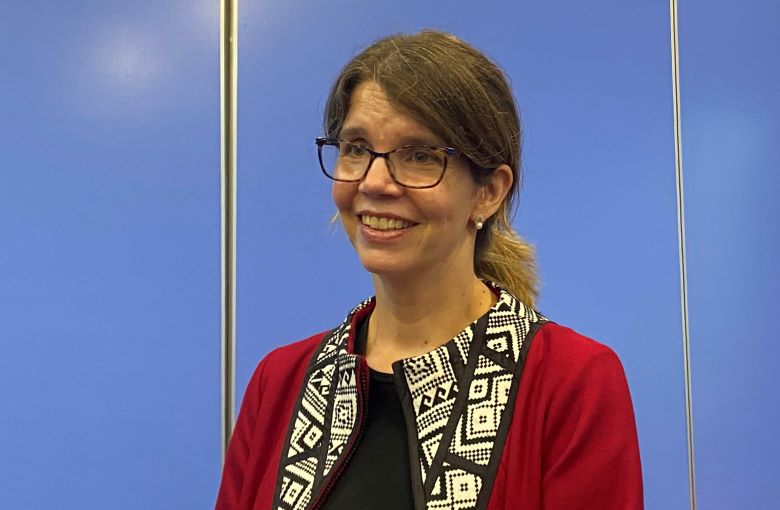
Meanwhile, Holly Lindquist Thomas, Environment, Science, Technology, and Health Officer from the US Embassy in Hanoi, stressed the necessity of action across all categories: government, companies, non-governmental organizations, students, and all visuals.
She suggested people think about using plastic, especially single-use plastic products, and encouraged them to engage in cleanup efforts to help keep trash from finding its way into Vietnam’s lakes and rivers.
“We must act today if we are to reverse one of the greatest environmental disasters of our lifetimes,” she noted.
At the conference, all experts stressed the importance of collective action, behavior change, capacity building, circular economy, and legal framework for this time-consuming task.
In this regard, USAID-supported typical projects design and implement holistic strategies that promote the waste value chain from production to end-use prioritizing the most inclusively reliable and environmentally sustainable solutions.
The USAID Vietnam Local Solutions for Plastic Pollution (LSPP) project in 2020-2023 aims to empower local communities to build collective action from the group up to reduce plastic pollution through strengthening and uniting networks to mobilize citizens and businesses.
The USAID Reduction Pollution project for 2021-2026, which aims to reduce environmental pollution through a collective impact approach, supports behavior change among a variety of social stakeholders, including local communities, social organizations, policymakers, and the private sector.
The USAID Vietnam Action Against Plastic Pollution project in 2022-2027 covers key targeted cities like Hanoi, Ho Chi Minh City, Mekong Delta, and Red River Region in reducing ocean plastic pollution at its source through strategic approaches with enhancing knowledge sharing, promoting appropriately scaled technology, and building capacity of local governments.
![[Efforts against pollution] Solutions for reducing plastic waste](https://cdn-media.hanoitimes.vn/2021/11/19/Cover.jpg?w=480&h=320&q=100)