Vietnam to ban disposable plastic bags at supermarkets from 2026
disposable plastic bags will be replaced with environmentally friendly alternatives by 2025.
Retailers including supermarkets and shopping malls in Vietnam will have to phase out disposable plastic bags as of 2026, according to the Ministry of Natural Resources and Environment (MoNRE).
The new ban is expected to replace all disposable plastic bags, which are commonly used for packaging, with environmentally friendly alternatives. Violators will be fined.
Many supermarkets in Hanoi have used banana leaves to pack food instead of plastic bags. Photo: Viet Dung |
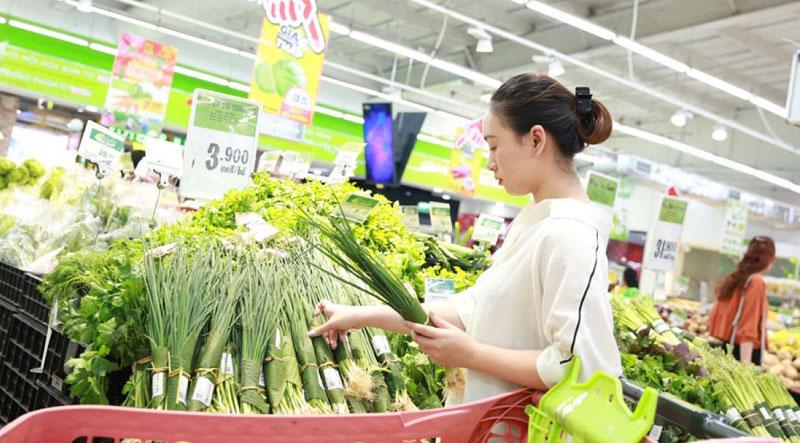
He cited a survey by his institute showing that up to 104,000 single-use plastic bags are used at supermarkets a day on average, equivalent to 38 million bags a year. Among the 48 supermarkets polled, 46 are providing free plastic bags, thus, each supermarket gives out some 1,454 nylon bags per day.
The PLASTIC ALLIANCE gathers 16 retailers that pledge to reduce the use of disposable plastic bags. This is part of the “Rethinking Plastics - Circular Economy Solutions to Marine Litter in Vietnam” project funded by the European Union (EU) and the German Government and carried out by Expertise France.
Fanny Quertamp, a representative of Expertise France, said the project's communication activities have been widely deployed in various forms, spreading the message of reducing plastic bag consumption to customers.
The alliance has stepped up communication with retailers either face-to-face or online on social media platforms with the aim of changing consumers’ towards moderating the use of single-use plastic bags and plastic products.
However, single-use plastic bags right now still remain popular. According to data released in 2021 by the MoNRE, plastic waste accounts for 7% of the solid waste discharged every day in Vietnam or nearly 2,500 tons.
Nguyen Trung Kien, a 39-year-old resident in Nam Tu Liem District of Hanoi, talked about a shop that sells sticky rice in front of a primary school near his house. Around 200 portions could be sold in a single morning thanks to the public awareness of environmental protection. "Everything is made from single-use plastic, from the container to the spoon to the plastic bag used to carry them."
“So 200 plastic bags, spoons, and containers go to the trash can every morning. And I am talking about a single breakfast stall at an ordinary school. Imagine how many stalls there are in a city or a country? Plastic waste can now be found in every corner of this planet. Everyone can already see how damaging it is to the environment,” Kien told The Hanoi Times.
Many supermarkets in Vietnam have pledged to replace plastic bags with environmentally-friendly materials. Photo: Thanh Hien |
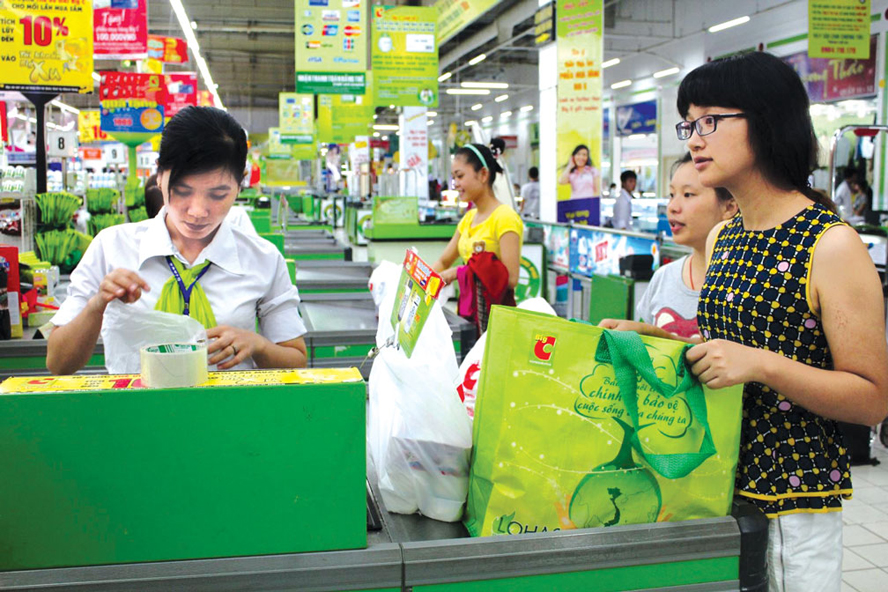
“In Vietnam, as long as we lack solutions good enough to treat plastic waste, we should move forward with a ban on such products. The prohibition of single-use plastic is certainly going to be disruptive, but nothing can disrupt human's capacity to adapt,” he added.
“We can still enjoy our sticky rice breakfasts wrapped in banana leaves, something we did for years before plastic came along. Who needs plastic straws when there are bamboo alternatives?” Kien asked the questions.
“At the very least, we each can do our part simply by using less single-use plastic. We can use recyclables or opt for a fabric bag when going to the supermarket,” he suggested.
Nguyen Thi Phuong, deputy general director of Hanoi-based WinCommerce shared with The Hanoi Times that her group is gradually creating a community without disposable plastic bags by facilitating the habit of refusing and minimizing the use of those bags.
“We intend to dedicate a counter just for customers who say no to plastic bags, improve the packing procedure at the cashier counter to reduce the average number of bags per transaction from five to three, display eco-bags in demand-triggered areas, and offer free eco-bags for customers with an invoice of more than VND300,000 (US$12),” Phuong said.
She added that her group will put forth some initiatives to reduce the habit of using single-use plastic bags such as the “one day without using plastic bags” campaign and offer refunds or discounts for customers who do not use plastic bags.
“We hope that these activities will help reduce plastic bags in Hanoi and across the country,” Phuong said.