Foreign businesses set to beef-up cattle imports
Vietnam’s growing demand for high-quality beef is creating significant trade opportunities for foreign businesses.
 |
|
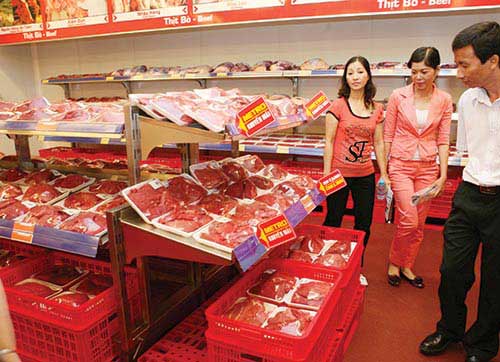
Foreign firms are making the most of growing consumer demand for high-quality beef |
Le Van Tu, vice director of investment consultancy Japan-Vietnam Commercial Investment Company, said the company was helping Japan’s Ogawa Company to implement a project to raise cattle and process beef in Hanoi’s Ba Vi District.
“The beef will be for the domestic market,” Tu said, adding that Japan’s Sanei Company was also likely to follow suit.
Vietnam had major potential for beef production. While the country had to import a big volume of beef annually at high prices, local production could help cut costs, he said.
According to Australia’s Meat & Livestock Australia Limited (MLA) report published late last month, Vietnam’s emergence as a live cattle market has helped ease prices, with shipments from Australia to Vietnam forecasted to almost double year-on-year to 130,000 head. Shipments comprise mainly of slaughter and feeder cattle, and demand is likely to remain robust over the coming years, given the reported depletion of the national cattle herd and strong beef demand in the region.
Aggregate shipments to Vietnam increased substantially year-on-year, reaching nearly 131,400 head for the July 2013-June 2014 period – eight times greater than 2012-2013.
According to MLA, Australian cattle imports into Vietnam increased from 128 head in 2009 to 1,427 in 2010, 1,276 in 2011, 3,353 in 2012, 66,953 last year and are expected to reach 130,000 this year, representing an increase of 94 per cent over 2010-2014 and making Vietnam the second largest importer of Australian cattle in the region after Indonesia.
Vietnam currently imports 12.5 per cent of Australia’s total live cattle exports.
Under the establishment of the ASEAN-Australia-New Zealand Free Trade Agreement in 2009, imports of Australian beef into Vietnam are subject to a tariff of 7 per cent.
Ross Ainsworth from Australia’s market intelligence service Beefcentral.com said the Vietnamese beef market had many different driving forces when compared to other customers. Vietnam has capacity to sell local cattle and processed beef into China.
“The 90 million population has a much flatter wealth profile compared to other Southeast Asian countries with less very poor and less very rich people. The vast majority are in the middle class and can afford to buy a wide variety of food products including small quantities of very expensive beef,” Ainsworth said.
“Vietnam is at a take-off stage for beef imports,” said Joel Haggard, the US Meat Export Federation’s (USMEF) senior vice president for the Asia Pacific region on Beef.
“Restaurant infrastructure is developing rapidly and this is reflected in the surge in orders for imported beef.”
Locally-owned Vissan Limited Company’s general director Van Duc Muoi said Vissan had begun importing Australian live cattle for slaughter in Vietnam last September as this beef was more competitive than locally-sourced alternatives, both in terms of price and quality.
French firms are also looking to export beef into Vietnam, in anticipation of the Vietnam-EU Free Trade Agreement set to cut tariffs.
Some restaurant chains have grown to the point at which they can purchase full container loads of beef directly from US exporters. Most of this growth has focused on Ho Chi Minh City and Hanoi markets, but operators are now looking at other urban areas such as Danang and Haiphong.