Hang Trong folk print- a touch of the legacy in the modern life
Hang Trong folk prints are the traditional trait of an ancient capital. The seemingly forgotten technique has been awakened recently.
Just plain folk
Hand-painted or wood-engraved paintings are on display at a wet market stall next to meat and vegetables are barely seen anywhere in the world. In Vietnam, though, it’s a common sight.
People put these pictures on the family altar as well as hang them on the walls. At certain times of the year- particularly Tet, the Lunar New Year – they are considered an indispensable element of the occasion.
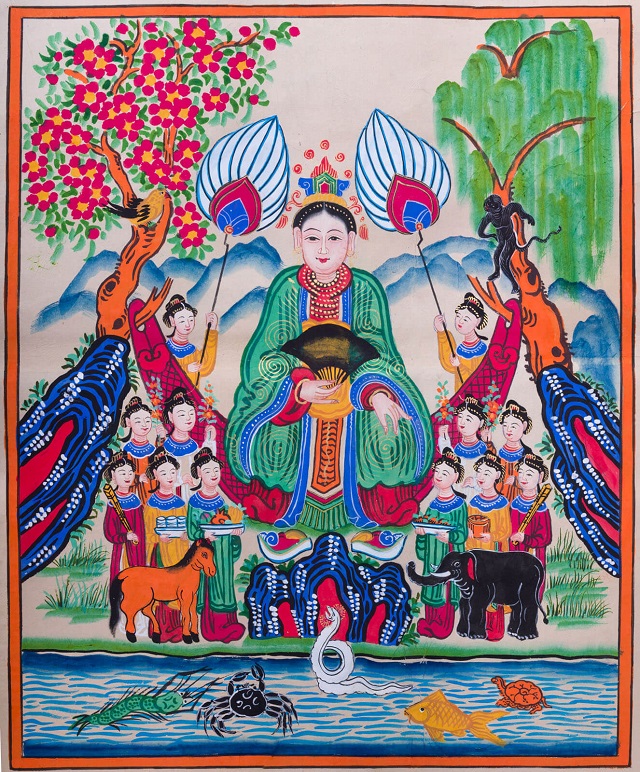
| The painting called Mau thuong ngan - Mother Goddess of the Forest. Documentary photo. |
Hang Trong folk print - a combination of traditional cultural values with ancient artistic methods contributed to the development of folk painting craft, making it flourish once upon a time.
Ever since the 1970s, Hang Trong prints have been on sale all over Hanoi three weeks before Tet. The paintings were once very popular among Vietnamese and had been displayed for sale on the ancient streets of Hang Trong, Hang Non or Hang Quat in Hanoi’s Old Quarter area.
The paintings had set their place deeply in the soul of Hanoian and remained its feature unchangeable in spite of the upheavals of the times.
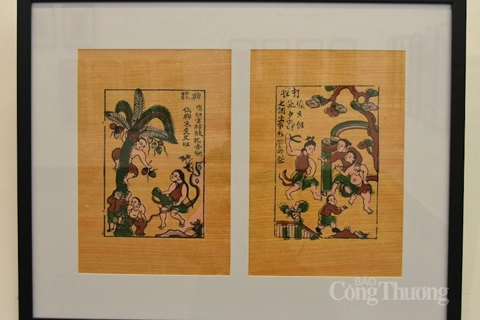
Hang Trong folk painting uses wood carving technique to print colorful inks on ‘do’ paper. In making a painting, the craftsman starts with woodblocks to print black outlines, then draws the details and finally colours the picture in by hand.
Woodblock making is the most important part of the painting producing process, which must be made by skillful craftsmen. The person who created the first-ever painting on woodblock is usually the best one among craftsmen. His dedicated skillful drawing will decide the beauty of a Hang Trong painting later. It might take months for a craftsman to finish a sophisticated printing sample.
The imprints of the ritual and daily life
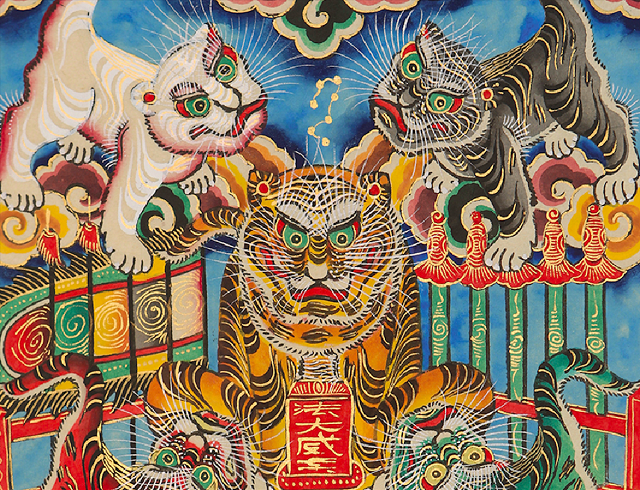
| The Ngu ho - Five Tigers. Documentary photo. |
Hang Trong paintings have vivid colours that reflect the beauty and rich culture of the community where they are originated. The folk paintings portrayed themes that associated with Vietnamese daily life such as: Tet paintings, worshiping paintings and paintings that depict people daily activities.
The subjects of paintings are also in variety including Tu quy - four specious kinds of trees and flowers of pine, bamboo, chrysanthemum and apricot; Ngu ho - Five Tigers; Ly ngu vong nguyet - Carp Looking at the Moon; To nu - Four female musicians; Chim cong -peacock, Tam Da – three gods symbolising longevity, prosperity and happiness; Cho que – rural market, Mau thuong ngan - Mother Goddess of the Forest; among others.
One of Hang Trong’s best loved images is the Carp Looking at the Moon. The carp symbolized the strong will. According to legend, it refused to accept the fate of ordinary fish and won a contest to cross the Rain Gate, thus becoming a dragon, king of all aquatic creatures.
| The Ly ngu vong nguyet - Carp Looking at the Moon and Chim cong -peacock |
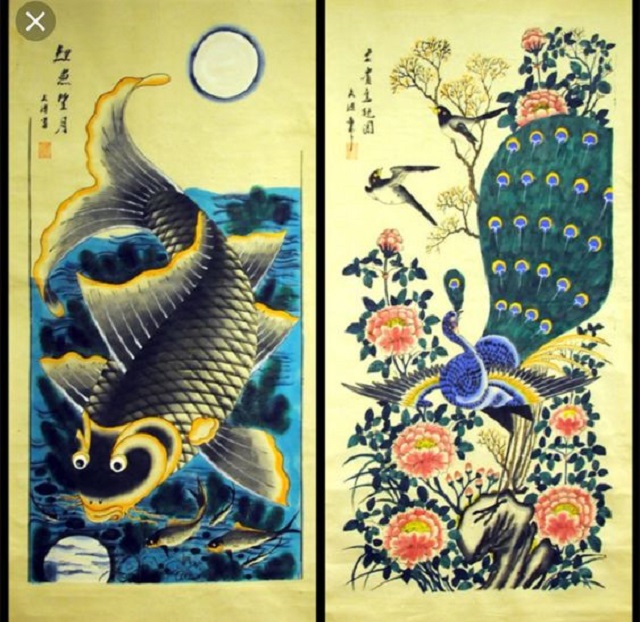
Another revered image of folk painting is that of the tiger, a sacred image and a symbol of strength. There used to be many tigers in Vietnam, they were believed to be capable of defeating demons. A tiger image of the front door protects a house from evil forces.
The painting of “Little Seven” is originated from the old opinion as “the more children, the greater the parents’ happiness”. For rice growers who need manpower for planting and the harvest, children were literally a source of wealth.
Strives for the folk prints’ preservation
However, the craft is fading now as there remains only the family of artisan Le Dinh Nghien who still practices it. There are no longer any household in this increasingly fashionable and touristy street devoted to the craft. “There is not much demand these days,” said the artisan, “But that means I have time to improve the quality of my picture, as well as to teach the skill to younger artisans.”
In order to resurrect this genre of traditional art, some painting projects and classes are also opened by Hang Trong ward authorities to help transmitting knowledge of making pictures from old craftsmen to young artists.
| Visitors admire Hang Trong paintings at Nam Huong communal house. Photo: Lai Tan. |
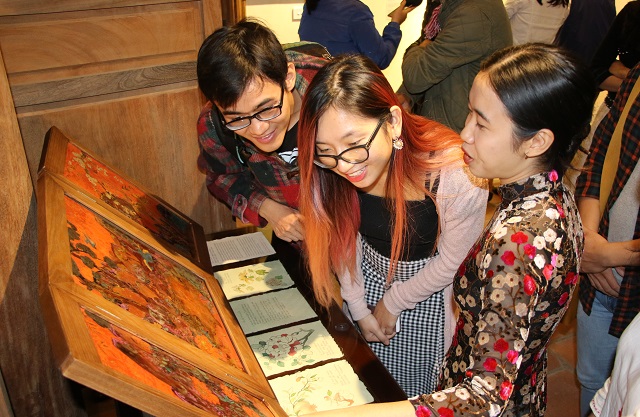
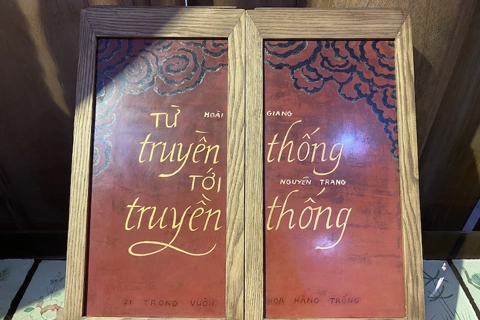
One among preservation efforts of Hang Trong folk prints was the project entitled "From tradition to tradition", launching by Hang Trong ward authorities and Vietnam University of Fine Arts in late 2020.
The project ‘From tradition to tradition’ means creating Hang Trong folk painting on Vietnamese traditional materials, namely try painting the ancient patterns on silk and lacquer, which is the intermingling of the two traditional values, instead of sticking to zo paper.
“One interesting thing about this folk art is that Hang Trong painting was born, developed and flourished right on this street. After a half of century, it almost disappears right on the same street,” said artist Nguyen The Son, teacher from Vietnam University of Fine Arts.
| New experiment: Hang Trong folk painting on lacquer and silk. Photo: Thoi Nguyen. |
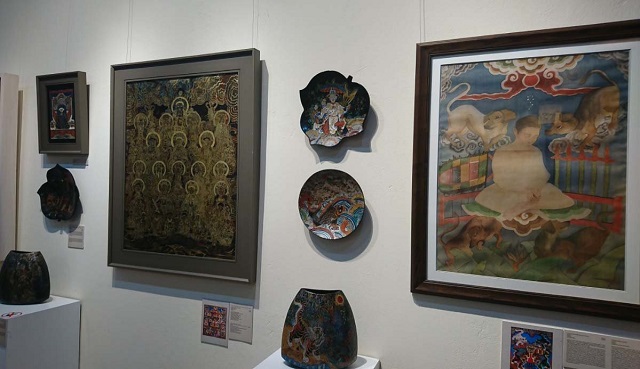
According to the artist, through the painting project, the artists wished to reconnect the ruptured history flow. Young painters, beside paying attention on their individual creativity, need to recognize and connect with the past heritage, and having the sense of national indigenous culture and tradition.
When approaching Hang Trong folk paintings, young artists and art students not only respect the cultural, artistic and historical values, but insert some creative features into the paintings.
They also draw them in the new material of silk or lacquer. Thanks to that, the folk prints began to have a new vitality, getting out of the classical motifs, not just the paintings themed a flower vase or decorative plates on zo paper for adorning the walls.
Hang Trong painting is a familiar folk painting line of Vietnamese people. However, with the skillful drawing techniques and vivid stories shown in the paintings, it is believed that the contemporary Hang Trong folk prints will bring a new vivid appearance that would enrich nonmaterial life of Hanoians as well as Vietnamese people.