Hanoi finds optimal solutions to sort solid waste at source
The capital needs to quickly issue technical guidelines for the sorting of waste at the source.
Hanoi has been looking for optimal solutions for waste treatment, an environmental expert said, suggesting that new modern waste treatment facilities and waste sorting at source are key to improving the city's waste treatment capacity.
According to Nguyen Huy Nga, former director of the Department of Environmental Management under the Ministry of Natural Resources and Environment, Hanoi has promoted solid waste management while raising public awareness of environmental protection, helping Vietnam as a whole reach the target of processing 96% of urban household waste by 2023.
However, the treatment of domestic solid waste is not only a challenge, but also a vital issue for the capital's sustainable development now and in the future. Therefore, Hanoi has been looking for optimal solutions to sort solid waste at source, Nga said.
He stressed that the key point is to sort waste at the source, as required by the Law on Environmental Protection 2020. This will help reduce overloading of landfills.
First, the city should identify the most important solid waste treatment technologies in the coming years so that appropriate measures can be taken. For example, whether to sort food waste for composting or burial or what kind of solid waste to burn to generate electricity.
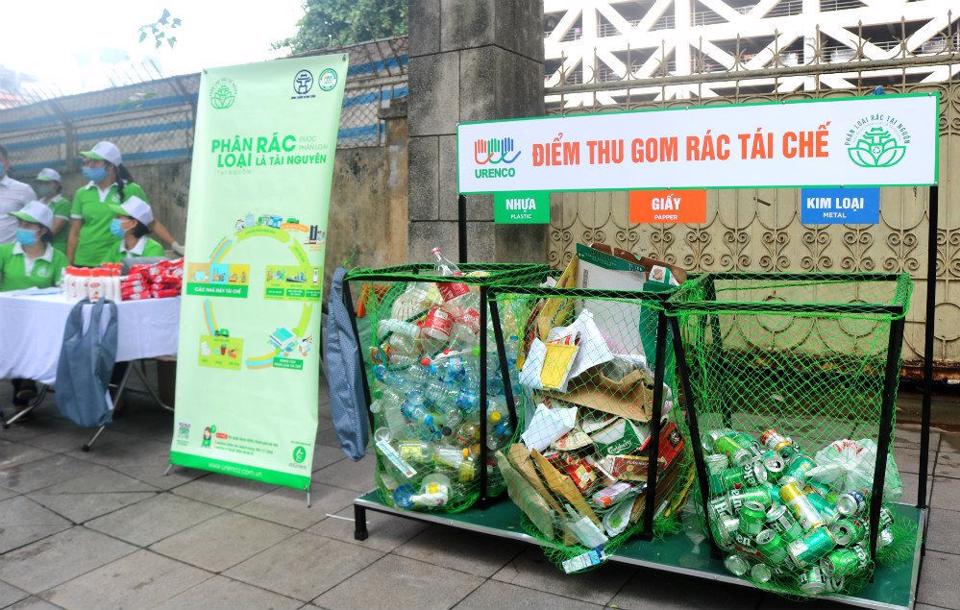
Recyclable waste collection point in Phan Chu Trinh Ward, Hoan Kiem District, Hanoi. Photo: Lam Thanh |
“The city must quickly issue technical guidelines on waste sorting at source. It is possible to pilot in some districts and then replicate good models,” Nga said.
He noted that the most important for sorting solid waste at source is to raise people’s awareness. One of the main reasons for the failure of previous projects to sort waste at source is that people are not aware of their important contribution to the city's environmental protection and they have not adopted waste sorting habits.
The municipal authorities should keep regular communication to raise people's awareness and schools in the city should teach students how to sort waste at source so that they can apply it at home, Nga suggested.
Another crucial aspect is for Hanoi to develop a specific policy on environmental fees and penalties, and at the same time, a very specific policy to create a competitive environment for businesses to participate in waste collection, treatment and recycling.
Moreover, the application of sanctions is also an effective solution to enforce waste classification regulations at source in the near future. According to Nga, burying garbage must be stopped to prevent pollution.
"No matter how advanced waste treatment technology is, waste must be sorted. This not only meets the processing requirements, but also helps ensure the durability and longevity of the processing system and machinery. Only when waste is classified according to the right standards can harmful emissions from the incineration process be prevented," he added.
Statistics from the Hanoi Urban Environment Company (Urenco) show that the city generates about 7,000 tons of solid waste every day, of which 51.9% (more than 3,600 tons) is food waste and only 7.1% (about 500 tons) is recyclable solid waste. At present, domestic solid waste is mainly collected and taken to landfill, accounting for 98%, only 2% of domestic solid waste is treated by incineration method.
Urenco is working on a waste segregation plan for power generation that will separate waste into many categories, such as: recyclable, organic, combustible and noncombustible.
Garbage will be divided into two categories: recyclable and non-recyclable. The main goal is to reduce the amount of waste in Hanoi's landfills. The city's two large landfills are now overloaded. In the long run, landfills will no longer be a suitable solution for waste disposal.
The Nam Son Waste Treatment Complex receives an average of 4,000 tons of waste per day, while the Xuan Son Complex receives the rest in the form of combined incineration and burial.
According to Hanoi's Solid Waste Management Plan to 2030 with a Vision to 2050, there will be 17 waste treatment zones with a capacity of up to 1,200 tons per day.
The Hanoi Department of Natural Resources and Environment is also developing a solid waste management plan that focuses on treating waste and plastic waste for recycling, promoting the development of circular economy models, sorting waste at source, collecting, reusing, recycling and treating.