Hanoi People’s Council set to ratify capital planning until 2045 in late March
The planning project is expected to not only help alleviate population density in the inner city area but also serve as a driving force for the sustainable development of the capital city, namely the city-within-a-city model.
The Hanoi People’s Council is set to discuss and ratify the revised master plan of the capital until 2045, with a vision to 2065, at its 15-hour thematic session, scheduled on March 29.
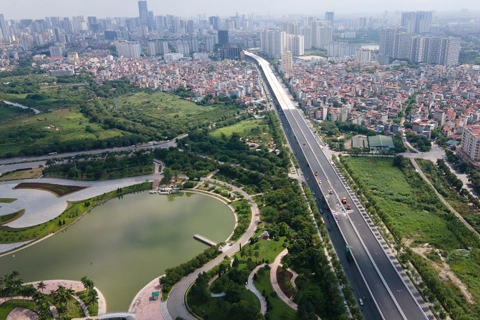
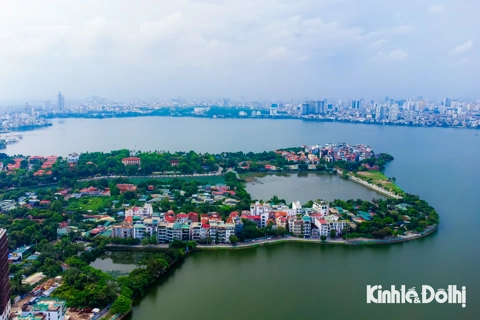
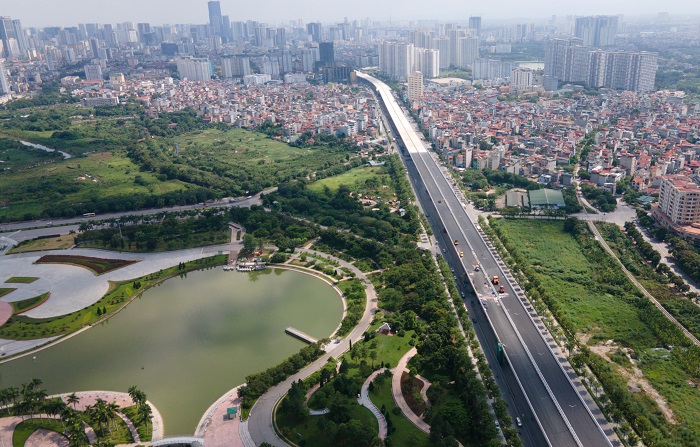
| Hanoi from above. Photo: Pham Hung/The Hanoi Times |
Finalizing the capital’s spatial structure
During the review session of the Hanoi master plan for the period 2021-2030, with a vision towards 2050 (the Capital Plan), held at the end of February 2024, Hanoi Party Secretary Dinh Tien Dung emphasized in refining the plan, the city would instruct consulting units to further emphasize the perspective of harmonious urban-rural development aimed at continually improving the quality of life for residents in both urban and rural areas.
Regarding urban development, satellite urban development under the TOD (Transit-Oriented Development) model, with the concept of a 15-minute city, will be promoted.
Inner-city areas will undergo renovation, restructuring, and modernization to enhance urban quality while avoiding premature urbanization of rural areas. Planning efforts will identify urban development areas, and during the planning process, these areas will be designated as urban once they meet the specified criteria, he noted.
In the immediate future, the city will consider forming two satellite cities to the north and west, with the possibility of adding a southern satellite city in the future.
According to Architect Le Hoang Phuong from the National Institute of Urban and Rural Planning (Ministry of Construction), the consulting unit responsible for revising the General Plan of Hanoi Capital until 2045, with a vision towards 2065, one noteworthy aspect of the plan is Hanoi's identification of certain urban areas for development as "cities within the city" with specific mechanisms and policies tailored to the capital.
At each development stage, standards will be set for urban administrative units, and proposals will be made by the National Assembly and the Government to establish urban administrative units such as cities or districts to align with the development requirements, he noted.
In the immediate phase, Hanoi will explore the establishment of two satellite cities, namely the Science and Education City (West City) in the Hoa Lac area and the Airport City (North City), encompassing parts of Dong Anh, Me Linh around Noi Bai International Airport, and Soc Son District. The North City will cover an area of 633km2 (including 385km2 of urban construction land and 248km2 of suburban land), focusing on service functions and international integration linked to Noi Bai International Airport. The West City will cover an area of 251km2 (including approximately 135km2 of urban construction land and 116km2 of suburban land)and will serve as a hub for science, technology, and education.
Regarding the formation of a third city in the Phu Xuyen, Ung Hoa, My Duc areas upon the construction of the second airport in the Capital Region, Hanoi Vice Chairman Duong Duc Tuan stated that the overall plan for developing the national airport system during the period 2021-2030, with a vision towards 2050, has identified the second airport in Hanoi with a capacity of 50 million passengers per year, to be studied after 2030 and implemented by 2040.
With this airport, Hanoi will build a Southern City between 2045 and 2065.
“In addition to building two cities in the north and west by 2045, the addition of a third city in the subsequent phase will complete the spatial structure of Hanoi,” Tuan said.
As a result, the development of the capital will not be concentrated in the central area alone, as is currently the case, Lan said.
“However, the creation of cities within cities requires them to be identified as urban areas with comprehensive and complete investments to ensure residents' peace of mind in living and working. It is especially crucial to ensure a distance and green spaces to differentiate them from the central city,” Lan continued.
"In essence, they are still satellite cities. When they become 'sufficiently large' and 'sufficiently robust, and meet all the criteria, they will be recognized as cities within cities. This model differs only from satellite cities in terms of administrative management mechanisms, development policies, and decentralization to create development incentives," stated Lan.
Architect Truong Van Quang, Deputy Secretary-General of the Vietnam Urban Development Planning Association, mentioned that the mega-city model, with millions of inhabitants clustered around a single core, has become obsolete due to overpopulation, traffic congestion, environmental pollution, social ills, and wealth disparities.
Compared to the development of massive megacities, the development of clusters of large and small cities with multiple centers within major cities, integrated into the urban network, is seen as a more sustainable and harmonious development solution, Quang said.
“We can look at examples from other countries such as the administrative region of Haut-de-Seine and Paris (France), Pudong in Shanghai (China), among others. Developing modern new cities has attracted over 500,000 new residents, mostly highly educated labor while focusing on renovating and improving the lives of one million existing residents,” Quang noted.
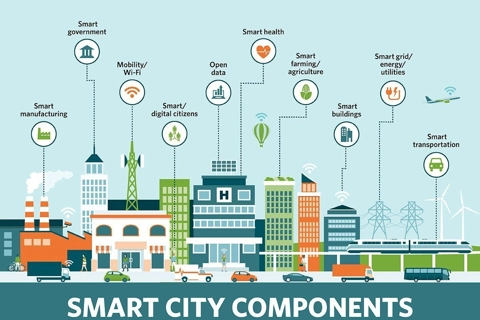
Quang expected these areas to encourage the exploration of new dynamic sectors (international finance, high technology, digital technology, biotechnology, and others), which would bring the highest economic and social benefits. Sustainable development, smart cities, underground cities, and green cities following international standards will minimize environmental impacts and effectively address climate change.
According to experts, the development of city-within-city models must consider the values they bring. Developing city-within-a-city models means changing or having to change the current mindset about economic and urban development and management to be suitable for development requirements, thereby creating new values. These values must be people-centered to prevent the development of city-within-a-city models from becoming a wasteful resource-consuming trend.
“The city-within-a-city model has been developed by many countries worldwide and has yielded encouraging results. Developing the city-within-a-city model involves restructuring the "parent" city to make more effective use of its potential in the urbanization process, urban development, and urban economy. Although it is a "child" city, it presents an opportunity to make breakthroughs in socio-economic development by serving as a nucleus, driving innovation, and leading the overall development of the entire city and its surrounding area,” Truong Van Quang, Vice Secretary of the Vietnam Urban Development Planning Association. |