Log in
Hanoi

Hanoi to build ten more bypasses for pedestrians

Currently, the Hanoi People’s Committee has approved projects to build four pedestrian bridges.

Hanoi will build another ten overpasses in crowded streets and across the To Lich river with a view to reducing traffic congestion and ensuring pedestrians’ safety and convenience, local media reported.

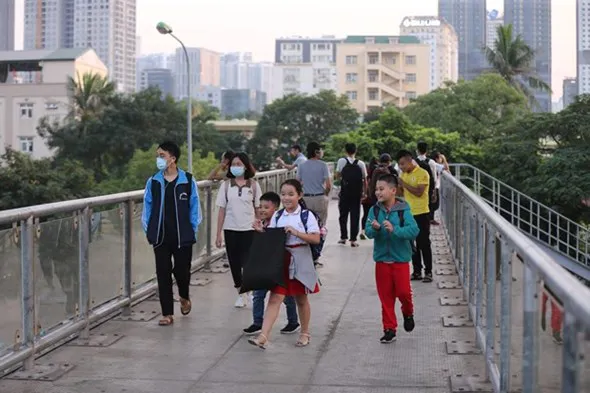
Accordingly, seven steel structure framed pedestrian overpasses will be built along the routes of Nguyen Trai in Thanh Xuan district, Lang in Dong Da district, Nguyen Van Cu in Long Bien district, and three other overhead bridges across the To Lich river.

 Illustrative photo

Currently, the Hanoi People’s Committee has approved projects to build four pedestrian bridges. Of them, one is located at the T-junction of Trieu Khuc road in Thanh Xuan district and three in Nguyen Van Cu street in Long Bien district.

All the four bridges will be assembled with steel structure and surface drainage system. The construction is scheduled to finish in 2020.

In reply to the municipal Department of Planning and Investment’s requirement on evaluating the possibility of building three pedestrian bridges across the To Lich River and three bridges along Lang street, the Department of Transport said these constructions are necessary and urgent.

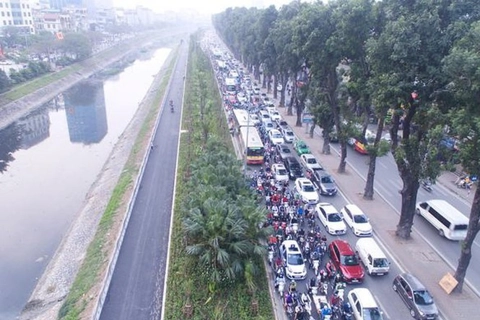
There is a high density of offices, schools and vehicles in Lang street. An increasing number of pedestrians cross Lang street and To Lich river everyday.

Three bridges include To Lich 1 bridge, which is located between the Cot and 361 bridges, To Lich 2 bridge, halfway between 361 and Trung Hoa bridges, and To Lich 3 bridge in the middle between Trung Hoa and Hoa Muc bridges. Each bridge has an estimated length of 40 meters.

The pedestrian bridges along Lang road includes Bridge No1 locating near 1174 Lang road with a length of 43m, Bridge No2 near 778 Lang road with a length 33m, and Bridge No3 near Lang Ha market with a length of 41m.

According to the department, Lang street runs through three big districts including Thanh Xuan, Dong Da and Cau Giay, and links Hanoi’s downtown with Noi Bai International Airport. It has a high density of vehicles, posing risks for pedestrians and bus riders as the bus stops are far from existing bridges.

Reactions:
Share:
Trending
Most Viewed
Related news
Hanoi gears up for a vibrant 2026 Countdown

Hanoi gears up for a vibrant 2026 Countdown

With the energy of thousands gathering in Hanoi downtown, the Countdown 2026 promises to be an unforgettable way for people to welcome the New Year.

Hanoi launches AI-powered traffic control center for traffic violations

Hanoi launches AI-powered traffic control center for traffic violations

The system automatically detects common violations, significantly reducing the need for traffic police to be deployed directly on the streets while improving accuracy and transparency in traffic management.

Hanoi plans 10,000-hectare urban megacity with world-class stadium

Hanoi plans 10,000-hectare urban megacity with world-class stadium

The stadium’s design draws inspiration from Dong Son bronze drums and the Lac bird motif, symbolizing Vietnam’s aspiration to rise.

Hanoi greenlights Olympic sports city and Red River boulevard to drive next growth phase

Hanoi greenlights Olympic sports city and Red River boulevard to drive next growth phase

The approval of two landmark projects underscores Hanoi’s push to unlock new growth engines, reshape its urban structure and accelerate its ambition to become a green, smart and globally connected capital.

Hanoi targets 1,200 supporting industry firms by 2030

Hanoi targets 1,200 supporting industry firms by 2030

The city aims to enhance the competitiveness of the capital’s industrial sector by tightening cooperation with Vietnamese enterprises and multinational corporations operating in Vietnam.

Red River Boulevards shape Hanoi’s new growth axis

Red River Boulevards shape Hanoi’s new growth axis

The creation of a landscape boulevard can help Hanoi reconnect with its historic identity shaped by water and restore the river-based character that defined the city for centuries.

Hanoi moves to strengthen urban order and civility

Hanoi moves to strengthen urban order and civility

These include expanding public communication efforts, reorganizing and upgrading streets and sidewalks, maintaining a clean and orderly urban environment and carrying out strict inspections to address violations.

Hanoi honors 87 entities and buildings for using green energy

Hanoi honors 87 entities and buildings for using green energy

Enterprises adopted highly automated technologies in line with Industry 4.0 standards and all businesses in industrial parks, clusters, rural industries and craft villages will keep applying energy-efficient measures.