Hanoi’s retail system grows after 15 years
The authorities in Hanoi have accelerated the pace of investment in the commercial infrastructure.
Hanoi has successfully cultivated an environment conducive to enterprises setting up modern retail systems. This strategic move has played a vital role in urbanizing suburban areas and significantly improving people's access to quality products.
Tran Thi Phuong Lan, Acting Director of the Hanoi Department of Industry and Trade, highlighted the impressive progress in developing Hanoi's retail landscape after 15 years of expanding its administrative boundaries.
| Local consumers shop at Lotte Mart in the Cau Giay District. Photo: Pham Hung/ The Hanoi Times |
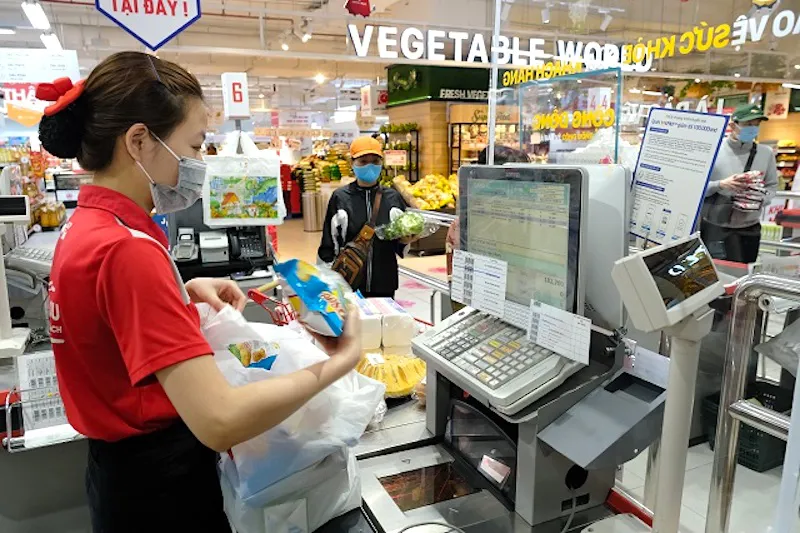
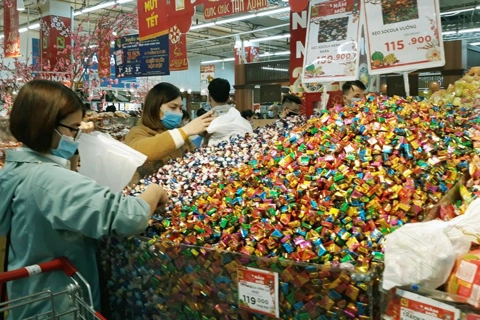
In 2008, Hanoi underwent significant expansion by merging neighboring Ha Tay Province, Me Linh District - Vinh Phuc Province, and four communes of Luong Son District - Hoa Binh Province. Since then, the city's commercial infrastructure has substantially developed, particularly in the former Ha Tay province. Back then, Hanoi had only 10 retail centers, 78 supermarkets, and 355 wet markets, most old and in poor condition.
After 15 years of expanding its administrative boundaries, the city has made remarkable progress, boasting 29 commercial centers, 135 supermarkets, 453 wet markets, over 2,000 convenience and food stores, and 415 vending machines. This impressive progress can be attributed to the efforts of Hanoi authorities to accelerate investment in commercial infrastructure.
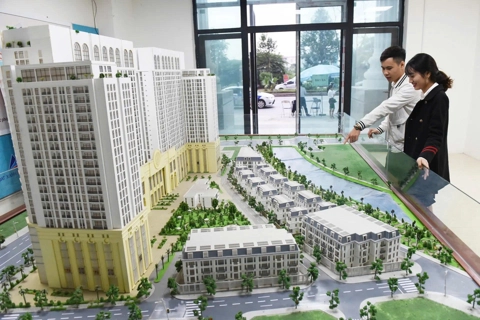
In its latest initiative, the city's Department of Industry and Trade has laid out plans for an outlet mall, the first of its kind in Vietnam. The mall will be constructed on an area of approximately 811.57 hectares, spanning both sides of Vo Nguyen Giap Avenue leading to Noi Bai International Airport.
If this outlet mall reaps success, the Department of Industry and Trade and the Department of Planning and Architecture will consider building a second one in Soc Son or Thanh Tri districts.
The construction of such a large-scale outlet mall is one of the 19 goals outlined by the Hanoi Party Committee in Program No. 03, which focuses on urban renewal and development for the 2021-2025 period.
The city aims to develop the trading industry into a high-quality, high-value-added trade and service sector. To achieve this, Hanoi encourages investment in various types of commercial facilities, such as markets, supermarkets, and shopping malls, in line with the city's planning.
Moreover, the city provides support to businesses to overcome challenges and accelerate the construction, renovation, and upgrading of markets, commercial centers, and supermarkets throughout the city.
In 2022, Hanoi primarily focused on constructing large commercial centers, including the Vinhomes Ocean Park commercial center in Gia Lam District and the Vinsmart City commercial center in Nam Tu Liem District.
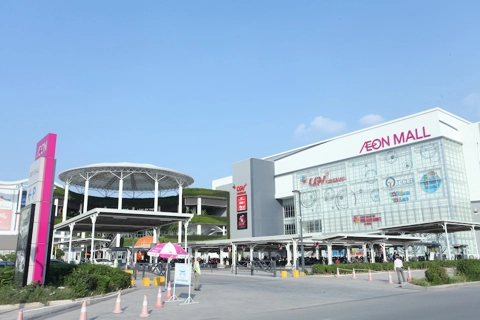
Hanoi will also support the expansion and diversification of commercial centers and expedite investment procedures for projects such as AEON Mall and Lotte Mall in the western districts of Tay Ho and Hoang Mai. According to the cooperation agreement signed between AEON Mall Vietnam and Hanoi authorities, AEON Mall Vietnam aims to build four shopping centers in Hanoi by 2026, with more planned by 2030.
| Hanoi's goal is for 50% of the population to be online shoppers by 2022. Photo: Phi Nhat/ The Hanoi Times |

In addition to building retail systems, the Hanoi's Department of Industry and Trade has actively promoted modern shopping channels through successful events such as "Online Shopping Day - One Friday" in cooperation with the Department of E-commerce and Digital Economy under the Ministry of Industry and Trade.
In 2022, Hanoi achieved 11% of total retail sales of consumer goods and services through business-to-consumer (B2C) e-commerce.
As part of the city's e-commerce development plan by 2025, cashless payments in e-commerce are expected to reach 50% of complete transactions.
About 75% of commercial websites are designed to integrate online ordering functions, and 45% of small and medium-sized enterprises will offer e-commerce services through social networks and e-commerce platforms. In addition, about 35% of enterprises will be encouraged to conduct e-commerce activities through mobile applications.
To boost e-commerce, the city has set a goal of training 2,000 business and household owners, civil servants, and students in e-commerce skills.
Hanoi is also prioritizing the development of e-commerce infrastructures, including electronic payments for government transactions, logistics and delivery services, and the use of new technologies to improve the connectivity of logistics activities between the city and other provinces and cities across the country.
Tran Thi Phuong Lan, Acting Director of the Hanoi Department of Industry and Trade, said her agency is actively seeking investment in modern retail systems, underscoring the immense potential and strength of the capital's commercial sector.
"It's needed to give favorable conditions for businesses to expand their modern service networks, including shopping malls, supermarkets, convenience store chains, online sales, and vending machines. This will help build the synchronized and civilized commercial infrastructure, with the ultimate goal of establishing Hanoi as the largest commercial center not only in the country but also in Southeast Asia," she noted.