Important archaeological discoveries in Thang Long Imperial Citadel announced
Artifacts of different periods have been unearthed in the Thang Long Imperial Citadel, corroborating the great historical and cultural values of the UNESCO heritage site.
Thang Long Hanoi Heritage Conservation Center and the Vietnam Institute of Archeology have announced new discoveries, which contribute important facts for the research of the citadel.
Valuable discovery
| Dr. Tong Trung Tin, President of the Vietnam Archeology Association, led a team of experts to investigate the newly found well. (Photo: Minh Thu/ Vietnam+) |
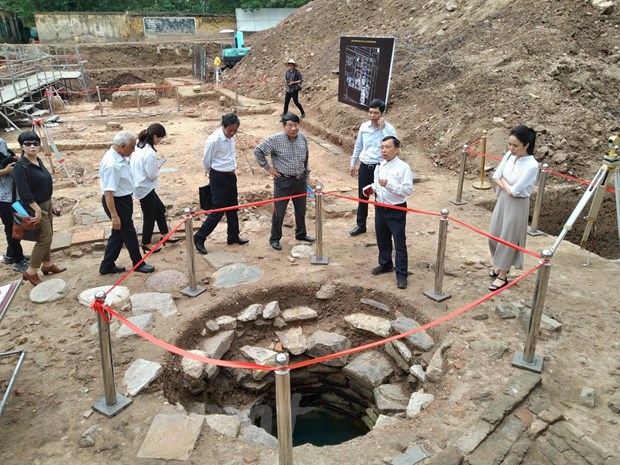
In the excavation area of nearly 1,000 square meters in the Northeast of the Kinh Thien Palace, five cultural layers have been found about 3.3 meters underground with the nearest to the surface belongs to the Nguyen Dynasty (1802-1945), then the Le Trung Hung Dynasty (1533-1789), the Later Le Dynasty (1428-1527), the Tran Dynasty (1225-1400), the Ly Dynasty (1009-1225) and the period before Thang Long Imperial Citadel was built, according to Dr. Tong Trung Tin, Director of the Vietnam Archeology Association.
Outstanding among these findings is the deepest well ever found by local archaeologists, measuring nearly seven meters. The last time that Dr. Tin found a deep well was in 1952, with 5.9 meter. The newly found well is estimated to be deeper than the average depth of the Red River.
| The close-up photo of the newly found treasure inside Thang Long Imperial Citadel. Photo: Minh Thu/ Vietnam+ |
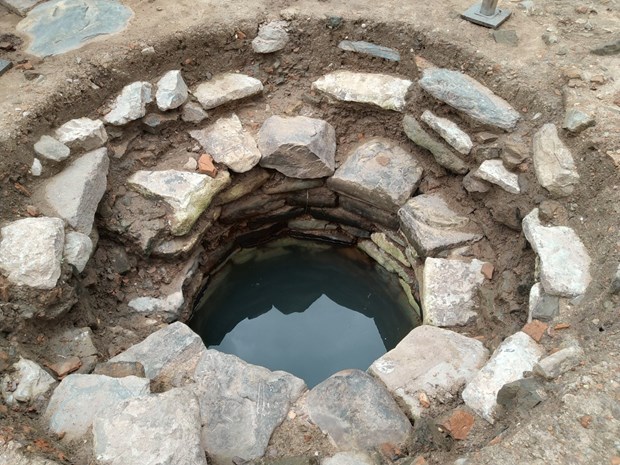
It is also very wide, about three meter in diameter. Its bottom is paved with flat rocks, including many layers of green rocks and large-sized pebbles, to make it leveled and add aesthetic traits to the well. This is a construction work typical of the Tran Dynasty. The well is assumed to be built to supply water to those working at Can Chanh Palace, the workplace of the king and his court.
In the well, copper coins under King Canh Thinh (1783-1802) were found as well, giving way to the assumption that the well was still not filled in this period.
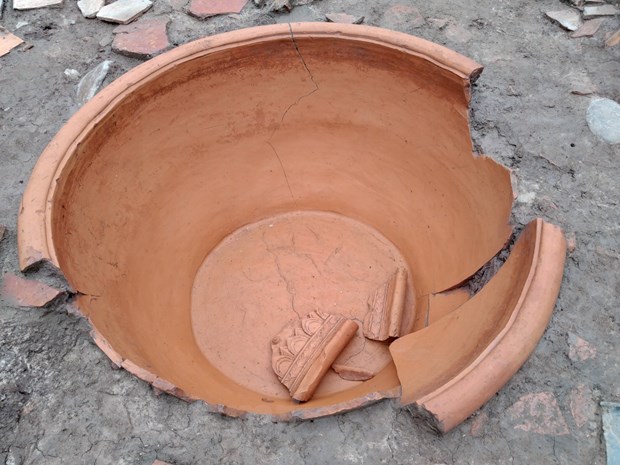
Also in this area, archaeologists found a large pot with 1.2 meters in diameter and 55 centimeters in height. Its opening is decorated with patterns of ochnas, lotus, among others. This is possibly the largest terracotta pot under the Tran Dynasty, which is almost intact.
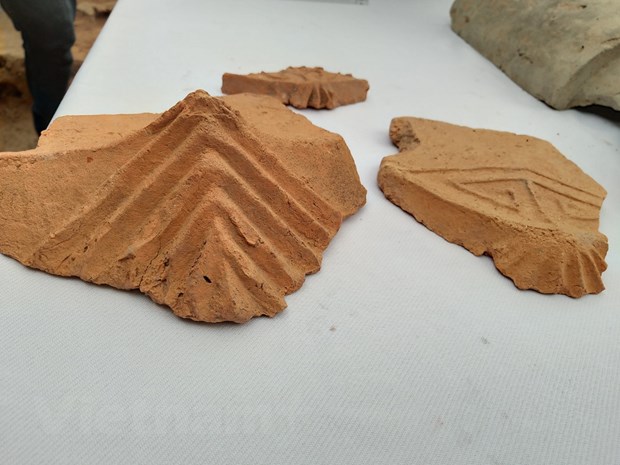
| Tiles from Nguyen Dynasty (1802-1945). Photo: Minh Thu |
At the bottom-most part of the site at 4.8 meters, the archaeological team also found traces of different periods.
Particularly, the largest findings of the excavation is two arched tombs built with bricks in the pre-Thang Long period. They are parallel to the northeast, built in an arched style. In the tombs, three ceramic pots and copper coins were found.
“This is the core zone of the citadel so we wonder why there were two tombs here?” said Dr. Tin, “it can be assumed that they had been there before the citadel was built. Found in the deepest layer, it shows vestiges of early human settlement here, from the fourth to the sixth centuries.”
Important legacy value of Thang Long Imperial Citadel
| Five cultural layers have been found about 3.3 meters underground of Thang Long Imperia; Citadel. Photo: Minh Thu. |

According to Associate Professor-Dr. Bui Minh Tri, Director of the Institute of Imperial Citadel Studies, in the years between 2011-2020, the institute has completed much of the project of revising, studying and assessing the value and making a scientific record of the Thang Long Imperial Citadel relic site with many scientific achievements.
Among them, the most prominent and important is the successful recodifications of the mysteries of the palatial architecture in the citadel based on archaeological vestiges and historical documents.
This 2020-2021 excavation has revealed a lot of new information, substantiating the value of the Thang Long Imperial Citadel of thousands of years of history.
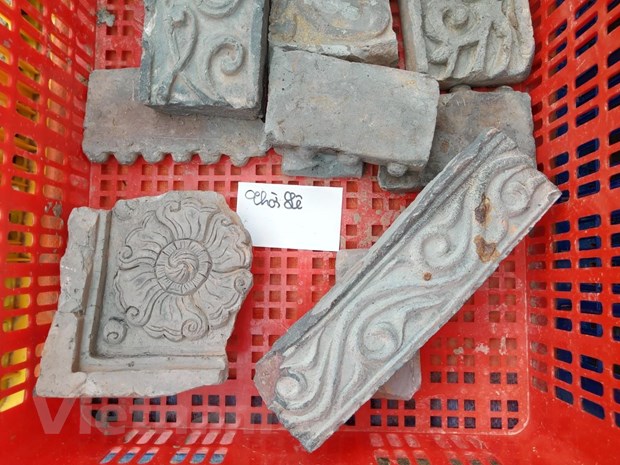
| Some stone pieces with carved patterns from Later Le Dynasty (1428-1527). Photo: Minh Thu |
In particular, there are many unknowns to study more thoroughly, such as a large circular architecture, which was popular in the Tran Dynasty’s constructions, but its function remains a question to archaeologists.
There are very few capitals in the world that preserve a complex of relics of a long history and culture which represented by superimposition of layers like the Thang Long Imperial Citadel. This is an outstanding feature that contributes to the great value and uniqueness of the site that has been recognized by UNESCO, according to Tri.
| A terracotta pot with a diameter of 1.2m, the largest ever pot found in the Tran dynasty (1225-1400). Photo: Minh Thu. |
Participating in the archaeological excavation at the Thang Long Imperial Citadel from the first days, Dr. Tin claimed that more historical truths of the relic site have been exposed year after year.
Local scientists expect to be able to draw the whole picture of the citadel over different periods of time soon. “Currently, only about 7% of the citadel has been excavated. Further research is necessary to restore a part of the ancient palace,” said Dr. Tin.