Minimum wage revisions to protect low-paid workers in Vietnam: ILO
The new regional minimum wages, which have been agreed by members of the National Wage Council, will be effective on July 1, 2022.
Revisions of regional minimum wages aim to protect low-paid workers, in addition to reducing poverty and inequity, increasing demand, and contributing to economic stability, according to the International Labor Organization (ILO) Country Office for Vietnam.
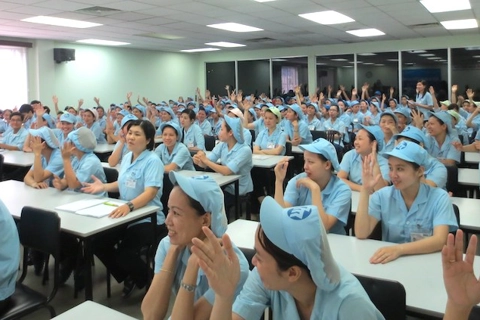
| Vietnamese workers in a production facility. Photos: ILO |

ILO experts gave the idea in the context that eight domestic and foreign associations have called for the postponement of the wage raise by 6% until January 1, 2023, instead of July 1, 2022 to give them time for better preparations after prolonged Covid-19.
ILO Country Office for Vietnam’s experts said the minimum wage revisions show the commitment of both workers and businesses, to overcome the difficulties together. Once the regular revision process has resumed with a proposal to raise the minimum wage, it is necessary to set the exact date of its implementation.
The entry into force of the new minimum wages set for July 1, 2022, corresponds to a temporary but immediate measure that prioritizes supporting the most vulnerable workers to offset the rising cost of living. This is an agreed decision at the National Wage Council, reflecting a comprehensive position of protecting workers’ wages from further deteriorating due to the higher living cost.
According to the ILO, many countries in Southeast Asia have established or strengthened minimum wages to protect low-paid workers and reduce inequalities. Yet the economic difficulties faced by enterprises during the crisis may have placed on the spotlight minimum wage revisions, thus interrupting regular adjustments. Vietnam, which undergoes minimum wage revisions on an annual basis, delayed the procedures in 2020 and 2021 to spur business recovery.
Vietnam’s economy grew by 2.6% last year, well below its pre-pandemic trend of 7%. However, according to the International Monetary Fund (IMF), its gross domestic product (GDP) is expected to grow by 6% in 2022 and 7.2% in 2023. Therefore, the proposed option for adjusting the minimum wages seems to have incorporated these economic factors, according to the ILO Country Office for Vietnam.
The Covid-19 pandemic disrupted the wage growth trend in many countries with a higher downward pressure burden on lower-paid workers, exacerbating wage inequality. In light of the economic recovery and reaching out to those in need of such protection, the minimum wage proposal also resumes a process that aims to protect workers and share the fruits of progress with the most vulnerable.
More importantly, the decision has emerged from a technical process buttressed by social dialogue and a consensus among the Vietnamese tripartite members.
| An adequate minimum wage should be agreed upon at the national level through evidence-based social dialogue. |

Long-term benefits for workers' lives
For low-paid workers, adequate minimum wages - set by governments or negotiated through collective bargaining - are crucial to prevent wages from spiraling down to unduly low levels, providing some buffer against poverty.
Experience provides evidence that minimum wages as a policy option have the potential to overcome some of the adverse effects of the current crisis. Its main emphasis is to protect low paid workers, but it can reduce poverty and inequity, increase demand and contribute to economic stability.
The crisis has significantly impacted the most vulnerable workers in the current context. And minimum wages are crucial to serving as a measure of social protection to mitigate this impact and reduce the exacerbated inequalities that have emerged, striking particular groups of workers such as women and youth.
The ILO Centenary Declaration for the Future of Work provides essential guidance on the policies that need to be strengthened to ensure long term benefits for workers' lives and to maintain sustainable enterprises. It has emphasized the importance of adequate minimum wages, statutory or negotiated.
Labor market institutions require to be strengthened to ensure adequate protection of all workers, enforcing the continued relevance of the employment relationship. In this context, all workers should enjoy adequate protection, taking into account respect for their fundamental rights; maximum limits on working time; safety and health at work; and “an adequate minimum wage, statutory or negotiated”.
Wages are among the working conditions that require special attention as it has tangible implications for workers’ well-being and their families. In this context, adequate minimum wages are an essential requirement for a human-centered approach to the world of work committed by all ILO member states, including Vietnam, through the recent Global Call to Action for a Human-Centered Recovery from the Covid-19 crisis, that is inclusive, sustainable and resilient.
The ILO underlined, therefore, an adequate minimum wage should be agreed upon at the national level through evidence-based social dialogue, in line with the Minimum Wage Fixing Convention, 1970 (No.131).
The ILO appreciates that Vietnam has taken many of these elements into practice and is actively studying and considering the ratification of No.131 in the coming months. It has developed a minimum wage system drawing from other country experiences and underpinned by international labor standards.
The National Wage Council sets the foundation for its minimum wage policy, using evidence to arrive at its recommendations. To strengthen its technical capacity for minimum wage setting, it expanded and restructured the National Wage Council in 2021.
A minimum wage policy that prioritizes protecting low-paid workers, taking technical decisions through evidence and a robust social dialogue can contribute to sustainable and inclusive growth.