PM warns of “bumpy road” dragging down economic growth
Digital transformation is an inevitable trend that will keep the economy going forward, Prime Minister Nguyen Xuan Phuc has said.
What is awaiting the economy in its future development process is not only the expressway but also a lot of bumps that any mishaps could drag down the upward trend, Prime Minister Nguyen Xuan Phuc has said.
| Prime Minister Nguyen Xuan Phuc at the meeting. Photo: Quang Hieu. |
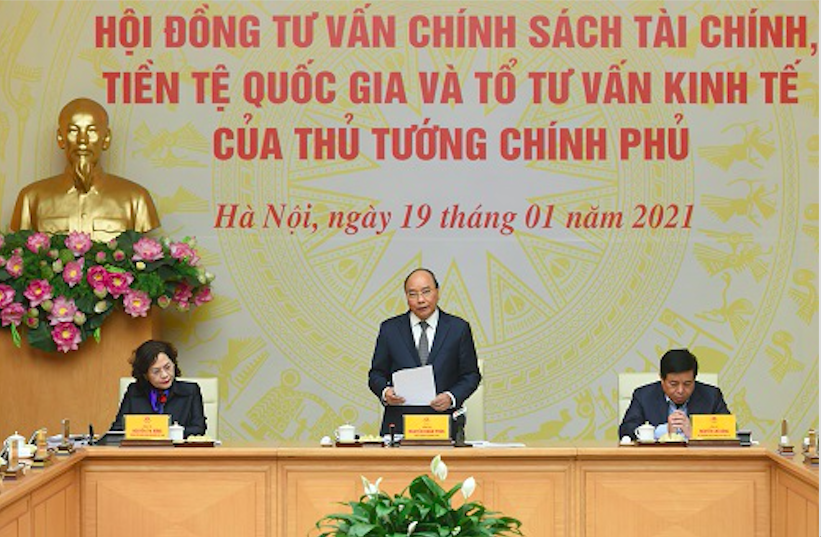
The government leader was speaking at a meeting with the National Financial and Monetary Policy Consultation Council and the Prime Minister’s Economic Advisory Group in Hanoi on January 19.
Vietnam has set target to become a middle-income country by 2025, marking its development with a certain level of modernization and industrialization.
Five years later, in 2030, as the country marks the 100th founding anniversary of the Communist Party of Vietnam, it aims to be an upper middle-income country and when celebrates the 100th Independence Day anniversary by 2045, it is expected to become a developed and high-income country.
Economist Tran Dinh Thien suggested that Vietnam is able to stabilize the economy and steer it back to the upward path was thanks to a strong economic base built up in the previous three years.
“As the world enters a new normal, it is the time for Vietnam to move to a digital economy,” Mr. Thien said, adding the government should allocate a part of its state resources for innovation.
“It is the time for countries to compete in terms of institutional capabilities, which requires Vietnam to continue reforming its legal framework,” noted Mr. Thien.
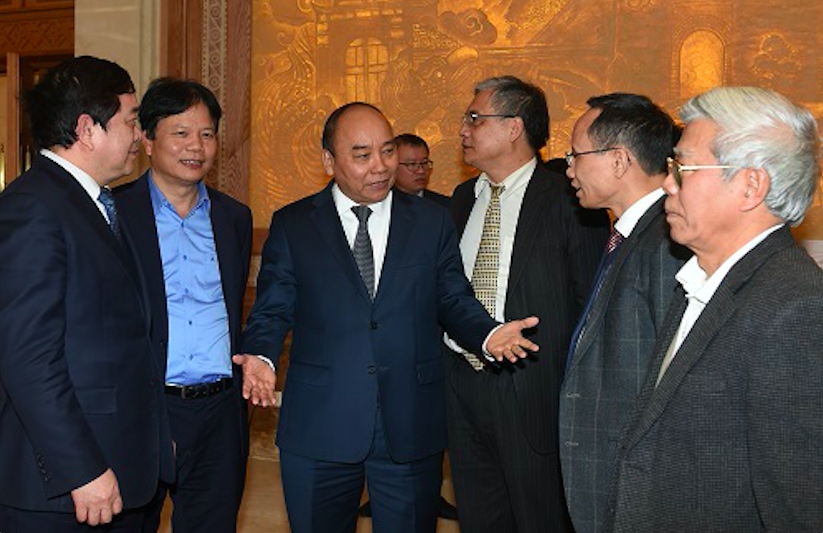
| Prime Minister Nguyen Xuan Phuc and delegates at the sideline of the meeting. Photo: Quang Hieu. |
Digital transformation is inevitable
While the global economy in 2021 is highly dependent on the likelihood of containing the Covid-19 pandemic, experts said that Vietnam should continue staying alert against the pandemic, while boosting exports, domestic consumption and public investment.
Director of the Academy of Policy and Development Dao Van Hung said the government made the right decision in gearing up public investment to offset a weakening private investment capital. “This is essential to ensure economic growth,” said Mr. Hung, but pointing to a possible high inflationary pressure.
Economist from Fulbright University Nguyen Xuan Thanh attributed Vietnam’s positive economic growth in 2020 to improved productivity from the digitalization process and operation optimization of enterprises.
Referring concern of high inflation rate, Mr. Thanh expected the government to keep maintaining a stable macro-economic environment, while further providing more supporting policies for the business community to speed up the recovery process of household consumption and private investment.
Sharing Mr. Thanh’s view, banking export Can Van Luc urged the government to continue providing stimulus packages for the economy.
“This is a golden opportunity for Vietnam to restructure its economy towards innovation and a digital economy for greater efficiency in utilization of state resources,” Mr. Luc suggested.
Acknowledging suggestions from experts, PM Phuc said more works needed to be done in the coming time, especially in creating strategic breakthroughs for development.
Mr. Phuc identified administrative reform, revising growth model, developing enterprises, improving business environment, pushing up digital transformation and resources for sustainable development are key priorities.
“However, digital transformation is an inevitable trend,” stressed Mr. Phuc, expecting government agencies to propose policies to ensure the dual target of both containing the pandemic and boosting economic growth this year.