Some 2,000 cameras installed at Noi Bai Int’l Airport for contract tracing
The cameras are installed to document human contact at the airdrome.
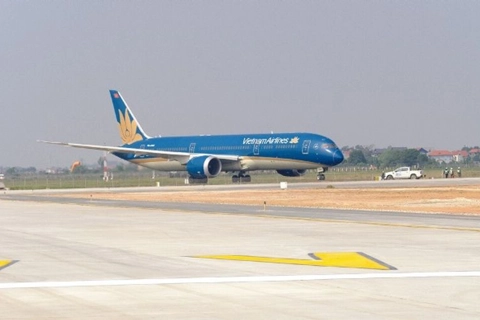
Noi Bai International Airport in Hanoi has set up a new center of surveillance with 2,000 closed-circuit television (CCTV) cameras for Covid-19 contact tracing, according to the Director of Noi Bai International Airport, To Tu Ha.
The center is aimed at documenting human contact at the airdrome that will help contact tracing of possible infected passengers in the future, Ha said.
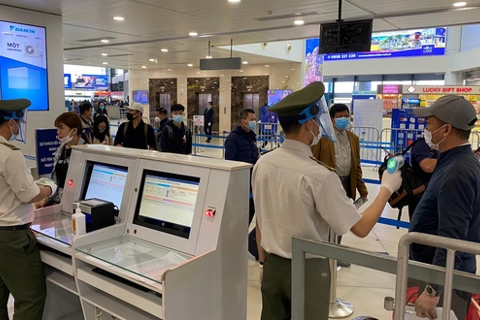
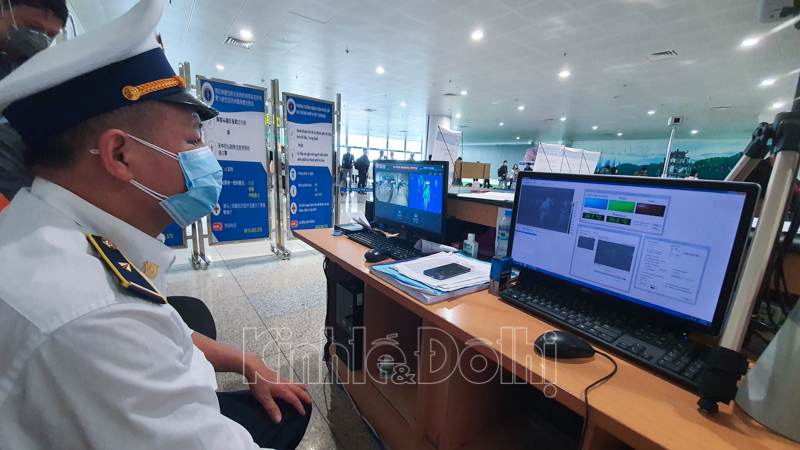
He added that all entrances of Noi Bai International Airport are equipped with body temperature scanners and controlled by security guards, who will single out passers-by with a body temperature of over 37.5 Celsius degrees.
“Those who cross the gates with their masks off or pulled down under their nose will immediately receive a warning from the automatic alarm system,” Ha said about the airport’s latest technology for pandemic prevention.
Noi Bai International Airport in Hanoi was open to passenger flights from Ho Chi Minh City and Danang from October 10 to 20, with one return flight on each route per day, carrying only 50% of their passenger capacity.
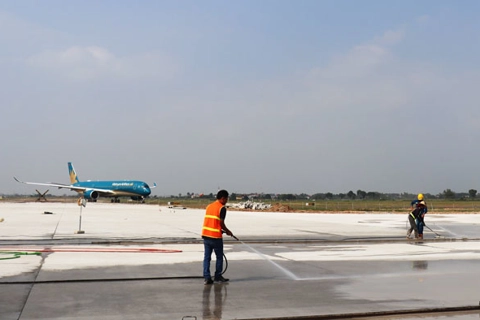
From October 10 to 20, Noi Bai International Airport reopened for passenger flights between Hanoi and Ho Chi Minh City after months of closure, thus, medical supervision at the airport is strictly managed. Photo: Ngoc Tu |
Upon arrival in Hanoi, passengers will spend seven days in self-isolation at home, and will not be required to be quarantined at centralized centers if they fulfill medical requirements for the flight.
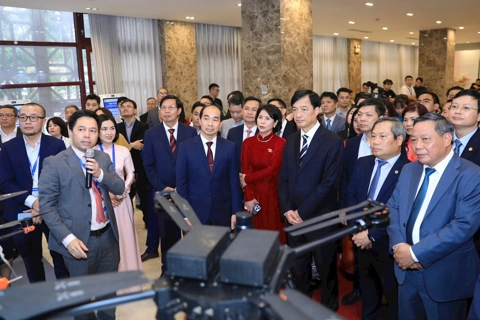
Therefore, on October 12, leaders of the Ministry of Transport, the Hanoi People’s Committee, and the Civil Aviation Authority of Vietnam (CAAV) have inspected the pandemic prevention protocols at Noi Bai Airport.
During the examination, Deputy Minister of Transport Le Anh Tuan and Vice Chairman of the Hanoi People's Committee Nguyen Manh Quyen required aviation officers and the management of Noi Bai to make sure that all departing and arriving passengers fulfilling medical requirements are free from the coronavirus.
Messages on the pandemic prevention and control, and quarantine should be spread among passengers in a simple way, Deputy Minister Le Anh Tuan said.
Director of Noi Bai International Airport To Tu Ha informed that aviation businesses have set up a “green corridor”, minimized social interactions, and followed regulations on pandemic prevention and control.
Up to 98.9% of the airport’s staff have been fully vaccinated. The airport has also built a database on vaccination for all of its 15,800 employees while utilizing QR codes in contact tracing.
Earlier, on July 22, the CAAV issued a ban on regular domestic flights between Hanoi and Ho Chi Minh City, as well as other municipalities that are under social distancing rules in line with the Prime Minister’s Directive No.16, which stipulates the highest level of restrictions.
On August 30, the CAAV asked all carriers to suspend ticket sales for domestic flights and refund passengers with tickets issued prior to July 21, due to the serious evolution of the Covid-19 pandemic in Vietnam.