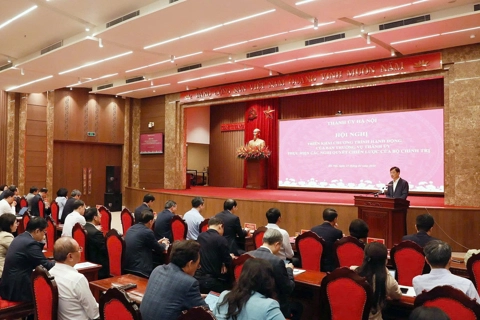
Underground sewer installation to help reducing pollution in To Lich river
After completing the installation of the underground sewer system running along the river, the wastewater will be completely separated, totally solving the source of pollution for To Lich river. The project is considered as an efforts of Hanoi authority to "rescue" the To Lich river.
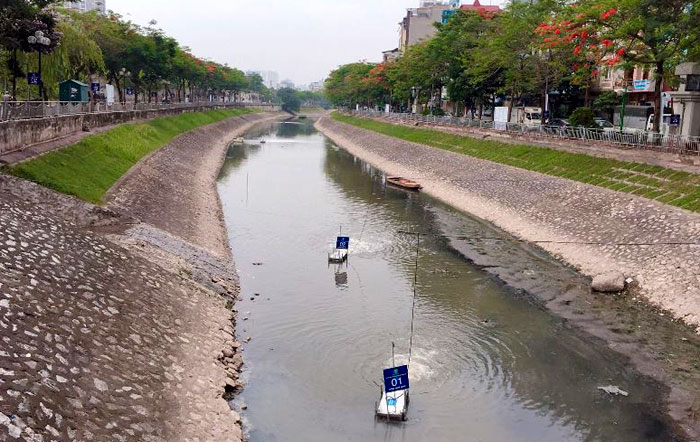
For years, To Lich River is one among five main rivers of the capital that are facing up with seriously pollution problems. The 14-kilometer-long river features over 280 outfall sewers that discharge sewage directly into the river. It is estimated that up to 150,000 cubic meters of sewage are discharged to To Lich River daily, constituting the main polluting source of the river.
| To Lich River/ Photo: Pham Hung |
During the past few years, a variety of river depolluting projects have been carried out by Hanoi’s authorities but have yielded no results. The newly launched plan of 'rescuing To Lich river' is considered the most promising one.
According to Hanoi Management Board of Investment, Construction Projects on Water supply, Drainage and Environment, the investor of the project, it’s an extremely important task, aiming to thoroughly tackle the pollution of To Lich and Lu rivers.
| The sewage collecting system installation project has now entered the stage of pipe burying and concrete embankment/ Photo: Thanh Luan |
.jpg)
Earlier, reporting to the municipal mayor in February this year, the Hanoi Management Board of the project said that Yen Xa wastewater treatment site project includes four bidding packages, covering about 4,874 hectares and will be able to handle of 270,000 cubic meters of waste water per day. The sewage system length totals 52,621 kilometers, with an investment of VND16,000 billion (US$688 million).
The sewage collecting system installation - an important stage of the project- is now implemented by workers along To Lich River at Nguyen Dinh Hoan street (in Cau Giay District, Hanoi) and Vu Tong Phan street (in Thanh Xuan District, Hanoi).
| A worker from Yen Xa Wastewater Treatment Plant is doing his work at Vu Tong Phan street (in Thanh Xuan District, Hanoi)/ Photo: Thanh Luan |
.jpg)
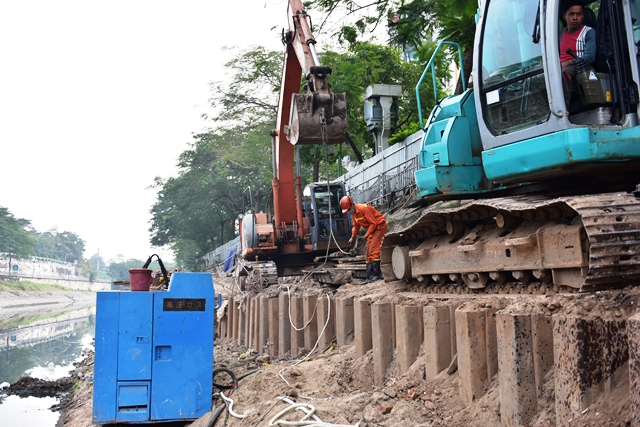
Firstly, they would reinforce the revetment of the riverbank to prevent erosion. Then the contractor will bury the sewage collecting pipes and cover them with concretes as well as install the manholes.
After nearly 10 months of construction, the 21km-long sewer system (of which more than 11km goes underground in the To Lich river bed) has now entered the stage of pipe burying and concrete embankment. Of the sewage collecting system, a 10km of sewer is dug with the open-pit excavation technology, while the remaining 11km is drilled underground for placing the sewer pipe in the river bed.
This new technology is applied for the first time in Hanoi, able to build drainage works at less than five-meters underground. The implementation new technology will help protecting the neighboring works, skipping the site clearance as well limiting the bad impacts to the people’s routine in the area. Sewage collection pipes are buried deep underground, connected by hollow pillars. These sewer pipes are all connected to a concrete cylinder, acting as manholes, to prevent sewage from flowing directly into To Lich River.
| The new technology undertaken is said to well limiting the bad impacts to the people’s routine in the area/ Photo: Thanh Luan |
“This is stage of sewer pipe placing, using the open-pit excavation technology, which is already mastered by Vietnamese workers. The more modern technology to be used at this project is the underground drilling technology. After a 2-kilometer- sewer pipe was placed using the open-pit excavation technology, we will place another of 6.5 km underground. For every 60 meters of the opened sewer, there will a septic tank. Meanwhile, for underground sewer, there will be one septic tank every 200 meters. The first installed sewer pipe is 800mm of diameter, the other pipes could have diameters of 1200mm and up to 2200mm,” a Japanese expert at To Lich sewage collecting system installation project told Hanoitimes.
Currently, project contractors have finished some sections of To Lich River sewage collection project on Hoang Quoc Viet Street, including pipe burying and concrete embankment. Besides, the installation of sewage collection pipes on Vu Tong Phan street, Thanh Xuan district, Hanoi is also underway. Works on the To Lich wastewater collection project kicked off in May 2020 and is expected to be completed after four years.
It’s such the good news for people who lives on the sides of To Lịch River in particular and the whole city in general.