Domestic automakers expected to enjoy excise tax payment extension
The local automobile industry would continue to face severe impacts from the Covid-19 pandemic as demands for cars are expected to stay low for the foreseeable future.
The Ministry of Finance (MoF) has proposed an excise tax payment deferral for domestically-produced cars until the end of 2021.
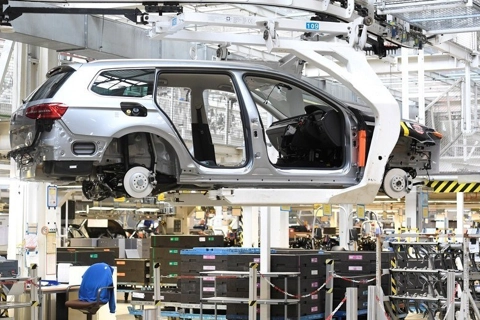
| Inside the Thanh Cong Hyundai Manufacturing Plant. Photo: Viet Dung |
The move is seen as another effort from the Government to aid businesses to overcome current pandemic hardship.
“Recent Covid-19 outbreaks since early 2021 has put many domestic car manufacturers and assemblers into a difficult position, and are in need of Government support,” stated the MoF.
A report from the Vietnam Automobile Manufacturers’ Association (VAMA) revealed that the total sale of domestic cars from their members suffered a decline of 13% in the first eight months of this year against the pre-Covid-19 period in 2019, with many even posting a plunge of up to 60% in revenue.
Meanwhile, the number of newly-registered cars in August also took a hit plummeting 60% against the previous month and was equivalent to 20% of the performance in months before the pandemic.
While the low sale figure in August was partially attributable to the belief that in the seventh month of the lunar calendar, traditionally called “the ghost month”, locals should avoid buying new valuable things on fear of bad luck, the social-distancing order in southern provinces/cities have forced many automobile manufacturing plants to stop production.
VAMA estimated around 200 car dealers and another 200 repair shops of its members have been closed due to the pandemic situation.
“At present, Toyota Vinh Phuc plant is operating at around 30% of its production capacity, while plants from the Truong Hai Auto Corporation (Thaco) are taking days off by turn,” VAMA General Secretary Ninh Huu Chan referred to a few examples on the current state of the automobile industry.
Last year, the Government issued Decree No.109/2020/ND-CP on the deferral of excise tax payment for domestically manufactured or assembled automobiles, subject to the payable amount incurred in the tax periods of March to October 2020.
Under the MoF’s calculation, a deferring excise tax payment would help improve enterprises’ working capital and maintain businesses activities, while promoting the development of the local automobile industry.
Around 13 local firms from eight provinces/cities have been qualified for support measures stipulated in Decree No.109 with the total amount of tax payment at VND19.2 trillion ($842 million) being delayed, including major names such as Hyundai Thanh Cong Ninh Binh with VND4 trillion ($175.4 million), Toyota Vietnam (VND3.2 trillion or $140.3 million), or Vinfast (VND2.5 trillion or $110 million).
Lower car registration fees?
To further support enterprises and car buyers, many major car manufacturers, including TC Motor or Thaco have proposed the Government apply the 50% cut in registration fees for domestic cars again.
“A lower registration fee would help boost car sales and subsequently higher tax revenue,” said General Director of TC Motor Le Ngoc Duc.
According to Duc, a report from the Ministry of Finance revealed a 50% cut in registration fees from June 28 – December 31, 2020, helped boost state budget revenue by over VND11.2 trillion ($492 million) against the same period of last year.
Economist Dinh Trong Thinh from the Academy of Finance shared the view by saying lowering car registration fees would not impact the state budget revenue.
“Last year's figures showed tax revenue in the last half of 2020 from car sales nearly doubled that of the beginning of the year. Such a move, therefore, would continue to encourage people to buy cars, support the industry, and also state budget,” Thinh told The Hanoi Times.