Econ
Vietnam is a "pedal" exporter for FDI enterprises
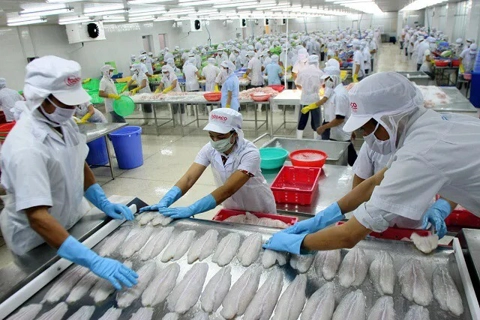
Foreign investment enterprises (FDI) using the cheap labor sources in Vietnam for export to major markets is sharply increased when our country`s prospect for signing trade agreements is clearer and clearer.
In order to take advantage of cheap labor as well as the opportunities that the Agreement on the Trans-Pacific partnership (TPP) brings, many foreign companies have used Vietnam as a "pedal" to enter the large markets.

At a recent meeting in Hanoi, JETRO Chief Atsusuke Kawada announced the results of a survey of Japanese companies doing business in Asia shows that 66% of those operating in Vietnam have expansion plans. “This rate is consistent with that of other countries in the Asia Pacific region, for which the median range was 60-70%,” said Kawada, adding that the rate was relatively unchanged from last year’s similar survey.
While the majority of manufacturing companies pointed to higher revenue growth as the driver for expanding operation, non-manufacturing businesses cited higher potential for domestic retail sales as the primary factor.
Other factors that Japanese companies found most appealing about Vietnam is the higher than average GDP growth over the past several years, relatively lower cost labour along with the stable political environment. On a more practical level, by far the overwhelming majority of respondents reported they and their Japanese co-workers enjoy living in Vietnam. Out of the 15 nations included in the survey, Vietnam ranked fourth in liveability. Kawada said, in regards to political stability it also ranked high— as it was fifth among the 15 nations in the Asia Pacific region.
The survey indicated the biggest perceived risks of doing business in Vietnam were the incompleteness of the legal system, lack of transparency in the legislative process and complex income tax procedures. “Laws are passed without adequate due process and research prior to enacting them, which places undue burdens on FDI companies, who are often left trying to ferret out inconsistent and incomplete legislation and regulations,” said Kawada.
He said on the upside he expects that income tax and other administrative procedures such as customs procedures will be greatly simplified in the near future as a result of the birth of the ASEAN Economic Community (AEC). “In addition, the Vietnam government is continually striving to make favourable changes in the laws on enterprises and investment Kawada underscored, adding that he is optimistic the business environment will change for the better as a result.
In 2015, Japanese companies represented the fourth largest FDI group operating in Vietnam – trailing the Republic of Korea, Hong Kong and Singapore with the majority of the investments under US$5 million each. Due to the weakening Japanese yen, Kawada said he does not anticipate a surge in large value investment projects in the coming year.
Meanwhile, the 12th National Party Congress re-election of General Party Secretary Nguyen Phu Trong has been highly welcomed by Japanese FDI companies who view him with high respect as a talented and dynamic leader.
Vietnam enterprises will have the opportunity to gain access to international capital investment to expand investment and production development and the extent of access to technology, modern management skills, production from advanced countries. On the other side, under the pressure of fierce competition in the context of globalization and participation in free trade agreements, companies are forced to raise their competitiveness to survive or they will be turned away from the market.
At a recent meeting in Hanoi, JETRO Chief Atsusuke Kawada announced the results of a survey of Japanese companies doing business in Asia shows that 66% of those operating in Vietnam have expansion plans. “This rate is consistent with that of other countries in the Asia Pacific region, for which the median range was 60-70%,” said Kawada, adding that the rate was relatively unchanged from last year’s similar survey.
While the majority of manufacturing companies pointed to higher revenue growth as the driver for expanding operation, non-manufacturing businesses cited higher potential for domestic retail sales as the primary factor.
Other factors that Japanese companies found most appealing about Vietnam is the higher than average GDP growth over the past several years, relatively lower cost labour along with the stable political environment. On a more practical level, by far the overwhelming majority of respondents reported they and their Japanese co-workers enjoy living in Vietnam. Out of the 15 nations included in the survey, Vietnam ranked fourth in liveability. Kawada said, in regards to political stability it also ranked high— as it was fifth among the 15 nations in the Asia Pacific region.
The survey indicated the biggest perceived risks of doing business in Vietnam were the incompleteness of the legal system, lack of transparency in the legislative process and complex income tax procedures. “Laws are passed without adequate due process and research prior to enacting them, which places undue burdens on FDI companies, who are often left trying to ferret out inconsistent and incomplete legislation and regulations,” said Kawada.
He said on the upside he expects that income tax and other administrative procedures such as customs procedures will be greatly simplified in the near future as a result of the birth of the ASEAN Economic Community (AEC). “In addition, the Vietnam government is continually striving to make favourable changes in the laws on enterprises and investment Kawada underscored, adding that he is optimistic the business environment will change for the better as a result.
In 2015, Japanese companies represented the fourth largest FDI group operating in Vietnam – trailing the Republic of Korea, Hong Kong and Singapore with the majority of the investments under US$5 million each. Due to the weakening Japanese yen, Kawada said he does not anticipate a surge in large value investment projects in the coming year.
Meanwhile, the 12th National Party Congress re-election of General Party Secretary Nguyen Phu Trong has been highly welcomed by Japanese FDI companies who view him with high respect as a talented and dynamic leader.
Vietnam enterprises will have the opportunity to gain access to international capital investment to expand investment and production development and the extent of access to technology, modern management skills, production from advanced countries. On the other side, under the pressure of fierce competition in the context of globalization and participation in free trade agreements, companies are forced to raise their competitiveness to survive or they will be turned away from the market.