Vietnam struggles against China's tactics in East Sea
Vietnam is advised to consider the possibility of joint patrols along with the coast guards of other nations.
The South China Sea (called East Sea by Vietnam) issues have been back in the limelight after the US in July expressed its crystal position on China’s maritime claims in the resources-rich sea.
Vietnam, one of major claimants, has been advised to seek for more international cooperation in resolving the issues linked to China’s strategy.
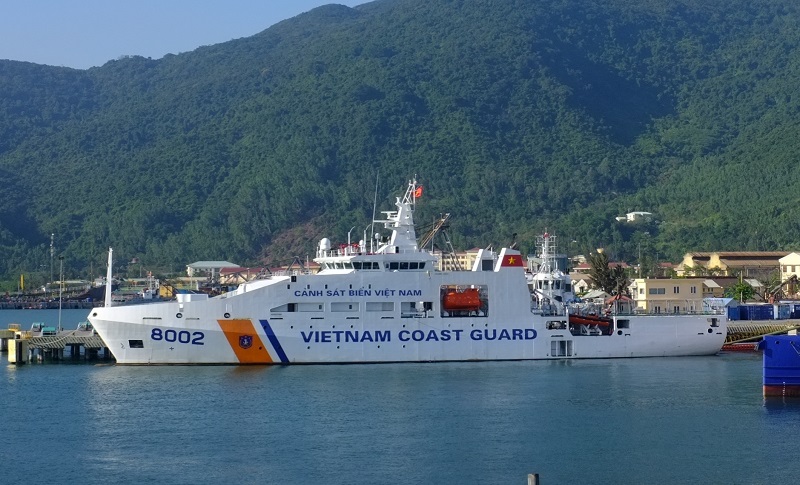
| Vietnam Coast Guard’s vessel docked in Danang city. Photo: Hoang Quang Hai |
China’s tactics
In recent years, China has deployed a number of tactics to enforce its claims that cover nearly 90% of the sea where one third of the world’s trade passed through.
In an article on the website of Center for International Maritime Security, Viet Hung Nguyen Cao, an MA student at the Graduate School of Political Science, Waseda University, and a Research Assistant at the South China Sea Data Initiative, has named some Chinese tactics in this highly disputed sea. They include the use of maritime militia and law enforcement vessels to intimidate fishermen; the use of research vessels and escort fleets to harass gas and oil development activities of other claimants; and standoff sometimes.
A primary component of China’s tactics in the South China Sea is the use of maritime militia and law enforcement vessels. These forces threaten fishermen and drive them away from traditional fishing areas.
Annually, China announces a fishing ban, claiming that its purpose is to preserve the fish stock in the South China Sea. Empowered with this ban, Chinese vessels frequently harass, attack, and sink Vietnamese vessels.
The most recent case occurred in June 2020, when a Chinese Coast Guard (CCG) cutter and motorboat surrounded a Vietnamese fishing boat and rammed it. The Vietnamese fishermen were then captured, beaten, and forced to sign documents stating that they had violated the fishing ban. The CCG also took away the fishing equipment and caused damage to the ship.
China’s tactics in the SCS also feature the use of research vessels and their escort fleets to harass gas and oil development activities of other claimants, forcing them to reconsider or abandon their projects. China often deploys several survey vessels, as well as an escort fleet of law enforcement vessels and maritime militia, to planned oil and gas blocks of claimant states in order to deny other claimants access to these waters. Notable cases include the Vanguard Bank standoff from July to October 2019, as well as the recent appearance of Chinese research vessel Haiyang Dizhi 4 inside Vietnam’s EEZ near Bloc 6.01, a gas bloc where Vietnam was planning to jointly explore with Russian gas conglomerate Rosneft.
These tactics clearly show China’s ambitions to establish a permanent maritime presence in the region. China aims to use these tactics as a means to enforce its excessive maritime claims and force Southeast Asian countries to accept China as the new hegemon.
China’s harassment
China has increased the frequency of its activities to harass Vietnam in recent years.
In 2014, China only deployed its vessels into Vietnam’s exclusive economic zone (EEZ) for about two months.
After the 2014 Haiyang Shiyou 981 standoff, China had repeatedly deployed research vessels and oil rigs to Vietnam EEZ and generally with longer duration and increased frequency of missions.
In 2019, it deployed the vessel four or five times, with the total duration of these missions being around six months, from late March until early October.
In the whole of 2019, there were three cases of Chinese vessels attacking and/or harassing Vietnamese fishing vessels.
In 2020, three cases have occurred in just the first six months.
With China showing little tolerance for vessels defying their arbitrary fishing ban.
This is a root cause for increasing illegal, unreported and unregulated (IUU) fishing activities in the region. These fishing vessels intrude into the waters of Indonesia and Malaysia and conduct illegal fishing.
This has created a wedge issue in the relations between Vietnam and both countries as more and more Vietnamese fishing vessels are being detained and in some cases, destroyed.
Most recently, a clash between Malaysian Maritime Enforcement Agency vessels and Vietnamese fishing vessels operating illegally inside Malaysian waters resulted in the death of a Vietnamese fisherman.
Vietnam’s efforts
Faced with these challenges, Vietnam has made strong protest against Chinese aggression. Its primary response has been through diplomatic protests and public statements.
Vietnam’s diplomatic protests against these actions are often conducted at the bilateral level, such as through meetings or teleconferences between foreign affairs officials, both at government and party levels.
Most recently, after the aforementioned incident in June, Vietnam’s Foreign Minister Pham Binh Minh held a teleconference with his Chinese counterpart to discuss solutions. Similar lines of communication have been effective in preventing conflict escalation, thus mitigating a potential diplomatic crisis or an all-out war.
In their public statements, Vietnam demonstrates a firmness regarding the sovereignty of Vietnam, as well as a willingness to cooperate to resolve the dispute according to international law, especially the United Nations Convention on the Law of the Sea (UNCLOS).
In recent years, these statements have begun to include mentions of litigation as a possible means of resolving the disputes, suggesting Vietnam’s willingness to bring China to court.
Policy recommendations
In order to resolve these issues, Vietnam should consider alternative policies, alongside existing ones, to both manage the situation in the meantime, as well as solving issues in the long run, Viet Hung Nguyen Cao suggested.
The first step is to expand its current international cooperation on increasing maritime domain awareness.
Vietnam should also negotiate with countries in the region, such as Malaysia and Indonesia, on protocols in situations where local authorities capture Vietnamese fishing vessels operating in their EEZs, as well as for unexpected encounters at seas.
By mitigating possible consequences of IUU fishing, Vietnam can avoid regional tensions and domestic backlashes.
Secondly, Vietnam should consider the possibility of initiating joint patrol operations along with the coast guards of other states. Considering how Chinese fishing bans and maritime militia are also affecting Indonesia, Malaysia, and the Philippines as well, these countries should consider coordinating patrol activities in the South China Sea, as well as improving their information sharing systems in order to minimize the impact of China’s actions.
The joint patrols will help in driving out Chinese maritime militia operating in the waters, as well as managing IUU fishing.
The author recommended it’s better to organize Vietnam’s fishing vessels into fleets to enable them to be better protected in dismiss or attack.