Vietnam, US strengthen cooperation in developing semiconductor industry ecosystem
The move is another step toward the realization of the bilateral Comprehensive Strategic Partnership.
Vietnam and the US would continue to strengthen cooperation in areas such as building a semiconductor industry ecosystem, key energy and mineral resources, business environment, IT infrastructure, and cybersecurity, the Ministry of Planning and Investment announced.
| Minister of Planning and Investment Nguyen Chi Dung and US Under Secretary of State Jose Fernandez. Source: MPI |
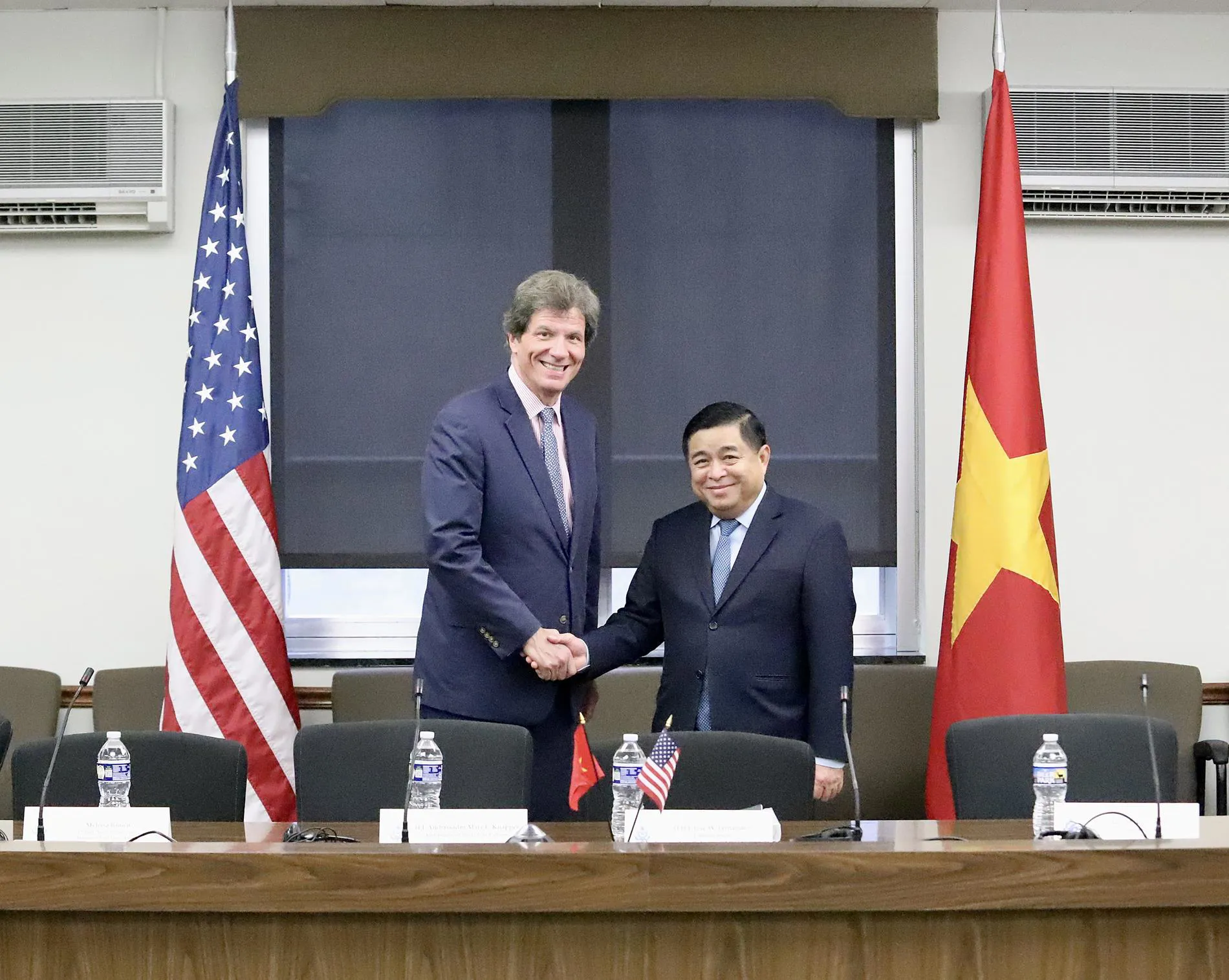
The view was shared during a meeting between Vietnamese Minister of Planning and Investment Nguyen Chi Dung and US Under Secretary of State Jose Fernandez on June 25 (local time) in Washington, which was part of the first Vietnam-US economic dialogue after upgrading bilateral relationship to a Comprehensive Strategic Partnership.
Vietnam-US relations were normalized in July 1995 and upgraded to a Comprehensive Partnership in July 2013, with many high-level visits between the two countries' leaders. During President Biden's visit to Hanoi last year, Vietnam and the US elevated their relationship to a Comprehensive Strategic Partnership.
At the dialogue, Dung stated that this first economic dialogue was significant, as it aimed to boost cooperation in the economic, trade, and investment sectors.
During the meeting, both sides also agreed to attract and retain high-quality investments and manage strategic export controls.
"Both sides achieved significant results at the meeting, particularly in semiconductors with specific solutions to be implemented," the ministry noted, adding that this dialogue lays the groundwork for expanding cooperation in other fields.
The second Comprehensive Strategic Partnership Economic Dialogue is expected to be held in Hanoi in 2025.
During his visit to the US, Minister Dung also met with leading US technology corporations like ARM, Marvell, and Google to discuss innovation, semiconductors, and artificial intelligence.
Dung urged these global corporations to expand their business investments further, contribute to the development of Vietnam's semiconductor industry ecosystem, and increase cooperation with the Vietnam National Innovation Center (NIC).
According to the Minister, the NIC operates a facility in Hoa Lac (nearly 20,000 square meters) with special incentives for partners working at the center. He requested members of the Vietnam Innovation Network to coordinate with the Center to bring together key US technology partners interested in the Vietnamese market, and potentially set up research units, offices, laboratories, and manufacturing plants at NIC.
Dung added that Vietnam is implementing a Semiconductor Industry Development Strategy and a Human Resources Project for the semiconductor industry. By 2030, Vietnam aims to train 50,000 semiconductor engineers, including 15,000 design engineers.
The government has repeatedly emphasized its determination to create the most favorable investment environment for high-tech, semiconductor, and AI projects by preparing the infrastructure, human resources, and institutions to attract and cooperate with major global technology corporations.
According to the Foreign Investment Agency, US businesses have invested in over 1,340 projects in Vietnam with a total capital exceeding $11.8 billion, ranking 11th in investment value after countries like South Korea, Japan, China, Singapore, and Malaysia.
The US is currently Vietnam's second-largest trading partner, after China, with trade reaching $100 billion for the first time in 2021. In 2023, total bilateral trade was nearly $111 billion, exceeding $100 billion for the third consecutive year, according to the General Department of Vietnam Customs.