Vietnam’s middle power diplomacy in ASEAN
Vietnam’s diplomatic activism in ASEAN reflects its status as an emerging middle power.
This year marks the 27th anniversary of Vietnam’s ASEAN membership. Accession into ASEAN in 1995 provided Vietnam with a springboard to pursue international integration, attract external resources for economic development, and expand its diplomatic networks.
| Phan Xuan Dung, Research Officer at the Vietnam Studies Programme, ISEAS – Yusof Ishak Institute |

With its growing economic and diplomatic prowess, Vietnam is now seen as an emerging middle power – a state with sufficient motivation and capacities to undertake and manage regional/international responsibilities. Middle power diplomacy typically includes leadership in niche areas, a strong preference for multilateralism, and the promotion of rules-based principles. Nowhere does Hanoi exhibit these behaviors more prominently than in ASEAN.
ASEAN is a crucial conduit for Vietnam to promote the rule of law at sea and internationalize the East Sea (internationally known as the South China Sea) dispute. For example, Vietnam leveraged its position as the ASEAN chair in 2010 to highlight the East Sea issue at various meetings, garnering the attention of the United States and other major powers. During its 2020 ASEAN chairmanship, Vietnam placed significant emphasis on international law, i.e. UNCLOS, as the basis for dispute management and settlement in the East Sea, reinforcing the group’s discourse on the matter.
Hanoi has been vocal in advocating for the full and effective implementation of the ASEAN-China Declaration on the Conduct of Parties in the South China Sea (DOC) and the completion of a Code of Conduct for the South China Sea (COC). Through the COC negotiations, it aims to work with ASEAN members and China to conclude a substantive and effective rules-based framework to foster peaceful and cooperative interactions in the maritime space.
As the Mekong River is increasingly threatened by climate change and anthropogenic activities, Vietnam has sought to bring these issues into ASEAN’s agenda. Notably, during its 2020 ASEAN Chairmanship, Vietnam organized a conference on harmonizing Mekong sub-regional cooperation with ASEAN goals, the first ASEAN activity of its kind.
Besides leadership in the niche areas of the East Sea dispute and Mekong water security, Vietnam’s middle power diplomacy also entails the promotion of broad principles and norms of multilateral cooperation within ASEAN. This is reflected in Vietnam's active collaboration with other member states in formulating and implementing various initiatives, including the ASEAN Vision 2025, Roadmap for ASEAN Community (2009-2015), Master Plan on ASEAN Connectivity 2025 (MPAC), and the Initiative for ASEAN Integration (IAI) on narrowing development gaps.
Hanoi’s efforts to consolidate ASEAN solidarity and enhance the bloc’s relations with dialogue partners should not be overlooked. First, Vietnam utilizes its ‘special relationship’ with Laos and Cambodia to nudge them toward greater integration with ASEAN, bridging the development and mindset gap between mainland and maritime Southeast Asia.
Second, Vietnam supports ASEAN’s bid to enmesh extra-regional powers into the regional architecture. During its 2010 ASEAN Chairmanship, Vietnam launched the ASEAN Defense Ministers’ Meeting-Plus (ADMM-Plus) and, along with Indonesia and Japan, lobbied for the inclusion of the United States and Russia in the East Asia Summit and the ADMM-Plus. Vietnam also lobbied for the ASEAN’s unanimous acceptance of the United Kingdom’s application to become the bloc’s 11th dialogue partner in 2021.
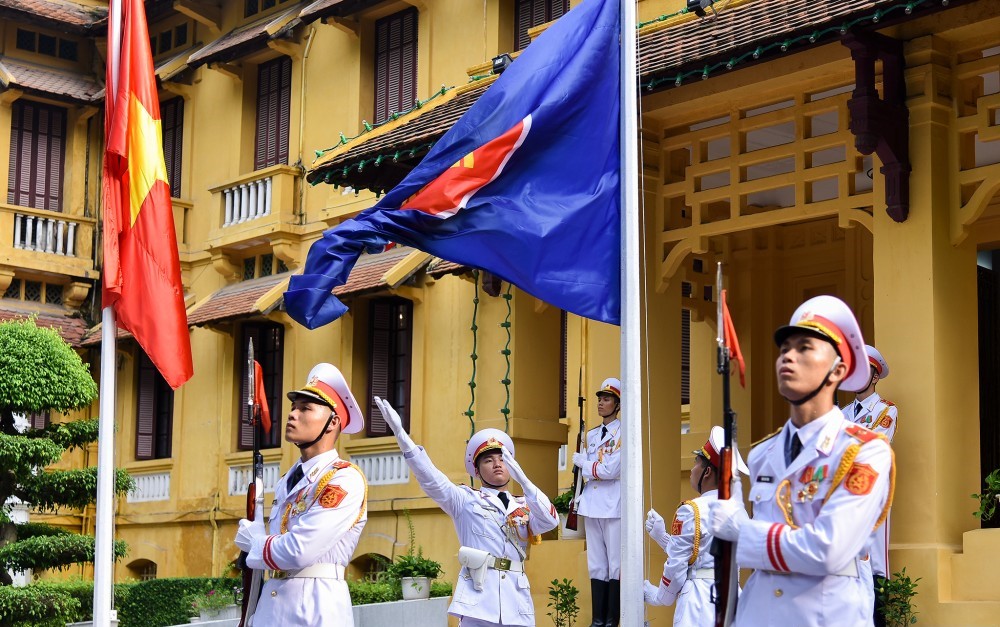
| Vietnam and ASEAN's flags raised in Hanoi. Photo: MOFA |
Vietnam’s diplomatic activism in recent years has reinforced ASEAN’s central role in addressing regional challenges – another indication of Hanoi’s strong preference for multilateralism. The most illustrative example is Vietnam’s 2020 chairmanship, themed “cohesive and responsive ASEAN”. Hanoi’s leadership in navigating the bloc through a tough year of the Covid-19 pandemic and intensifying great power competition truly reflected this ‘cohesive and responsive’ spirit.
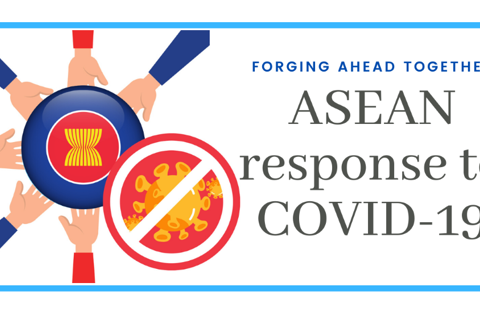
In April 2020, one month after WHO declared the Covid-19 pandemic, Vietnam hosted a special ASEAN Summit on Coronavirus Disease, which resulted in the creation of a Covid-19 ASEAN Response Fund and regional medical supplies stock. Leveraging on its chairmanship, Vietnam also facilitated ASEAN’s cooperation with China, the United States, Japan, South Korea, and the European Union in minimizing the health and economic impacts of the pandemic.
Hanoi is wary about the impacts of great power competition on regional peace and stability, as well as ASEAN’s centrality. Hence, Vietnam has urged external powers to adhere to the norms and principles set by ASEAN, lest more powerful states impose their will upon Southeast Asian countries.
At a press conference following the 37th ASEAN Summit in 2020, then-Prime Minister Nguyen Xuan Phuc remarked that major powers should provide substantive contributions to the region and respect the central role of ASEAN. The Vietnamese foreign ministry has consistently echoed the same view on minilateral groupings spurred by US-China strategic competition such as the Quad and AUKUS.
Vietnam's middle power diplomacy in ASEAN has strengthened the group itself and contributed to the preservation of regional peace and stability. Its championship of regional multilateralism and ASEAN centrality is welcomed amid growing challenges posed by non-traditional security threats and great power rivalry.
Phan Xuan Dung is Research Officer at the Vietnam Studies Programme, ISEAS – Yusof Ishak Institute