A successful year in attracting foreign investment
In 2013, the economy of Viet Nam expanded by 5.42%, with one fifth of GDP contributed by foreign-invested companies. With pledges totalling $21.6 billion, foreign direct investment (FDI) in 2013 far exceeded the estimate of $13-14 billion.
According to the ND, there are three core issues that an FDI recipient country needs to take into account, namely capital, technology and State management. The good news is that in 2013, FDI attraction recorded many achievements on all three of these aspects.
Capital is viewed as the most important objective, because capital is the prerequisite for investment to generate revenue, create jobs, produce exports and help realise the goals of industrialisation and modernisation.
In 2013, amidst a drop in investment from the State sector and a large proportion of investment from the non-State sector trapped in the property sector, investment from the foreign sector rose sharply, reflecting the irreplaceable role of FDI over the past 25 years.
In the first half or 2013, FDI disbursement hit$5.7 billion, a rise of 5.6% from a year earlier and equal to 54.8% of the 2012 total. During the same period, FDI pledges reached $10.5 billion, up 15% from a year ago and equal to 80% of the 2012 total. That momentum was maintained in the final months to bring FDI disbursement and pledges to $11.5 billion and $21.6 billion respectively, respective rises of 9.9% and 54.5%.
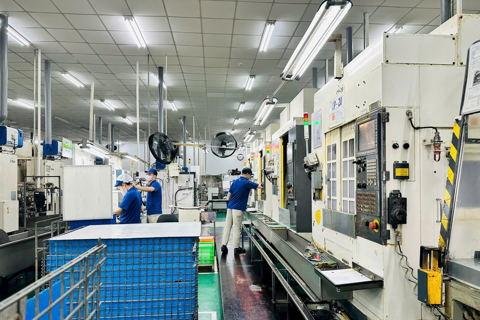
As well as an increase in quantity, FDI also saw an improvement in quality with the majority of capital poured into high-tech and manufacturing projects. A number of large projects were granted investment licences in 2013, including two Samsung manufacturing facilities in Thai Nguyen and Bac Ninh provinces with a total capital of $3 billion, the $2.8 billion Nghi Son Refinery project in Thanh Hoa province and the Phu Yen-based. Vung Ro Refinery project worth$3.18 billion.
In addition to capital, FDI was also considered an important channel for attracting high technology from advanced economies in order to innovate the industry and enhance the technological level of Vietnamese companies and the broader economy. Viet Nam will fail to narrow the development gap with other countries and attain industrialisation and modernisation goals without advanced technology. Given that only around 5-6% of foreign companies currently employ high tech in their Viet Nam-based production processes, investment projects by Samsung and Nokia have set a new trend. Foreign-invested projects are shifting from product assembly only to include both component manufacturing and product assembly.
State management on foreign investment also has played a central role in the success of any country in absorbing this capital font. No matter how much capital and how advanced technology may become, foreign-invested projects will not succeed without good management. It can be seen from the March conference on 25 years of foreign investment in Viet Nam and Government Resolution 103 on enhancing the effectiveness of FDI attraction, use and management that the Government is taking bold steps to improve the quality of FDI and its contributions to Viet Nam’s economic growth.
Refining the investment environment
Achievements in FDI activity this year were largely a result of improvement in the Government’s management capacity and the dynamism of foreign-invested firms. The investment climate in Viet Nam, despite many weaknesses, still possesses the fundamental conditions in terms of infrastructure, water, power, human resources, services and legal system for foreign enterprises to operate effectively. Efforts to improve the investment environment in Viet Nam have been recognised by the international community. In the 2013-14 Global Competitiveness Report released at the World Economic Forum, Viet Nam jumped five positions to 70th, which resulted from better macroeconomic environment (87th, up 19 positions) and improvements to the quality of transport and energy infrastructure (82nd, up 13 positions). Viet Nam also advanced on the goods market efficiency index (74th, up 17) thanks to lower trade barriers and a less restrictive tax rate on businesses. Socio-political stability is a further advantage of the investment environment in Viet Nam.
In addition, a large population of over 90 million people with increasing income and a bright economic outlook make Viet Nam an attractive destination for both established and new investors. Investors such as Samsung and LG saw the potential of a growing demand for smartphones and other electronic devices in Viet Nam. In addition to high-tech gadgets, Viet Nam is also a potential market for other consumer goods, hospitality and culinary services, education and training and healthcare.
With their expertise on the market, the legal system and the way of doing business in Viet Nam, traditional partners in Asia such as Japan, the Republic of Korea, and Singapore have continued to increase their investment in Viet Nam. In 2013, Japan was the largest investor in Viet Nam while Singapore, the Republic of Korea and China also ranked among the top ten.
Encouraging results in FDI attraction in 2013 are expected to herald a new phase for the sustainable development of foreign investment in Viet Nam as directed in Resolution 103. The aggressive implementation of Resolution 103 is an urgent requirement for Government, ministries, agencies and localities. If policies and legal documents related to this activity are slow to be introduced, it will impede Viet Nam’s pathway to prosperity during the integration process. From the experience in the implementation of Government resolutions and directives, as well as the organisation of conferences on foreign investment, the Viet Nam Business Forum and the Viet Nam – Japan Joint Initiative, the Government needs to establish an interdisciplinary working group to oversee and expedite the implementation of Resolution 103 in the early days of 2014.
This is a prerequisite to enhancing the effectiveness of foreign investment in 2014 and the following years.