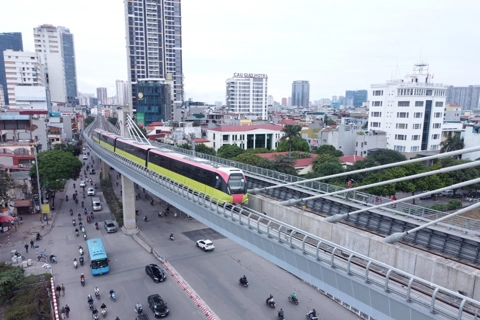
AIIB ready to fund Hanoi’s urban railway projects
Hanoi expects the AIIB to assist with planning, implementation methods, and financing strategies to rapidly deploy metro projects.
The Asian Infrastructure Investment Bank (AIIB) is standing ready to provide resources to help Hanoi implement railway and highway projects connecting various regions. This support will assist the city in maintaining and advancing its economic growth and infrastructure development.
| Chairman of the Hanoi People's Committee Tran Sy Thanh and AIIB President Jin Liqun. Photo: Lien Ha/The Hanoi Times |
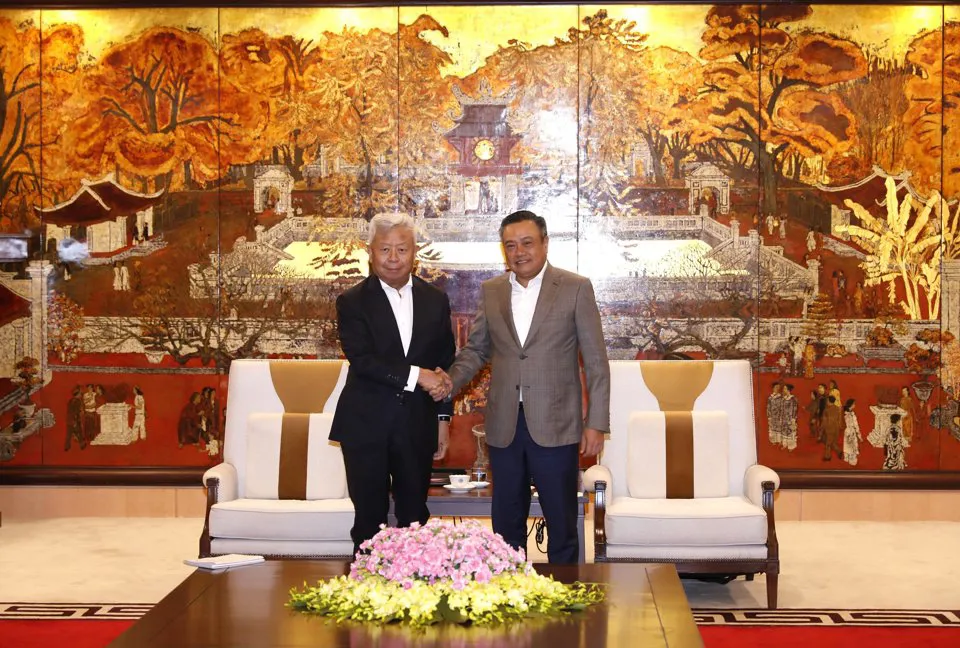
AIIB President Jin Liqun shared the view during a meeting with Chairman of the Hanoi People’s Committee Tran Sy Thanh on July 16.
Jin said he was honored to have the opportunity to discuss with the Hanoi authorities. He emphasized that Hanoi's development plays a crucial role in Vietnam's socio-economic progress.
According to the AIIB President, Vietnam has been one of the first partners to collaborate with China since the bank's inception.
Over the past 20 years, Vietnam has made remarkable socio-economic progress and still has significant potential for further development in energy and transportation, aiming to become a modern urban area in the region, he said.
The railway and highway projects connecting different regions are vital backbones. The AIIB is ready to provide resources to help Hanoi maintain and further its economic and infrastructure achievements, Jin said.
The Chairman of the Hanoi People's Committee also expressed his support for Hanoi's cooperation with the AIIB and his willingness to work with the Bank's management based on the proposal of the State Bank of Vietnam (SBV).
Thanh affirmed that the visit of the AIIB delegation was timely, as the National Assembly had recently approved important documents, including the Hanoi Planning to 2030 with a vision to 2045, and the General Adjustment Planning of the Capital to 2045 with a vision to 2065. These plans aim to restructure the city's appearance and enhance urban infrastructure.
The Chairman mentioned that Hanoi aims to add 10 more metro lines, with the basic completion expected by 2035. Additionally, the recently amended Capital Law grants Hanoi autonomy in implementing projects and mobilizing both domestic and international resources.
In this context, Hanoi hopes to receive advice from AIIB investors and experts on planning, implementation methods, and financing strategies to rapidly deploy these projects, he continued. Moreover, the city needs to consider future urban railway lines' technology, uniformity, and integration capabilities.
The AIIB President confirmed that the issues raised by the Mayor were in line with global trends in urban transportation projects. He noted that Hanoi's approach of having a unique mechanism for project implementation is logical and targeted, minimizing administrative procedures.
The AIIB President emphasized that the bank's priority is to maximize the efficiency of financial resources and operational productivity, with effective design and rapid implementation being crucial factors for each project.
Jin expressed the Bank’s desire to have more positive exchanges with the city authorities to open up specific cooperation opportunities.
"The AIIB wants to be a trustworthy partner for Vietnam, bringing positive impacts to the development of Hanoi," said Jin.