Amended Capital Law raises development standards above national average
Well-designed mechanisms will make Hanoi a driving force for socio-economic development while ensuring national defense, security, and cultural advancement.
The revised Capital Law should significantly raise Hanoi's development standards, surpassing the national average and embodying the vision of a cultured, modern, and civilized city.
| Deputy Hoang Van Cuong during the session. Photos: VGP |
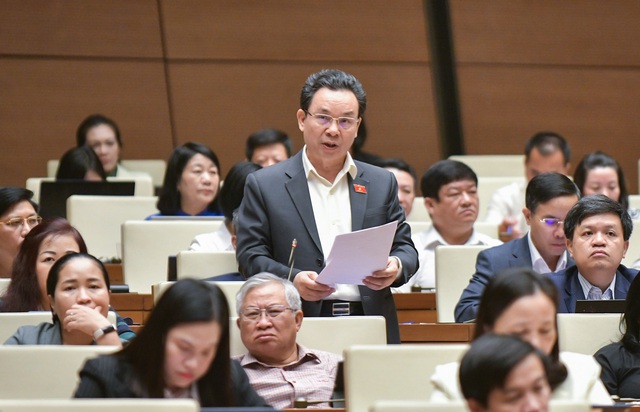
National Assembly Deputy and Vice President of National Economics University Hoang Van Cuong made the remarks today [November 27] during a discussion session at the National Assembly on the draft law project.
Commenting on the bill, Cuong highlighted the need for the revised Capital Law to set higher development requirements. He emphasized the importance of creating a mechanism to harness internal advantages and foster a strong allure to attract external sources for investment.
"It is necessary for the law to define roles, responsibilities, and powers that the capital's government and residents assume, some of which will be distinct from those of other localities in the country," Cuong stressed.
The deputy underscored the importance of a comprehensive and synchronized approach in establishing standards, regulations, and development planning for the capital.
This approach aims to meet the criteria of a modern, civilized, and cultured capital, exceeding the general national standards.
"Architectural projects in the capital should carry cultural and historical significance, creating spaces that amalgamate regional characteristics," he noted.
Cuong also pointed out the necessity to manage the overall development of the entire territorial space of the capital in compliance with the management standards of special urban areas. "This includes the central urban area, rural regions, and outer urban areas according to a city-within-city model."
He also urged that various spaces, such as areas planned for urban agricultural development, should be allowed for the construction of tourism service projects. Craft village industrial development spaces need integration with commercial and service projects.
"To achieve these goals, the Law should delegate specific powers to the municipal People's Council and People's Committee, ensuring clear authority without fear of abuse or disruption of planning," Cuong said. However, he also stressed the importance of avoiding excessive detail in the law to prevent implementation challenges.
In light of the proposed decentralization and empowerment, he acknowledged that the city government's tasks and workload would increase, requiring higher levels of oversight responsibility. Therefore, Cuong advocated for a model of urban government better suited to this empowerment, as outlined in the draft law.
Leaders of urban governments at all levels should play a more influential role with greater decision-making authority and self-responsibility.
There is a consensus that the number of People's Council deputies needs to be expanded, with a higher proportion of full-time deputies to enhance professionalism. Standards and qualifications for these representatives must also be elevated.
Regarding the allocation of resources for the capital's development, Cuong expressed his support for the policy mechanisms outlined in the draft law, particularly the mobilization of the private sector to invest in culture, sports, heritage exploitation, and tourism.
Deputy Nguyen Thi Lan from the Hanoi National Assembly delegation expressed general agreement with many aspects of the amended Capital Law. She praised the comprehensive and serious preparation of the draft, which assesses the outcomes of the implementation of the 2012 Capital Law and clearly defines the context, position, role, and requirements for capital development in the current situation.
"The draft law has updated its provisions to be compatible with other laws, such as those related to land, science and technology, innovation, talent attraction, and the global context," Lan noted.
According to Lan, the bill is considered to be highly inheritable and closely aligned with guidelines and policies for the country's overall development and the capital's development in the foreseeable future.
In particular, Lan noted that the draft law introduces novel elements aimed at advancing science and technology, linking them to practice, and positioning Hanoi as a leading hub for innovation, research, development, and technology transfer at national and regional levels. The emphasis is on fostering a creative entrepreneurial ecosystem.
In addressing science and technology matters related to the capital, with a particular focus on Article 25 of the draft law, Lan called for more incentives and favorable conditions for scientists and researchers.
"The amendment should mandate the Hanoi People's Committee to develop a focused, interdisciplinary, and continuous science, technology, and innovation program that addresses key issues or fields facing the city and links them to final products bearing the city's brand," Lan said.
Simultaneously, she expected the city to set up a creative fund, which incorporates a distinctive reward system for experts in crucial science and technology fields in the city. The law should also empower Hanoi's universities to actively recruit, select, train, and cultivate a team of experts for the city.
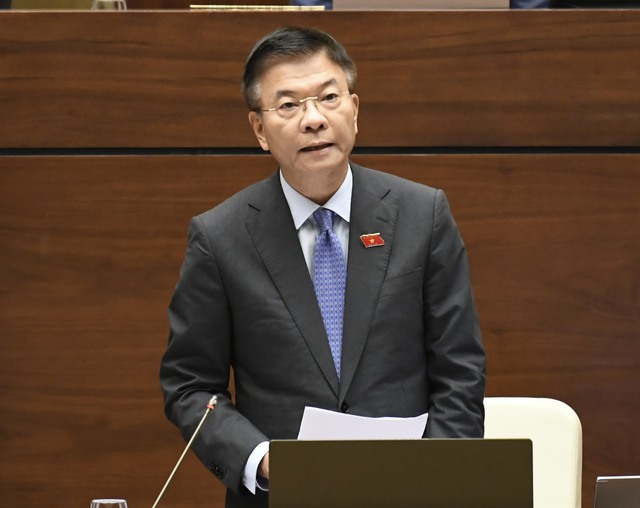
| Minister of Justice Le Thanh Long. |
Significance of draft amended Capital Law
During the discussion session, Minister of Justice Le Thanh Long reported that there have been over 100 comments on the Law project, both in group discussions and in written form.
Long emphasized that there is unanimous agreement on the necessity of enacting this law.
"The project has a clear legal, political, and practical basis and provides specific mechanisms not only for Hanoi as a city but also as the national capital," Long said.
The minister highlighted that if well-crafted mechanisms are established for the capital's development, it can act as a driving force for socio-economic development while ensuring national defense, security, and cultural advancement for the entire country—a view widely supported by the deputies.
Furthermore, Long mentioned that deputies agreed with the mechanisms and policies outlined in the draft law. However, they also suggested clarifications on certain policies, expansions in scope and specificity, and adjustments in the order and content of some chapters and articles. Specific issues such as housing, talent-based urban management, Build-Operate-Transfer (BOT), and cultural matters were also highlighted for more detailed consideration.
The minister assured the deputies that their opinions would be thoroughly studied, assimilated, and explained by the agencies responsible for drafting the law. The feedback, along with a report from Hanoi, will be forwarded to the Government and the National Assembly Standing Committee to further refine the bill for consideration and approval in subsequent sessions.
The final version of the draft revised Capital Law is set to be presented for approval during the National Assembly's 7th session in May 2024.