Amended Capital Law helps Hanoi ensure urban rebalancing
A major change under the upcoming amended Capital Law is the imminent development of new, modern offices, industrial parks, university towns, and hospitals in Hanoi.
Moving polluting manufacturing facilities and hospitals out of the city center is a key strategy for urban development and rebalancing. The draft amendment to the Capital Law provides refined regulations in this regard to better suit present circumstances.
| The University of Social Sciences and Humanities on Nguyen Trai Street. Photo: Cong Hung/The Hanoi Times |
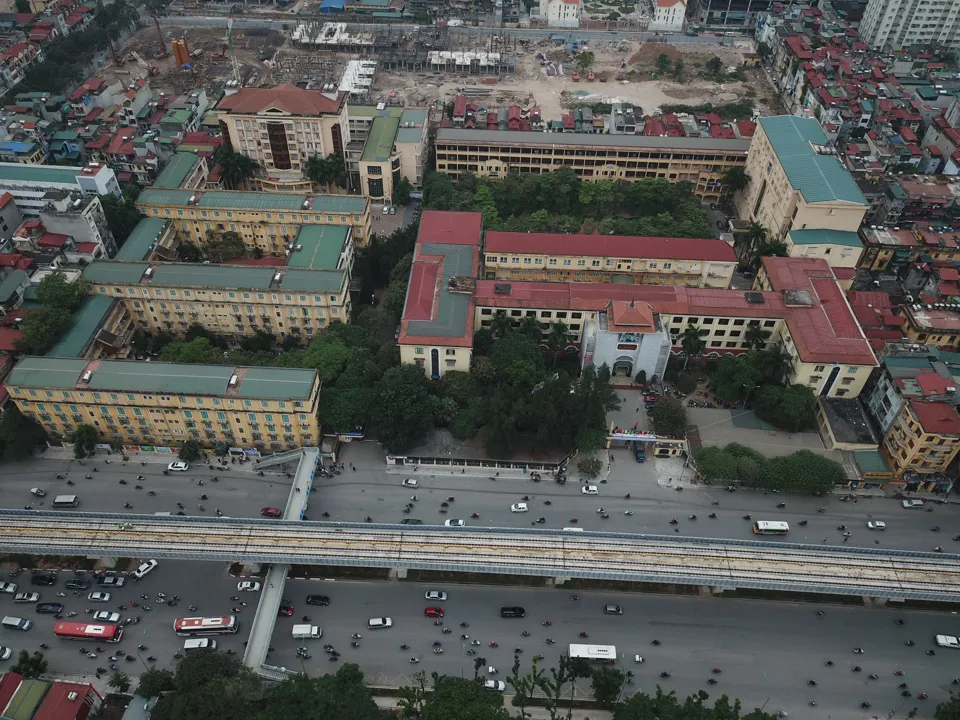
The central area of Hanoi faces numerous challenges, including limited land resources, strained infrastructure, traffic congestion, and environmental pollution. Consequently, the need to relocate factories, offices, hospitals, and universities away from downtown is evident.
In March 2021, the Hanoi People's Committee approved six historic inner-city subdivision planning projects to reduce the area's population density by about 215,000 people by 2030. One proposed solution involves relocating industrial facilities, central agency headquarters, and educational and medical institutions.
Director of the Hanoi Urban Planning Institute Luu Quang Huy during a conference on Capital Planning held recently expected this strategic relocation to free up some 176 hectares of land, providing much-needed space for public projects and green areas.
Despite the pressing demands, however, the organizational and implementation aspects, from programming and planning to on-the-ground execution, are progressing at a slow pace, Huy said.
In particular, there are concerns that some agencies will not hand over the vacated land or build high-rise residential and commercial buildings on it.
Some universities and colleges, including the University of Public Health and Hanoi National University, have begun partial relocation to places like the Hoa Lac Hi-tech Park in Thach That District. But overall progress remains slow.
In a recent discussion session at the National Assembly, Minister of Construction Nguyen Thanh Nghi highlighted that the agency has issued several directives, urging speedy relocation. However, the implementation is encountering challenges stemming from the shortage of funds for relocation and the construction of new facilities, compounded by the absence of a construction resource mobilization plan.
The Ministry of Construction has conducted a comprehensive review of 36 central agencies whose headquarters are to be moved out of central Hanoi. These include 18 ministries, 4 ministerial-level agencies, 8 agencies under the Government, and 6 central agencies and organizations that are subject to specific planning for development.
The Prime Minister approved the planning project to build a system of ministry and agency headquarters in Hanoi in April 2023.
Promoting decentralization in relocating facilities
At the National Assembly's sixth session on November 10, Secretary of the Hanoi Party Committee Dinh Tien Dung urged the draft amended Capital Law should give more power to the city. This is intended to address limitations and inadequacies, including the relocation of medical and educational facilities from the inner city.
Dung proposed a mechanism for Hanoi to allocate budget funds for site clearance and the construction of new headquarters for universities and hospitals. The old facilities could then be handed over to the city or repurposed for postgraduate training or international cooperation research facilities, thereby reducing population density.
In the draft amended Capital Law, regulations related to relocating environmentally polluting production facilities and hospitals from the historic inner city have been reviewed and adjusted. This aligns with Resolution No. 15-NQ/TU of the Politburo, focusing on the development of the capital city of Hanoi by 2030 with a vision for 2045. The goal is to prevent existing hospitals from building more in the central city and to discourage the construction of new industrial facilities, universities, and colleges in the historic downtown area.
Planning experts support this new regulation to build hospital facilities in new locations, considering Hanoi's current population of about 8.5 million people. Notably, the urban population has grown by 49.82% from 2009 to the present, underscoring the need for a better distribution of hospitals to meet the city's and the country's healthcare needs. This approach is also consistent with relocating polluting medical facilities out of central urban areas.
Concerning the utilization of land resources post-relocation, the regulation prioritizes the construction of public spaces and the preservation and promotion of cultural values. This stipulation is regarded as a novel addition to concretize the requirements outlined in Resolution No. 15-NQ/TU of the Politburo, establishing specific conditions and tasks for the use of land resources after relocation.
To uphold the genuine intent of Resolution No. 15-NQ/TU, prevent arbitrary actions, and avoid misuse in implementing this regulation, some proposals suggest adjusting the draft to explicitly state that the land vacated post-relocation should be exclusively used for the construction of public facilities and social amenities. These may include schools, libraries, cultural and sports facilities, parks, gardens, and green spaces.
With a resolute commitment to addressing long-standing limitations and shortcomings, the provisions of the amended draft of the Capital Law are expected to usher in transformative changes in urban development and rebalancing.
| “A significant change under the forthcoming amended Capital Law is the imminent development of new, modern offices, industrial parks, university towns, and hospitals in Hanoi. These will be strategically distributed, contributing to sustainable urban development, showcasing Hanoi's status as the capital while upholding its urban identity with a rich history spanning a thousand years of civilization,” said architect Vu Hoai Duc from Hanoi National University. |