Australia invests another US$17 million in Vietnam’s innovation ecosystem
Australia's support through the Aus4Innovation program has delivered tangible, significant results, which are substantial to the lives of many Vietnamese people.
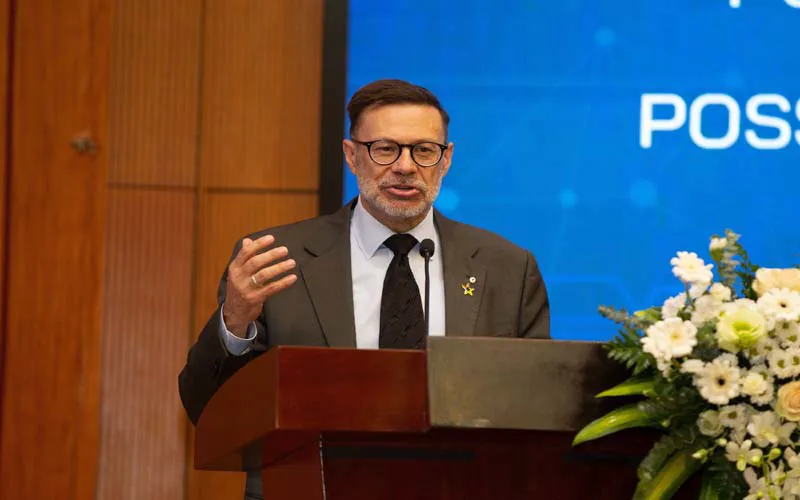
The Australian Government has decided to invest an additional A$17 million (US$11.2 million) in Vietnam's innovation ecosystem, Andrew Goledzinowski, Australian Ambassador to Vietnam, said at the Vietnam-Australia Innovation Partnership Day in Hanoi on June 30.
"While Australia and Vietnam are at different stages of development, we share the ambition to base our future growth on science and technology and the potential for increased international cooperation in innovation for global and regional solutions," Andrew Goledzinowski added.
He said the innovation cooperation involving all levels - individual, institutional, and governmental - is proving sustainable.
"As our two countries work to elevate our relationship to a Comprehensive Strategic Partnership, we will continue to deepen our cooperation in trade and investment, defense and security, and knowledge and innovation," he emphasized.
Andrew Goledzinowski, Australian Ambassador to Vietnam, gives the opening speech. Photo: DFAT |
Speaking at the event, Huynh Thanh Dat, Vietnamese Minister of Science and Technology, said that the partnership with Australia through the Aus4Innovation program had produced tangible and significant results that have had a significant positive impact on the lives of the Vietnamese people.
With the launch of the Strategy for the Development of Science, Technology and Innovation (STI) in Vietnam to 2030, the country reaffirms the central role of STI in addressing emerging economic, societal, and institutional challenges.
Dat said MoST is working hard to achieve the goals set out in the strategy, knowing that it has the support of a trusted partner like Australia to achieve much more over the next five years and beyond.
CSIRO's Executive Director of Growth, Jonathan Law, said the next phase of the Aus4Innovation program would build on the established strong foundations.
Over the next five years, the program will focus more on areas of Vietnamese priority, such as resilient agriculture and food, and introduce appropriate interventions for the digital age, including responsible artificial intelligence, he added.
The Aus4Innovation program is delivered through a tripartite partnership between Australia's Department of Foreign Affairs and Trade (DFAT), CSIRO - Australia's national science agency - and Vietnam's Ministry of Science and Technology (MoST).
The program has explored emerging areas of technology and digital transformation, piloted new models for public-private partnerships, and strengthened Vietnamese capabilities in digital foresight, scenario planning, science commercialization and innovation policy.
Since 2018, the Australian government has been investing in the development of an innovation ecosystem in Vietnam through its flagship Aus4Innovation program. It was recently announced that the Aus4Innovation program will be extended to 2028, making it a 10-year commitment with a total budget of AU$33.5 million.
After five years of operation across 37 provinces in Vietnam, the program has achieved some notable successes: laid the groundwork for 82 partnerships between Australian and Vietnamese universities, research institutions, high-tech companies, and policymakers; and developed a pool of 875 trainers and experts through capacity-building activities.
At the same time, it demonstrates 12 innovative solutions to illustrate how innovation and technology can solve socio-economic challenges; contributes to national science, technology and innovation policies and develops practical tools for innovation policy development to contribute to a more enabling environment; and develops eight platforms to enable collaboration on innovation across research institutions and business.
The partnership between CSIRO and MoST was formalized in 2018 with a Memorandum of Understanding to promote collaboration in science, technology and innovation. In June 2023, this collaboration was further strengthened with another Memorandum of Understanding between the Australian Department of Foreign Affairs and Trade (DFAT) and MoST, signed during the official visit of Australian Prime Minister Anthony Albanese to Vietnam.