Bright prospects for FDI inflows into Vietnam in 2025
Market size, growth potential, low labor costs, and stable political and social conditions continue to be Vietnam’s selling points in attracting foreign investors.
Although the world in 2025 is still uncertain, experts predict that FDI in Vietnam will remain stable if policies and infrastructure continue to improve.
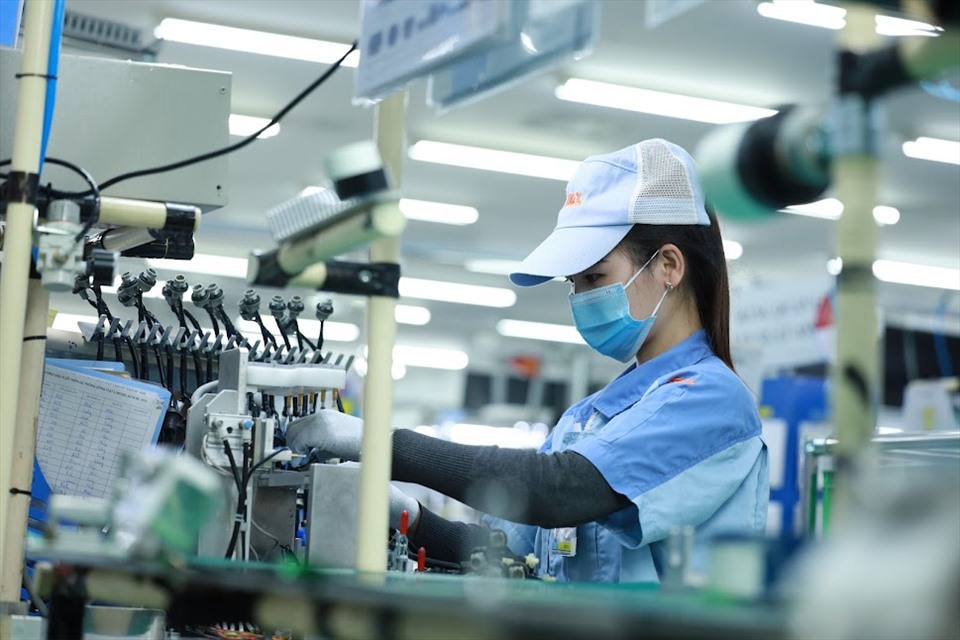
| A local worker at Stanley Electronic Company in Vietnam. Photo: Hai Nguyen/The Hanoi Times |
The latest survey revealed that 75% of European business leaders said they would recommend Vietnam as an ideal investment destination. EuroCham Vietnam described this figure as the most outstanding result in the Business Confidence Index survey for the fourth quarter of 2024.
Bruno Jaspaert, Chairman of EuroCham Vietnam, noted that European investors are interested in sectors such as technology, manufacturing, tourism, and renewable energy. He said that despite global challenges, Vietnam’s positive investment environment is creating many new opportunities for European businesses.
Last year, total foreign direct investment in Vietnam reached nearly US$38.23 billion, a 3% decline compared to 2023, according to data from the Foreign Investment Agency (FIA) of the Ministry of Planning and Investment. A bright spot was that actual FDI increased by 9.4% year on year to $25.35 billion, while adjusted capital also grew in both the number of projects (11.2%) and in value (50.4%).
The two largest partners, Singapore and South Korea increased their investments in Vietnam by 31.1% and 37.5% respectively last year. China led in terms of new projects, accounting for 28.3% of the total. The FIA assessed that foreign investors continue to have confidence in Vietnam’s investment environment.
The global economy in 2025 is forecast to grow by 2.7%, a slight improvement from last year’s 2.6%, according to the World Bank. Even the more optimistic estimate from the UN is only slightly higher, at 2.8%.
At the same time, several major factors are conditioning international investor sentiment, including geopolitical conflicts, the policies of US President Donald Trump, and the response strategies of various economies – all of which are hard to predict.
Nevertheless, research groups forecast that FDI inflows into Vietnam will remain stable. HSBC experts Ngo Dang Khoa and Vu Binh Minh recently noted that foreign capital in the manufacturing sector is likely to continue growing.
These trends are the result of diplomatic visits by leaders, which have sparked investment interest from many global companies and corporations. In its first-half 2025 strategic report, the analysis team from VNDirect Securities suggested that Trump's return might cause short-term disruptions to FDI flows as investors reassess tariff risks.
However, in the medium and long term, the capital flows are expected to stabilize and grow sustainably. With the Republican Party in power in the US, Vietnam remains attractive for FDI which tends to be long-term in nature, as well as thanks to its solid production base, skilled workforce, and strategic geographic location, stated the VNDirect Securities’ report.
Commenting on the fact that 75% of European companies view Vietnam as an ideal destination, the Chairman of EuroCham noted that the growing confidence is due to Vietnam’s strong foundation in trade and economic policies.
The Japanese investor community shares a similar view, with more than 56% planning to expand their business in Vietnam within the next one to two years. This is the highest rate in Southeast Asia, according to a 2024 survey by the Japan External Trade Organization (JETRO).
Japanese businesses cite market size, growth potential, low labor costs, and stable political and social conditions as their top advantages, all of which are above the ASEAN average.
However, foreign investors have pointed out that Vietnam needs to improve the efficiency of its government operations and administrative procedures. JETRO has identified three main factors that make Japanese companies reluctant to invest further: cumbersome administrative procedures, complex taxation, and an imperfect legal system with insufficient transparent enforcement. Similarly, European companies have indicated that administrative burdens, unclear regulations, and difficulties in obtaining permits are obstacles. Chairman Jaspaert compared building a regulatory framework to constructing a house, stressing the need for a strong foundation.
He added that a transparent and clear legal process would help the country develop, improve trade, and encourage investors to see Vietnam as their new home.
Many European companies expect that reorganizing and streamlining the government apparatus will lead to significant improvements in administrative procedures. "This is a huge and complex project, but achievements such as economic development and increased FDI will make all efforts worthwhile," said the Jaspaert.
At the same time, 40% of European companies mentioned that improved infrastructure helps reduce transportation costs and enhance foreign trade connectivity.