Log in
Business

Car sales in Vietnam down 14% on “ghost month”

The figure marked the first decline in car sales in four months, following month-on-month increases of 0.3% in July, 26.4% in June and 103% in May.

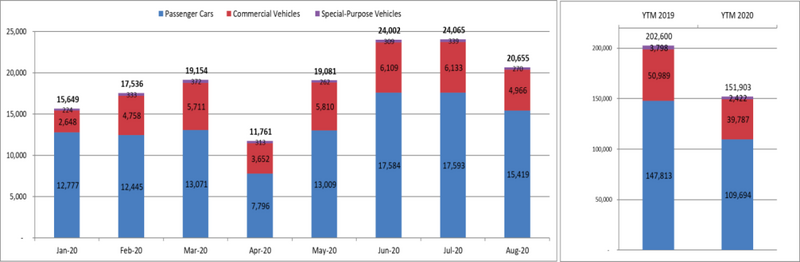
The number of cars sold in Vietnam decreased by 14% month-on-month and 4% year-on-year to 20,655 units in August, which is also the seventh month on lunar calendar, traditionally called “the ghost month” when locals avoid buying new valuable things on fear of bad luck.

The figure, released monthly by the Vietnam Automobile Manufacturers Association (VAMA), marked the first decline in car sales number in four months, following month-on-month growth of 0.3%  in July, 26.4% in June and 62% in May.

 Number of car sales in eight-month period. Source: VAMA. 

The volume included 15,419 passenger cars, down 12% inter-monthly; 4,966 commercial cars, down 20%; and 270 special-purpose vehicles, down 19%. 

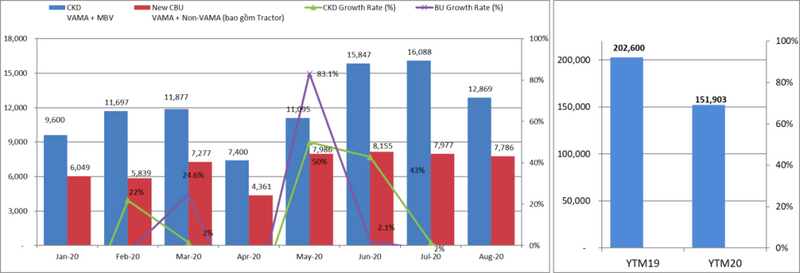
The sales volume of locally assembled cars in August was 12,869 units, down 20% against the previous month, and that of imported cars was 7,786, down 2%.

Overall, car sales in Vietnam in the January–August period dropped 25% year-on-year to 151,903 units across all segments. Upon breaking down, 109,694 were passenger cars, down 26% year-on-year; 39,787 were commercial vehicles, down 22%; and 2,422 were special-purpose vehicles, down 36%. 

Sales of domestically assembled cars reached 96,473 units during the period, down 19% compared to the same period of last year, while imported completely-built-units (CBUs) totaled 55,430 units (-33%).

 Sales of imported cars down 33% year-on-year in January - August period. Source: VAMA. 

Truong Hai Auto Corporation (Thaco) led the market in the first eight months with 49,940 units sold, down 16% year-on-year, followed by TC Motor with 40,987 and Toyota with 34,743.

Automobile is considered a key industry in Vietnam, accounting for approximately 3% of national GDP. However, this industry was severely impacted by the Covid-19 pandemic, with Viet Dragon Securities Company predicting a decline of 15% in sales volume this year compared to its prevision earlier this year.

The government has been adopting a number of supporting policies to boost sales of made-in Vietnam cars in the remaining months of the year, including the decision to slash the registration fee for domestically-produced cars by 50%, effective from June 28, and extend the deadline for payment of excise taxes for domestically-produced/assembled cars until late 2020.

From July 10, 2020, the government’s Decree No.57 amending and supplementing Decree No. 122, allows domestic assembling companies (meeting standards) to be entitled with 0% import tariff on raw materials, components and supplies which cannot be produced locally. The move is set to reduce production costs by 2-5%, so that selling prices can be consequently lowered in order to boost demand. 
Reactions:
Share:
Trending
Most Viewed
Related news
Vietnam honors 50 transparent listed companies as stock market reaches new milestones

Vietnam honors 50 transparent listed companies as stock market reaches new milestones

Vietnam honored 50 listed companies for excellence in transparency at the 2025 Vietnam Listed Company Awards, which spotlighted standout annual reports, corporate governance and sustainability disclosures amid rising foreign investor interest and growing alignment with international reporting standards.

Vietnam to tighten biometric authentication for new bank cards next year

Vietnam to tighten biometric authentication for new bank cards next year

Bank card issuers must conduct a face-to-face meeting and match the biometric data of individual customers or the legal representative of organizational customers with their identity documents.

Make in Vietnam forum spotlights breakthroughs shaping digital future in the country

Make in Vietnam forum spotlights breakthroughs shaping digital future in the country

Vietnam will host the seventh National Forum on Vietnamese Digital Technology Enterprises on December 25 in Hanoi, highlighting policy directions, strategic technologies and progress under the “Make in Vietnam” initiative as the country pushes toward a stronger digital economy.

Hanoi and Moscow seek new economic momentum as partnership marks 75 years

Hanoi and Moscow seek new economic momentum as partnership marks 75 years

At the Moscow–Hanoi Business Forum, leaders from both capitals said 75 years of Vietnam–Russia ties provide a strong foundation to deepen economic and investment cooperation, especially in technology, trade and urban development.

Vietnam manufacturing maintains strong momentum despite storms disrupting supply chains

Vietnam manufacturing maintains strong momentum despite storms disrupting supply chains

Vietnam’s manufacturing sector continued to expand in November, marking the fifth straight month of improvement, even as severe storms caused supply-chain delays and slowed production, according to S&P Global.

Techfest 2025 returns to Hanoi, spotlighting Vietnam’s vibrant startup community

Techfest 2025 returns to Hanoi, spotlighting Vietnam’s vibrant startup community

Hanoi’s Hoan Kiem pedestrian street will host Techfest Vietnam 2025 from December 12 to December 14, welcoming entrepreneurs, investors and the public to explore emerging technologies and celebrate the country’s growing culture of innovation.

Vietnam expands major entrepreneurship program to unlock opportunities for women nationwide

Vietnam expands major entrepreneurship program to unlock opportunities for women nationwide

The Vietnam Women’s Entrepreneurship Support Program has surpassed nearly every target set for 2017–2025, empowering more than 118,000 women to launch new ventures and laying the groundwork for a stronger, more inclusive entrepreneurial ecosystem in the next decade.

HHTIP accompanies businesses in efficient energy use for sustainability

HHTIP accompanies businesses in efficient energy use for sustainability

As green transition becomes a decisive factor shaping future growth, Hanoi is intensifying efforts to push energy efficiency across its industrial zones. The city’s management board is building a development model centered on clean energy, responsible production and sustainable operations.