Circular economy matters to agriculture: Experts
Vietnam has enormous potential in the development of value-added biomass products, as well as biofuels and organic fertilizers.
Circular economy is of great significance to Vietnam’s agriculture as it helps the country achieve climate targets, increase comprehensiveness, protect people’s health and ecosystem.
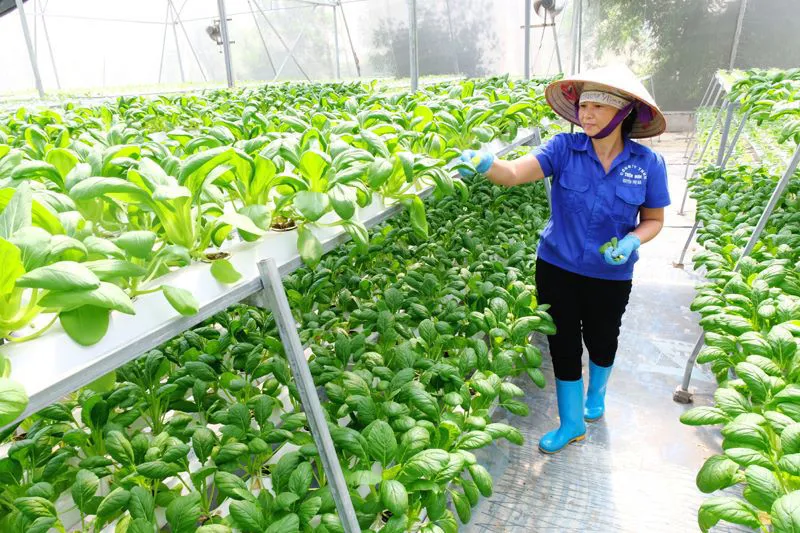
| Hydroponic farming in Soc Son District, Hanoi. Photo: Trong Tung/The Hanoi Times |
The view was shared by Ramla Khalidi, UNDP Resident Representative in Vietnam, at the Policy Dialogue on “Enhancing International Cooperation and Multi-sectoral Coordination on Circular Economy in Agriculture” held recently in Hanoi.
Making the most of large-scale cyclical models would be crucial given the scope and significance of Vietnam’s agricultural sector, including its effects on the environment, contribution to greenhouse gas emissions, and susceptibility to the effects of climate change, Ramla Khalidi said at the event she co-chaired with Deputy Minister of Agriculture and Rural Development (MARD) Phung Duc Tien.
Currently, rice production is responsible for 75% of Vietnam’s methane emissions and nearly half of its agricultural sector’s greenhouse gas emissions. The high amount of emissions is caused by excessive irrigation, wasteful use of energy and fertilizers, and inadequate management.
Circular agriculture also helps improve Vietnam’s competitiveness as the agricultural sector plays an important role in economic development, food security, and livelihoods. In 2022, agro-forestry-fisheries made US$53 billion worth of exports and posted an annual growth rate of 3.36% – a record high over the past years.
It is estimated that Vietnam produces between 95 and 98 million tons of agricultural waste annually as by-products from food and industrial crop production, of which, 52 million tons of straw and rice husks come from rice production. This means Vietnam has great potential in creating value-added biomass products and developing biofuels and organic fertilizers. In fact, more than 85 million tons of liquid organic fertilizer can be produced in the soil by mixing livestock manure with crop residue.
Additionally, circular economy in agriculture can safeguard ecosystems and public health. Every year, the livestock sector in Vietnam produces over 76 million tons of liquid waste and close to 72 million tons of solid waste. If not treated, this waste will harm water and soil, affecting crop quality.
Sharing with The Hanoi Times, Ramla Khalidi emphasized that “Accelerated resource recovery from agro-waste will contribute to reusing and producing materials, proteins, energy, and nutrients while improving food quality and strengthening the resilience of food systems and smallholders to rapidly increasing climate impacts.”
She highlighted efforts to stimulate markets for circular products from the supply side, which builds on science technologies to design farming systems that efficiently use natural resources at the farm level and along the whole supply chain, including all actors in processing, transport, retailers, therefore promoting responsible sourcing from farm to fork.
In the talks with The Hanoi Times, Deputy Minister Phung Duc Tien of the Ministry of Agriculture and Rural Development stressed the importance of developing a circular economy in agriculture, saying “It is not only a requirement and an inevitable trend, but also a solution for a sustainable and effective agricultural development to fulfill international commitments and implement national tasks on green and sustainable development.”
He emphasized the crucial and practical role of circular agriculture in ensuring economic, social, and environmental benefits when applying circular agricultural models. More than ever, climate change, scarcity of natural resources, environmental degradation, diseases, and other factors are compelling countries to reconsider their approaches to development and production, guided by the fundamental principle that “everything serves as input for something else.”
Based on the principles of strengthening multilateral international cooperation and multi-sectoral coordination, he called upon the international community, ministries, and agencies from central to local levels and the private sector to collaborate in supporting the agricultural sector to achieve the 10 goals and 6 tasks outlined in the proposal on the prime minister-approved “Development and application of science and technology transfer to accelerate circular economy in agriculture up to 2030.”
The contributions by local and international experts aimed to raise awareness among stakeholders about the role of the circular economy in achieving development goals in the agriculture sector and communicate the key messages of the “Development and application of science and technology transfer to accelerate circular economy in agriculture up to 2030” recently promulgated.
The Dialogue further aims to share best practices in the circular economy; orient key agricultural sectors towards circular economic development and corresponding markets; and identify the challenges and opportunities to make recommendations on appropriate mechanisms and policies for the development of the circular economy. In particular, in the context of development and integration, no single sector can grow independently without interaction and coordination with other sectors.
At the dialogue, representatives from international organizations, including the EU, Australia, Canada, IRRI, and FAO, the private sector, non-governmental organizations, and agencies came together to share international cooperation mechanisms and inter-sectoral coordination to promote circular agriculture practices.
They emphasized the public-private partnership (PPP) in the success of circular agriculture, specifically the proactive role of the private sector in applying science and technology and deploying innovative circular agriculture initiatives and models.
At the Dialogue, UNDP also presented initial results collected under the NDC-Circular Economy Toolbox which aims to support Vietnam in identifying, prioritizing, implementing, and tracking circular interventions in agriculture that contribute to the NDC 2025.
The participating parties agreed and committed to promoting international cooperation and multi sectoral coordination in circular agriculture, pledging to share responsibility for implementing international commitments on climate change and the country’s net-zero goal.
Hanoi's sustainable agriculture plays a crucial role in advancing its circular economy, which aims to minimize waste and make the most of available resources. By promoting sustainable agricultural practices, the city is integrating food production into its broader environmental and economic goals, which include reducing carbon footprints, conserving resources, and promoting efficient waste management.
Hanoi’s emphasis on sustainable agriculture aligns with its efforts to transition towards a circular economy, where the interconnectedness of agriculture, waste, and resource management is leveraged to create more sustainable, efficient systems. This approach contributes to both environmental conservation and economic resilience. | |