Costa Rica becomes 73rd country to recognize Vietnam as market economy
Costa Rica's acknowledgment reflects the achievements Vietnam has made in its development and integration into the global economy.
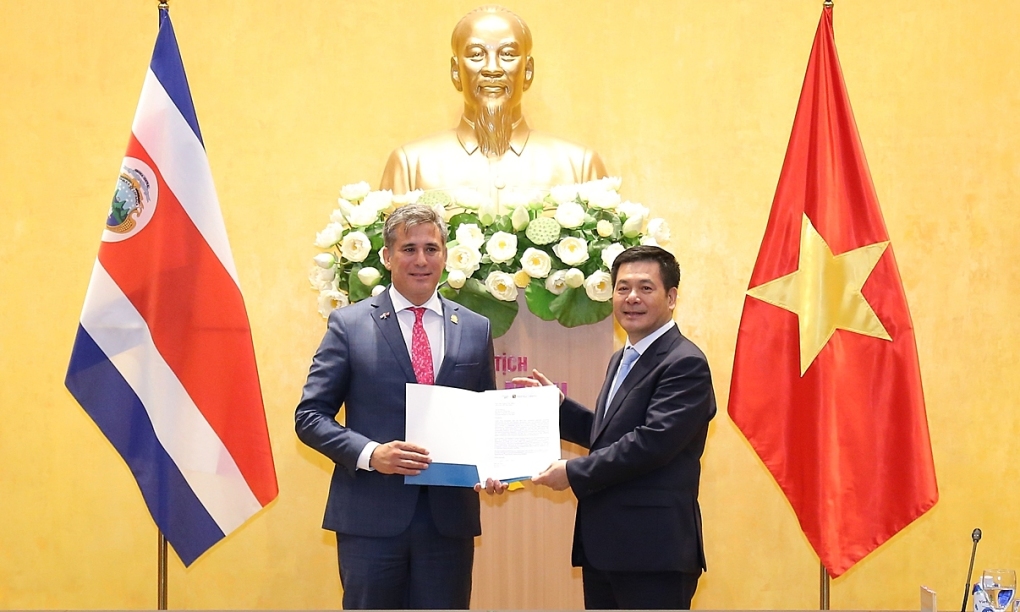
Minister of Foreign Trade Manuel Tovar under the authorization of Costa Rican President Rodrigo Chaves on August 5 presented a diplomatic note to Minister of Industry and Trade Nguyen Hong Dien, recognizing Vietnam as a market economy.
| Costa Rican Minister of Foreign Trade Manuel Tovar presented a diplomatic note to Minister of Industry and Trade Nguyen Hong Dien. Photo: MoIT |
In doing so, Costa Rica becomes the 73rd country to acknowledge Vietnam's market economy status.
"This is a positive step as Vietnam seeks recognition of its market economy status from several trading partners," stated a representative from the Trade Remedies Authority of Vietnam (Ministry of Industry and Trade).
At the meeting, Minister Nguyen Hong Dien stressed that Costa Rica's recognition of Vietnam as a market economy accurately reflects the achievements Vietnam has made in its development and integration.
“This recognition also contributes to strengthening economic and trade relations between the two countries,” he noted.
Costa Rica is a member of the World Trade Organization (WTO) and the Organization for Economic Co-operation and Development (OECD), which comprises 38 countries with the most developed market economies.
Costa Rica's acknowledgment reflects Vietnam's achievements in its development and integration into the global economy, and it will help promote bilateral economic and trade relations between the two countries.
According to the Ministry of Industry and Trade, a total of 73 countries have now recognized Vietnam's market economy status, including several major economies.
International organizations have noted the significant progress made by Vietnam's economy. Additionally, Vietnam has participated in numerous high-quality free trade agreements (FTAs).
Some of the major economies that have recognized Vietnam's market economy status include China (2004); Russia and ASEAN members (2007); Australia and New Zealand (2008); India and South Korea (2009); Japan (2011); members of the European Free Trade Association (EFTA) such as Norway and Switzerland (2012); Canada (2016); and the United Kingdom (2023).
A market economy is one in which decisions regarding production, pricing, and distribution are driven by competition and market supply and demand, rather than being directly determined by the government or organizations. Generally, market economy status provides exporters with a competitive advantage in anti-dumping and subsidy investigations. In such cases, importing countries will use the production prices of the exporting companies themselves, rather than relying on prices from third-party countries with market economies, to calculate the dumping margin. This means that the dumping margin will more accurately reflect the actual production costs of the exporter, enabling it to compete better with goods from other countries.
Like many nations, Costa Rica has regulations in place for conducting investigations and applying trade defense measures. As of the end of 2023, WTO statistics indicate that Costa Rica has opened 12 anti-dumping investigations involving imports from countries such as Brazil, Chile, Mexico, the United States, Nicaragua, El Salvador, Venezuela, and Guatemala.